
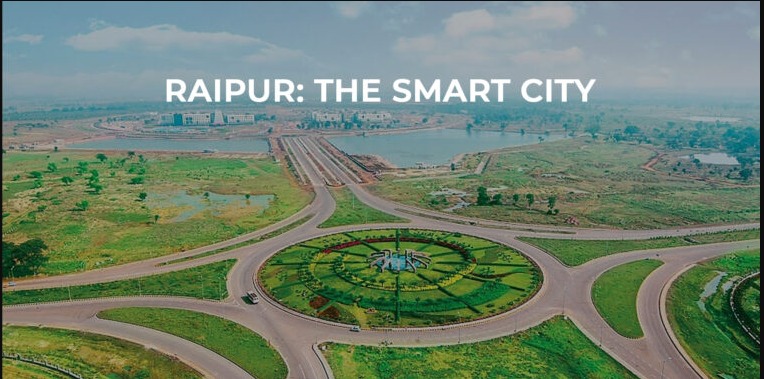
At the recent summit held in Raipur under the auspices of the Smart Cities Mission, stakeholders gathered to benchmark progress, share lessons and chart the next phase for the state capital region — Atal Nagar (formerly Naya Raipur). The summit reaffirmed how Atal Nagar, conceived as a green-field smart city, is rapidly evolving into a world-class, digitally enabled urban centre. The key take-aways show how deep planning, citizen-centric services and sustainable infrastructure converge to make the city a model for India’s smart-urban transition.
Integrated Planning & Green Infrastructure
One of the strongest messages of the summit was the need for holistic, upfront planning rather than patch-on improvements. Atal Nagar was developed on a green-field basis with a master-plan framing physical, social and ICT infrastructure in sync. For example, roughly 27% of the land has been earmarked for green space, lakes and open public areas. The summit reinforced that such advance zoning and mixed-use layout ensures urban resilience and liveability. Many sessions highlighted how other Indian cities can adopt this blueprint.
Additionally, the summit emphasized utility corridors being underground, integrated city-services from the planning stage, and non-motorised transport tracks for pedestrians and cyclists — all reinforcing the “smart and green” ambition of Atal Nagar.
Digitised Governance, Single-Window Citizen Services
A key takeaway was how technology is enabling governance to become leaner, more transparent and more citizen-friendly. Atal Nagar’s system now offers a single-window portal and mobile-app for citizens to access services such as allotments, water connections, billing, RTI and grievances — without physically visiting offices. The summit highlighted this as a hallmark of the Smart City vision. (This aligns with your earlier description of ANVP’s ICT-enabled smart city system.)
Equally important – the deployment of the city’s Integrated Command & Control Centre (ICCC) that brings together water SCADA, electrical monitoring, city-surveillance and transport data on one operational platform. Real-time dashboards, GIS mapping, performance analytics were all underscored at the summit as essential to transform city administration from reactive to proactive
Smart Utilities: Water, Power & Transport
The summit placed heavy emphasis on utility management as a foundation of smart-cities. Points that emerged include:
Water supply systems: Real-time monitoring via SCADA from source to sector level, promise of truly 24×7 pressurised water supply, automatic meter reading and integration with billing systems. This ensures high reliability and efficient asset-management.
Power distribution: Underground power networks, ring-main units, smart-meters, alternative energy (solar/wind) and outage-management via the ICCC. Such features were flagged as necessary for future-ready cities.
Transport infrastructure: Non-motorised transport tracks, cycling lanes, pedestrian-friendly spaces and intelligent transport management (speed detection, ANPR) were highlighted as ways to tackle congestion and promote inclusive mobility.
These reflect many of the very features you noted for the Atal Nagar system, and the summit reinforced them as not just desirable, but critical.
Financing & Governance Models for Sustainability
Another major takeaway was the importance of sustainable financing and governance models for smart city implementation. During the summit, planners stressed the value of public–private partnerships (PPP), land-monetisation, and integrating real-estate / logistics hubs into the financial model so that the city development is less dependent on grant-only funding.
Further, the summit made clear that governance arrangements — such as having a smart city special purpose vehicle (SPV) or dedicated authority — help streamline implementation, monitor performance and ensure accountability. For example, in Raipur region, the SPV model was mentioned as part of this discussion.
Citizen-Inclusion, Accessibility & Social Infrastructure
Finally, the summit emphasised that smart Cities are not just about technology and infrastructure, but about citizens, communities and inclusion. At the Atal Nagar context, this means accessible citizen-services (including for differently-abled), built neighbourhoods with education, health and recreation as core components, and a culture of participation in planning. The summit sessions pointed to feedback loops, online citizen surveys and apps to engage the public in city development
Conclusion
The Raipur Smart City Summit crystallised a clear learning for Atal Nagar and cities nationwide: the convergence of advanced infrastructure, digital citizen-services, sustainable financing and inclusive planning is what defines a 21st-century smart city. For Atal Nagar — with its already impressive features such as ICT-enabled utilities, underground networks, green open-spaces and an ICCC — the summit reaffirmed its trajectory and provided a roadmap for scaling and replication.
-Mahak Jain