Indian politics has officially entered its internet era.
Not through rallies. Not through giant manifestos. But through memes, reels, sarcasm, and surprisingly… cockroaches.
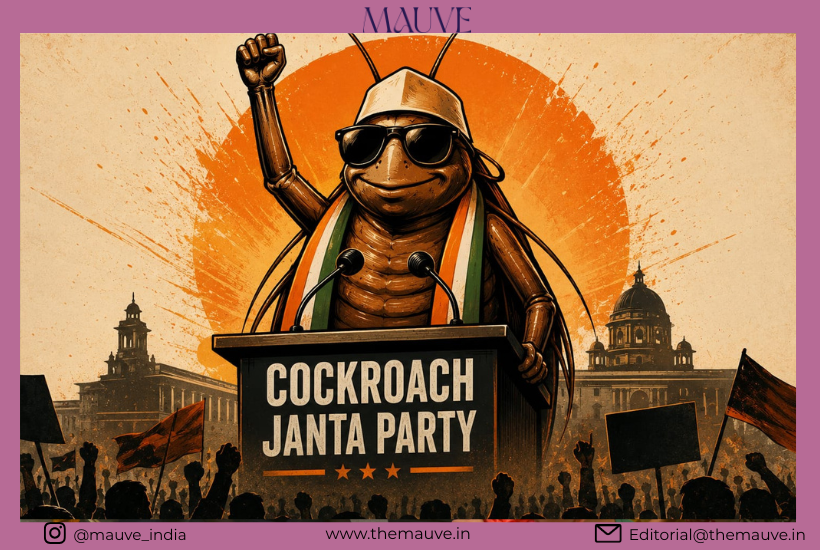
Yes, the new era of politics has arrived in the form of the Cockroach Janata Party — a movement that has exploded across social media and become one of the most talked-about topics among Gen Z. Founded by Abhijeet Dipke, the party is not just another viral joke floating around Instagram. It represents something deeper: frustration, rebellion, internet culture, and the growing political voice of the youth.
And honestly, the symbolism is clever.
Cockroaches survive everything. They adapt. They exist quietly until someone tries to crush them. In many ways, that is exactly how today’s youth feels. Gen Z often stays silent, busy surviving unemployment, inflation, pressure, competition, and a system they feel rarely listens to them. But the moment they feel attacked or ignored, they respond loudly — online and offline.
The movement reportedly started after controversial remarks made by Chief Justice of India (CJI) Surya Kant during a Supreme Court hearing, where unemployed youth and online critics were reportedly referred to as “cockroaches” and “parasites.”
Within days, the Cockroach Janata Party gained massive traction online, attracting millions of followers and turning into a nationwide conversation.
But here comes the real question:
Will the Cockroach Janata Party survive?
Because social media has a short memory.
Every week there is a new outrage, a new meme trend, a new “movement,” and then suddenly everyone moves on. One day the internet is obsessed with a topic, and two days later it disappears completely. So is the Cockroach Janata Party genuinely building a political culture, or is it simply another viral moment that will vanish after the algorithm gets bored?
That uncertainty is exactly what makes this story interesting.
Unlike traditional political parties that spend years building grassroots structures, the Cockroach Janata Party was born entirely in the digital age. It understands meme culture, attention spans, internet humour, and the emotional language of frustrated youth. Its growth proves one thing very clearly — Gen Z is politically aware, but they no longer want politics to look traditional.
And this is where the Nepal comparison starts entering the conversation.
Recently, Nepal witnessed massive youth-led political shifts where younger generations became more vocal, active, and influential in reshaping governance discussions. Across South Asia, Gen Z is becoming increasingly political — not necessarily through traditional rallies, but through digital narratives, online campaigns, creators, satire, and community-led discussions.
So naturally, people are asking:
Is India witnessing its own Gen Z political awakening?
This generation does not communicate like older generations. They use memes instead of speeches. Irony instead of slogans. Humour instead of formal debates. But underneath all the jokes are very real issues: unemployment, lack of representation, educational pressure, economic stress, and growing distrust toward institutions.
That is why the Cockroach Janata Party is bigger than just a meme page.
It reflects a generation that wants to participate in politics without becoming “traditional politicians.” A generation that wants its language, its humour, and its internet culture to become part of national conversations.
At the same time, critics argue that the movement may simply be performative politics designed for engagement and virality. Some question whether it has genuine structure, leadership, or long-term vision beyond social media traction. Others believe the movement selectively targets institutions and may eventually fade away once the novelty ends.
But whether people support it or mock it, one thing is undeniable:
The youth has found a new political language.
And maybe this is just the beginning.
Because as we already know, Gen Z is eventually going to dominate industries, culture, media, business, and politics. The generation that grew up online now understands the power of virality better than anyone before them. And in today’s world, attention itself has become political power.
So maybe the Cockroach Janata Party is not really about cockroaches.
Maybe it is about visibility.
Maybe it is about frustration.
Maybe it is about reclaiming insult as identity.
Or maybe this is simply the first trailer of what Gen Z politics in India will actually look like.
Chaotic. Meme-driven. Viral. Emotional. Unpredictable.
And impossible to ignore.
So now the question is:
Are you for this party or against it?
-Khizra Khan