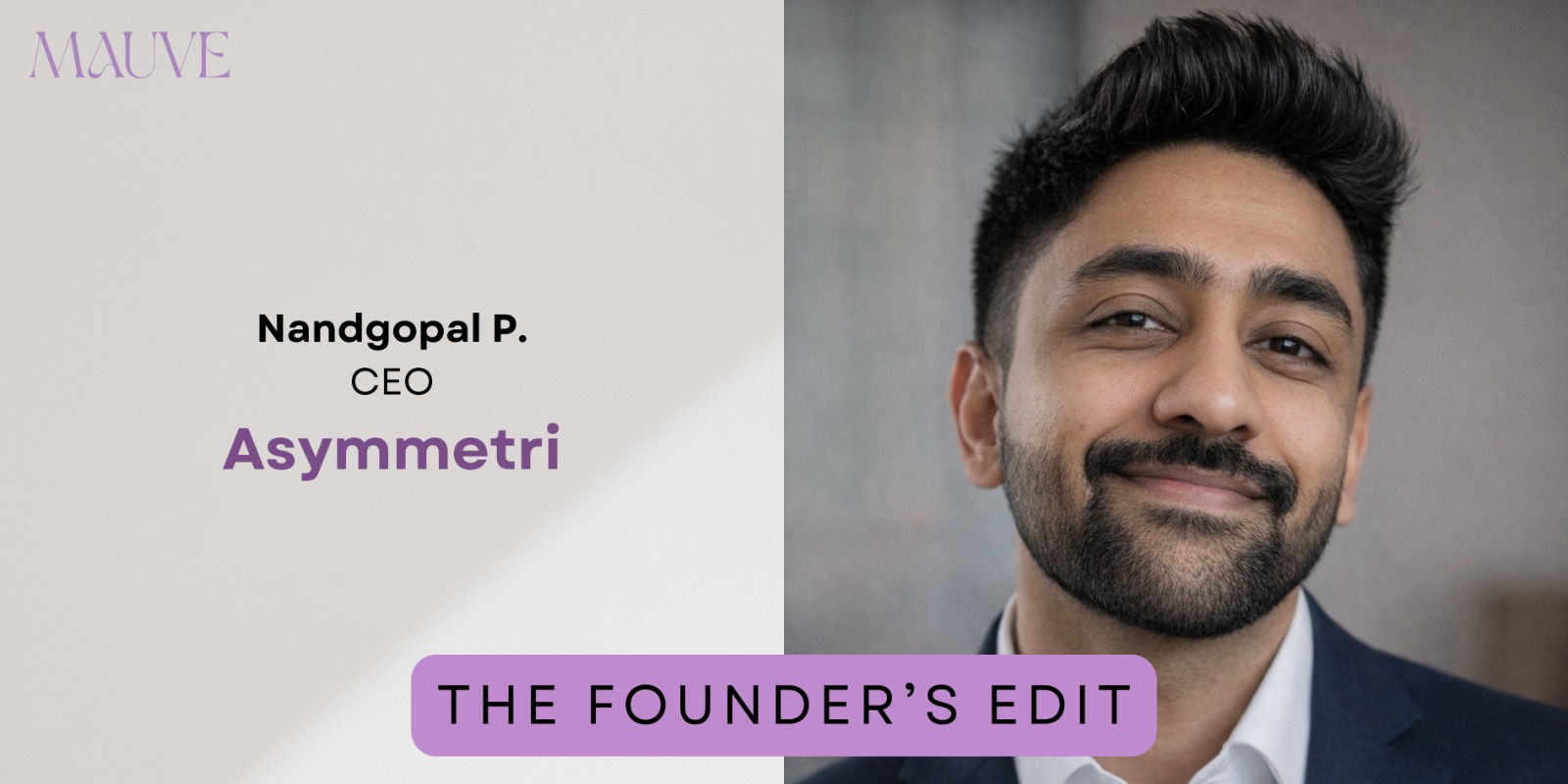
For the CEO of Asymmetri, technology isn’t a competitive advantage on its own. Judgment, clarity and execution are what ultimately determine whether a company succeeds.
By Journalist Priya Lalwani
In today’s startup ecosystem, conversations around technology are often dominated by artificial intelligence, rapid scaling and the race to launch faster. But according to Nandagopal P—CEO of Asymmetri, CTO at Gacsym Ventures, and Limited Partner at Arya Ventures—technology has never been the hardest part of building a company. The real challenge lies in making the right decisions before writing the first line of code. Through Asymmetri, he has positioned technology not as a service, but as a strategic business function that helps founders navigate uncertainty with confidence. At The Founder’s Edit, Nandagopal shares insights on building technology-first businesses, leading through ambiguity, and why engineering excellence begins long before software development.
The idea behind Asymmetri emerged from a pattern he observed repeatedly while working alongside entrepreneurs.
Many founders possessed remarkable ambition and strong ideas, yet their biggest obstacle wasn’t determination—it was technical clarity.
Some rushed into development, building products that couldn’t scale. Others spent months pursuing technical perfection, delaying valuable market feedback. Between moving too quickly and waiting too long, companies often found themselves trapped by decisions made without the right guidance.
That recurring gap became the foundation for Asymmetri.
Rather than operating as another software development company, the business was built to provide strategic technology leadership—helping founders understand not just how to build products, but what should be built in the first place.
Building that vision required embracing uncertainty.
Nandagopal chose to leave behind the comfort and predictability of a conventional technology career, accepting that entrepreneurship demands operating without guarantees. Yet throughout that transition, some principles remained entirely non-negotiable.
Trust.
Quality of thinking.
And long-term credibility.
While speed remains essential in startups, he believes it should never come at the expense of integrity, customer confidence or building products incapable of surviving real-world complexity.
One misconception about technology startups particularly stands out to him.
Many people believe successful software companies are built through superior technology alone.
In reality, he argues, technology is only one component of a much larger equation.
Great companies emerge where customer understanding, market timing, product architecture, distribution strategy and disciplined execution intersect. Writing code may build software—but judgment determines whether that software creates meaningful businesses.
That perspective ultimately shaped the creation of Asymmetri.
Throughout his career, Nandagopal recognised a significant gap between traditional software agencies and genuine technology partners. Many organisations could successfully build exactly what clients requested, yet very few challenged whether those requests actually solved the underlying business problem.
Asymmetri was created to bridge that gap.
Its philosophy continues to influence every engagement today.
Whether working with artificial intelligence, automation, enterprise platforms or product architecture, the company deliberately begins with the business challenge rather than the technology itself. Innovation, in his view, should always follow strategy—not the other way around.
In an increasingly crowded technology ecosystem, Asymmetri differentiates itself by occupying a unique intersection.
The company combines strategic thinking, engineering capability and execution discipline within one integrated model. It understands both the urgency founders experience while building businesses and the responsibility engineers carry while building systems that last.
Helping companies move quickly without allowing speed to become chaos has become one of its defining strengths.
Growth, however, requires more than talented individuals.
Nandagopal believes quality cannot depend on heroic effort.
As the company scales, engineering standards, architectural reviews, documentation, reusable frameworks and clear technical ownership ensure consistency across every project. Strong systems, he argues, allow good decisions to become repeatable rather than accidental.
Innovation, therefore, doesn’t require every team to reinvent existing solutions.
It requires giving talented people the freedom to solve new problems while standing on reliable foundations.
The founders and businesses Asymmetri works with share another common characteristic.
They operate in uncertainty.
Whether startups or growth-stage organisations, their greatest challenge extends beyond software development itself. Determining priorities, making intelligent technical investments, integrating artificial intelligence responsibly and creating products customers genuinely trust often prove significantly more difficult than writing code.
Listening closely to customers has fundamentally reinforced that belief.
One project in particular changed the company’s product philosophy. Initial assumptions suggested users wanted additional features. Yet customer conversations revealed something very different.
What users actually wanted was simplicity.
Clarity.
Confidence.
The product was redesigned around fewer, more meaningful interactions, proving that customers may rarely ask for simpler experiences—but they consistently reward them.
Beyond building technology, Nandagopal sees another responsibility.
Supporting the startup ecosystem itself.
Through mentoring, investing, advising founders, public speaking and sharing practical execution frameworks, he believes experienced entrepreneurs can help future builders avoid avoidable mistakes. In his view, startups need fewer headlines and more honest conversations about execution, leadership and decision-making.
Looking ahead, he expects artificial intelligence to become less visible yet far more influential.
Rather than existing as standalone features, AI will increasingly become embedded within the operational layer of businesses, improving workflows, decisions and customer outcomes. Alongside technological advancement, privacy, transparency, explainability and regulatory compliance will become equally important.
Responsible innovation, he believes, will evolve into one of the strongest competitive advantages companies can possess.
Although startup success is often measured through funding announcements and revenue growth, Nandagopal evaluates businesses differently.
Customer trust.
Retention.
Product reliability.
Team quality.
Decision-making speed.
And whether an organisation becomes stronger as it grows.
For him, enduring companies build capabilities and reputations that continue thriving long after founders step away from everyday operations.
As his own career has evolved, so too has his role.
Where he once focused primarily on solving technical problems, he now spends far more time designing systems that bring together people, products, technology and capital. Leadership has shifted away from execution alone towards helping organisations make better decisions under uncertainty.
Today, the quality he values above all others is judgment.
Not simply knowing the right answer—but knowing how to make thoughtful decisions when certainty doesn’t exist.
Maintaining culture follows a similarly practical philosophy.
Culture isn’t created through mission statements or office walls.
It is created through repeated behaviour.
Reward shortcuts, and shortcuts become culture.
Reward ownership, documentation, customer empathy and engineering discipline, and those values naturally become embedded throughout the organisation.
Reflecting on his entrepreneurial journey, one lesson has fundamentally reshaped his leadership philosophy.
Being technically correct is not always enough.
Products can be beautifully engineered while still solving the wrong problem.
That realisation taught him to question assumptions earlier, listen more carefully and separate personal conviction from customer reality. The strongest leaders, he believes, are not those who always possess the answers—but those willing to keep learning while continuing to move forward.
In a world increasingly captivated by emerging technologies, Asymmetri serves as a reminder that successful innovation rarely begins with code.
It begins with asking better questions.