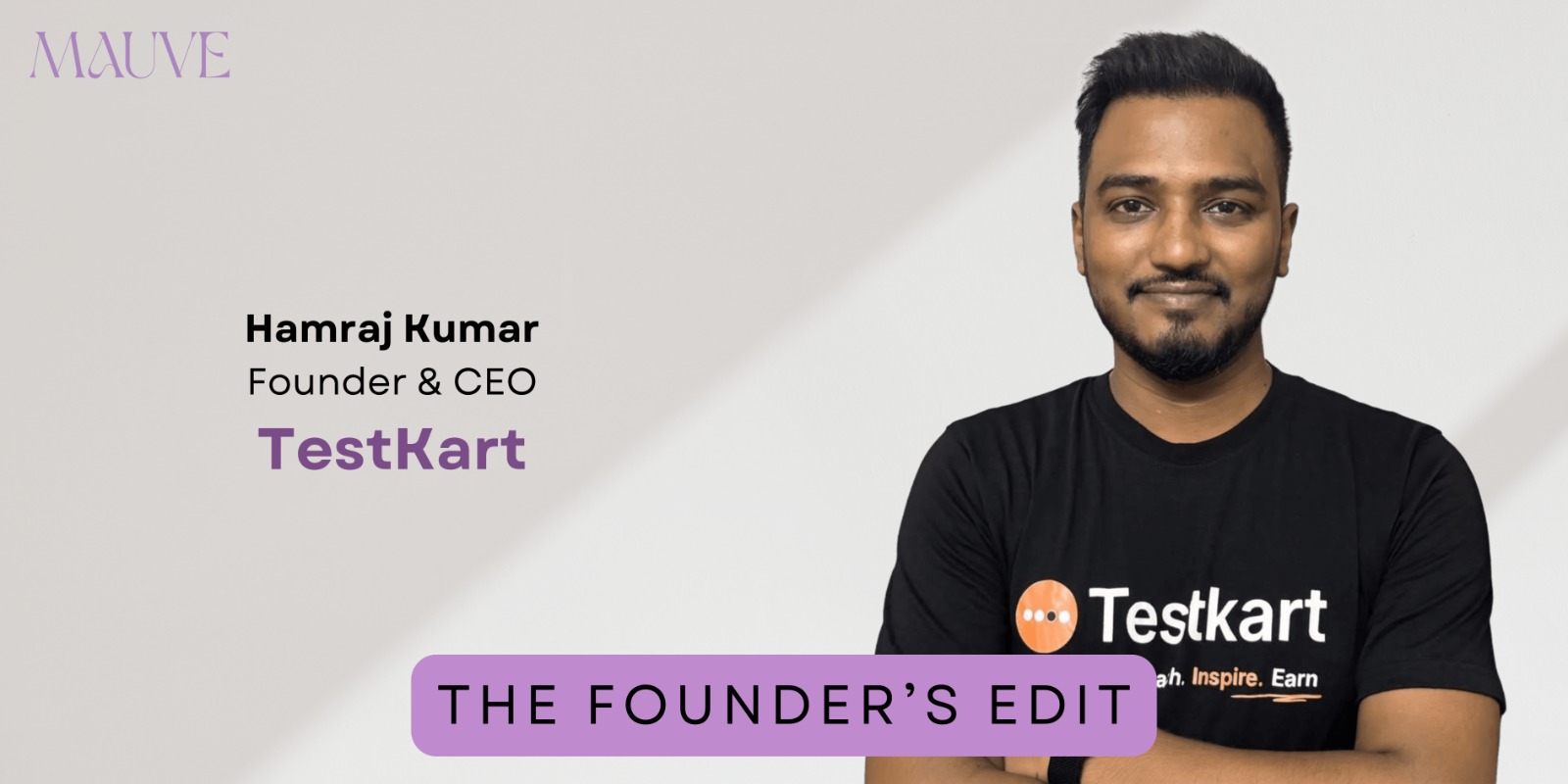
For the Founder & CEO of TestKart, technology isn’t meant to replace teachers—it’s meant to remove every barrier that stands between educators and their impact.
By Journalist Priya Lalwani
The future of education is often discussed in terms of artificial intelligence, digital classrooms and online courses. Yet for Hamraj Kumar, Founder & CEO of TestKart, the real challenge has never been technology itself—it has been making technology accessible to educators. Having experienced the frustrations of teaching online firsthand, he set out to build a platform that allows teachers to create, evaluate and monetise their expertise without needing to become technology specialists. At The Founder’s Edit, he shares insights on simplifying educational technology, building an educator-first platform, and why empowering teachers remains the company’s most meaningful measure of success.
For Kumar, the foundation of TestKart was laid not in a boardroom but inside a classroom.
While teaching online, he found himself juggling multiple applications and software simply to deliver lessons effectively. The process demanded unnecessary time, money and technical effort. If one educator was facing these challenges, he realised, thousands across the country were likely struggling with the very same problems.
That observation became the beginning of TestKart.
Rather than creating another online learning platform, Kumar envisioned an ecosystem where educators could teach, evaluate students and generate sustainable income through one simple, integrated platform. The objective wasn’t to make teachers adapt to technology—it was to make technology adapt to teachers.
Interestingly, Kumar doesn’t describe entrepreneurship through the lens of sacrifice.
While building TestKart required persistence, time and unwavering commitment, he believes every effort was an investment towards creating meaningful value. What remained non-negotiable throughout the journey was the company’s original mission: making educational technology simple, affordable and accessible regardless of an educator’s technical background.
One of the biggest misconceptions about online education, he believes, is that it begins and ends with video courses.
Teaching is far more multidimensional.
Beyond recorded lectures, educators spend their time designing mock tests, creating assignments, conducting live assessments, building quizzes and developing learning experiences that actively engage students. Technology, Kumar argues, should support every one of these activities rather than confining education to a single delivery format.
His own professional background reinforced that belief.
Coming from digital marketing, Kumar understood how digital products could be built and scaled. Yet even with that technical knowledge, he found the process unnecessarily complicated. That experience made him wonder how much more difficult the journey must be for educators whose expertise lies in teaching rather than software.
Bridging that gap became TestKart’s defining purpose.
Today, the company’s origin story continues to influence every strategic decision it makes.
Every feature begins with one simple question: Will this make life easier for educators?
Whether introducing AI-powered mock test generation, simplifying content organisation or enabling seamless live assessments, the company’s objective remains consistent—to eliminate unnecessary complexity so teachers can focus on what truly matters: teaching.
In an increasingly crowded EdTech landscape, Kumar believes TestKart’s greatest value proposition is remarkably straightforward.
The platform enables educators to monetise their knowledge without forcing them to become technology experts. Rather than spending weeks learning complicated software, teachers can concentrate on delivering meaningful learning experiences while TestKart provides the digital infrastructure required to build, manage and grow their educational offerings.
Artificial intelligence, however, plays a carefully defined role within that ecosystem.
For Kumar, AI should enhance human expertise rather than replace it. Tasks such as generating question banks, formatting assessments and organising educational content can be automated, but authentic learning continues to revolve around teachers themselves. Technology may improve efficiency, but human connection remains at the heart of education.
That philosophy also shapes how TestKart defines its audience.
Instead of categorising users by age or geography, Kumar sees them as individuals united by mindset. They are educators driven by purpose, eager to create meaningful learning experiences, expand their reach, establish professional credibility and build sustainable income streams without compromising educational quality.
Listening to those educators has become one of the company’s strongest competitive advantages.
One recurring insight fundamentally shaped TestKart’s product direction. Teachers consistently expressed that they didn’t want complicated software—they wanted to begin teaching immediately. That feedback inspired the development of AI-powered tools capable of helping educators create quizzes, assessments and practice tests within minutes rather than days.
For Kumar, almost every meaningful product decision begins with listening.
Community, too, is cultivated through collaboration rather than campaigns.
Instead of relying on short-term engagement strategies, TestKart maintains ongoing conversations with educators through training programmes, product discussions and continuous feedback sessions. More importantly, those suggestions are actively incorporated into the platform. When educators see their feedback influencing the product itself, trust develops naturally—and with it, lasting loyalty.
Looking ahead, Kumar believes artificial intelligence will transform education by accelerating content creation and enabling deeply personalised learning experiences.
Yet alongside technological advancement, trust, educational integrity and credibility will become increasingly important. As digital education continues to evolve, he believes the platforms that successfully balance responsible AI with genuine educational value will define the next generation of learning.
Although startup success is often measured through revenue and valuation, Kumar views impact differently.
For him, the strongest indicator of TestKart’s health is the number of educators who are able to build meaningful, sustainable livelihoods through the platform. Financial performance matters, but genuine success is reflected in teachers becoming more independent, more confident and more empowered because of the opportunities technology has created.
As the organisation has matured, Kumar’s own role has evolved alongside it.
Where he once handled everything from product development and marketing to customer support, his focus today lies in setting long-term direction, building capable teams and establishing systems that enable sustainable growth. Clarity, adaptability, humility and long-term thinking have become the leadership qualities he values most as TestKart continues to scale.
Maintaining the company’s culture has required equal discipline.
Growth, Kumar believes, should never come at the expense of purpose. Every product decision continues to be measured against real educator needs rather than market trends or short-term expansion opportunities. Remaining deeply connected to users has allowed TestKart to preserve the values upon which it was founded while continuing to grow responsibly.
Reflecting on his entrepreneurial journey, one lesson stands above all others.
Building a great product alone is never enough.
Distribution, trust and consistent execution are equally essential. Every setback has reinforced the importance of listening closely to users, responding quickly to their evolving needs and remaining willing to adapt whenever necessary. Entrepreneurship, Kumar believes, isn’t about avoiding failure—it is about learning faster than the challenges evolve.
In a rapidly changing education landscape, TestKart isn’t simply building technology for teachers.
It is building technology around them—ensuring educators spend less time navigating software and more time doing what they do best: shaping the future through learning.