For the Founder of CosmoQuick, recruitment isn’t broken because of a lack of talent—it’s broken because of inefficient systems.
By Journalist Priya Lalwani
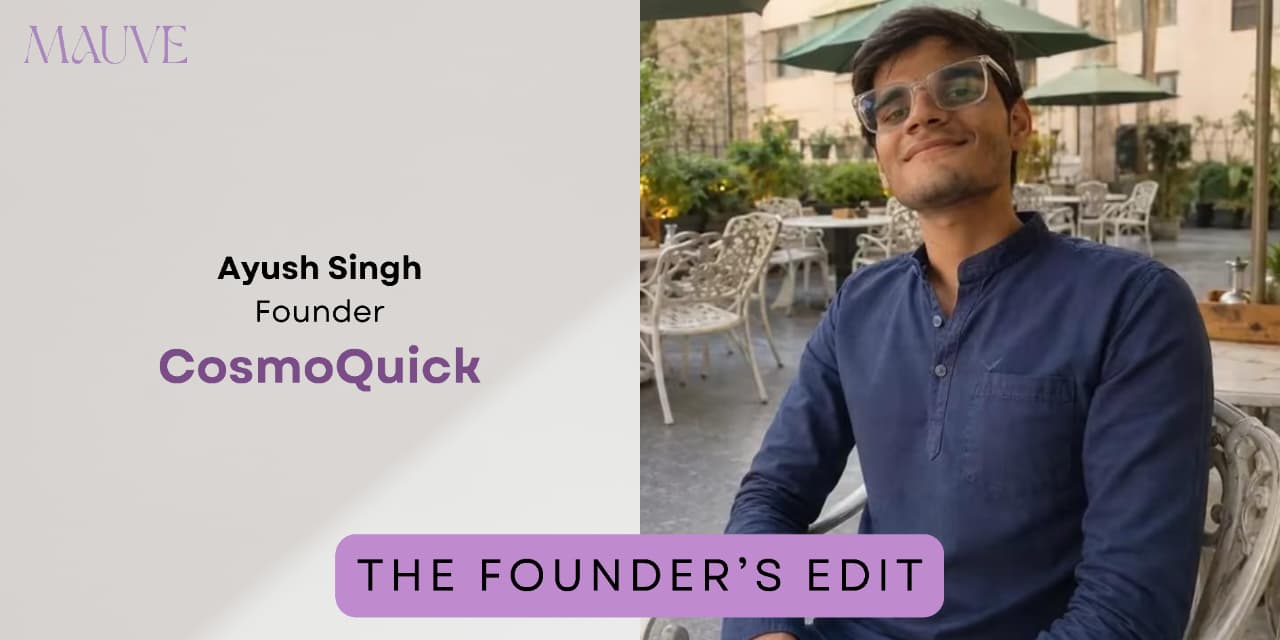
At just 23, Ayush Singh has already built more than ten products and successfully exited three of them. Today, as the founder of CosmoQuick, he’s focused on solving one of the most persistent challenges businesses face: hiring. What began as a traditional recruitment agency has evolved into an AI-powered hiring ecosystem serving more than 100,000 users. At The Founder’s Edit, Ayush shares insights on building through constant iteration, embracing pivots, the future of AI in recruitment, and why understanding customers matters more than falling in love with ideas.
For Singh, the story of CosmoQuick didn’t begin with artificial intelligence—it began with frustration.
In its earliest form, CosmoQuick operated as a recruitment agency, giving him a front-row seat to the realities of hiring. Every day, he witnessed recruiters spending countless hours distributing job postings, sorting resumes and manually shortlisting candidates. The process wasn’t just repetitive; it was inefficient. The more deeply he immersed himself in recruitment, the more obvious it became that much of the work could—and should—be automated.
That realisation sparked a transformation.
Rather than remaining a recruitment consultancy, CosmoQuick evolved into an AI-powered hiring platform designed to eliminate repetitive tasks while enabling recruiters to focus on what truly matters: making better hiring decisions.
Building that vision required difficult trade-offs.
Singh walked away from the stability of a conventional career and the predictable revenue that a services business could have offered. Building a consumer-facing technology platform demanded patience, experimentation and the willingness to spend months searching for product-market fit before growth could accelerate.
Yet one thing was never negotiable.
He refused to compromise on authenticity or the ambition of creating something genuinely different. While he still considers CosmoQuick a work in progress, crossing the milestone of more than 100,000 users has reinforced his belief that the company is moving in the right direction.
One misconception about recruitment particularly stands out to him.
Many organisations assume hiring must always be outsourced because the process itself is too time-consuming and resource-intensive. Singh sees things differently. In his view, recruitment agencies often exist because hiring workflows have remained unnecessarily manual for decades. His ambition is to package the expertise of a recruitment consultancy into technology, allowing companies to achieve similar outcomes through a single, intelligently distributed job post.
That philosophy continues to shape CosmoQuick’s evolution.
Speed has become part of the company’s identity. True to its name, CosmoQuick is built around rapid execution. New features are launched continuously, experiments happen almost daily and the platform evolves so quickly that Singh describes it as becoming “a different company every 30 days.”
Rather than waiting months between major product releases, the team embraces micro-launches, constantly refining features, testing narratives and responding to user behaviour in real time.
In an increasingly crowded HRTech landscape, Singh believes iteration itself has become a competitive advantage.
While many companies claim to solve similar hiring challenges, he argues that meaningful innovation requires continuous improvement rather than static feature lists. CosmoQuick receives more than ten pieces of user feedback every day, powers over thirty interconnected products and tools across multiple hiring verticals, and has even introduced the concept of “Hiring Distribution”—an approach that extends job opportunities far beyond a single recruitment platform.
The result is an ecosystem rather than simply another applicant tracking system.
Artificial intelligence, however, is only one part of the equation.
Singh is careful to emphasise that recruitment remains fundamentally human. AI can automate administrative tasks, organise applications and assist with screening, but judgement, relationships and final hiring decisions will always belong to people. For him, the future isn’t about replacing recruiters—it is about giving them the time and tools to make better decisions.
That same philosophy shapes how CosmoQuick thinks about its users.
Rather than defining customers by demographics alone, Singh believes they are united by a common objective: measurable outcomes. Recruiters and hiring managers aren’t looking for software simply because it’s powered by AI—they’re looking for solutions that reduce hiring friction, improve productivity and help them identify stronger candidates more efficiently.
Perhaps the company’s most significant product evolution came from listening closely to those users.
Recruiters repeatedly shared that they didn’t want another standalone applicant tracking system. They wanted a unified ecosystem connecting every stage of the hiring journey. That insight fundamentally reshaped CosmoQuick’s roadmap, allowing recruiters to integrate seamlessly with their existing ATS while accessing AI-powered screening, hiring workflows and recruitment tools within a single platform.
Community, too, is built through utility rather than promotion.
Alongside its hiring platform, CosmoQuick has expanded into educational resources, AI-powered career tools, recruiter communities, free productivity solutions, glossaries and an edtech division. Rather than relying solely on marketing campaigns, the platform encourages loyalty by continuously creating practical value for both recruiters and job seekers.
Looking ahead, Singh believes recruitment will undergo one of its biggest transformations yet.
Artificial intelligence will increasingly automate administrative hiring tasks, allowing recruiters to focus on strategy, relationships and decision-making. At the same time, regulations surrounding privacy, transparency and algorithmic fairness will become central to the industry’s future. The companies that successfully balance responsible AI with meaningful human oversight, he believes, will earn the greatest trust.
Despite the attention often given to funding rounds and valuations, Singh measures success through a different lens.
For him, the truest indicator of CosmoQuick’s health is the number of successful hires facilitated through the platform. Revenue may follow, but helping organisations consistently find the right talent faster remains the company’s real mission.
As the organisation has matured, so too has his own leadership philosophy.
Where he once spent his days building products and solving technical challenges himself, his focus has gradually shifted towards setting direction, designing systems and understanding customer pain points at an even deeper level. Clarity and long-term thinking, he says, now matter more than simply executing at speed.
Maintaining culture has required equal discipline.
Every feature, workflow and product decision is measured against the company’s original purpose: simplifying hiring. Growth, Singh believes, should amplify clarity—not introduce unnecessary complexity.
Reflecting on the journey so far, one lesson stands above the rest.
Founders often become emotionally attached to ideas when they should remain committed to outcomes. The willingness to pivot, ship quickly and learn continuously has shaped every stage of CosmoQuick’s evolution. Equally transformative was learning to think like the customer. By understanding how recruiters actually work—their incentives, frustrations and daily decisions—building better products became significantly clearer.
For Singh, innovation isn’t about building more features.
It’s about solving the right problems.
And in a hiring landscape rapidly being reshaped by artificial intelligence, that mindset may ultimately prove to be CosmoQuick’s greatest competitive advantage.