
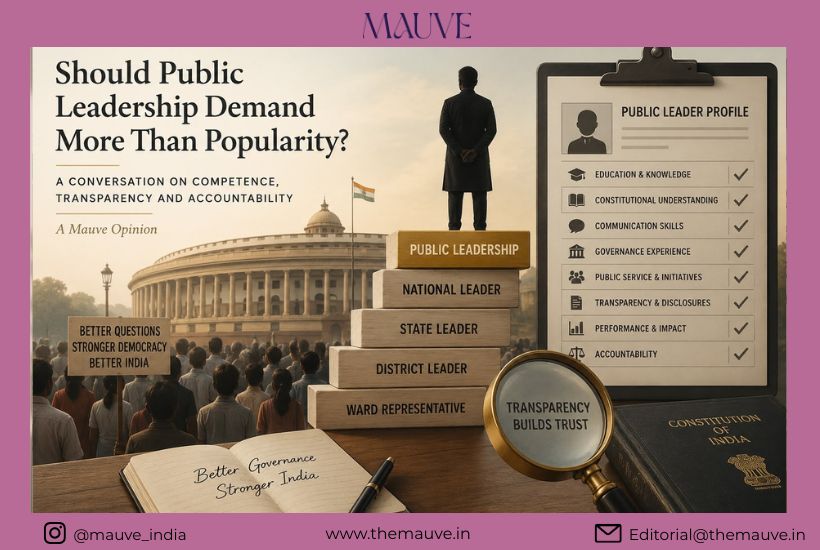
Should ministers undergo competency assessments before holding public office? The Mauve explores whether political leadership should be measured through transparency, accountability and continuous performance rather than elections alone
Mauve’s Take on the System
It started as an ordinary team discussion.
A former employee walked into our meeting room for a casual conversation. Somewhere between discussing stories and current affairs, he posed a simple question:
“Why don’t ministers have to qualify for the positions they hold?”
The question stayed with us.
In almost every profession, competence is evaluated. Doctors clear medical exams. Lawyers study law. Chartered accountants spend years qualifying. Bureaucrats go through one of the toughest examinations in the country.
Yet, the people entrusted with making decisions that affect millions of lives are often judged only during elections.
What if there was another layer of accountability?
What if political leadership followed a transparent progression—almost like a professional career path? Imagine every aspiring leader maintaining a public profile, similar to LinkedIn or an ERP system, documenting their journey from ward representative to district leader, state leadership, and beyond. Every milestone, every responsibility, every achievement, and every promise fulfilled would become part of a permanent public record.
When we discussed this idea with local residents, one perspective particularly stood out.
Vishal Popat, Founder of Travel 7th Gear, suggested that every level of political leadership should have both theoretical and practical assessments.
According to him, promotions in politics should resemble promotions in an organisation—not based merely on popularity, but on measurable performance, completed responsibilities, and demonstrated capability.
He believes the qualities worth evaluating include:
- Communication skills
- Commitment to equality
- Understanding of governance and the Constitution
- Awareness of India’s social and economic realities
- Problem-solving ability
- Crisis management
- Decision-making under pressure
- National security awareness
- Leadership and accountability
The discussion naturally raised another important question.
Who decides the scores?
Instead of a closed-door committee, we imagined something different.
An open, transparent evaluation system.
Every citizen could view a leader’s public record—their work completed, attendance, initiatives undertaken, financial disclosures, constituency performance, and assessment reports. Rather than asking voters to rely solely on speeches and campaign promises every five years, citizens could judge leaders based on verified performance throughout their tenure.
Would such a system be perfect?
Certainly not.
There would be constitutional questions, implementation challenges, political bias, and countless loopholes to address.
But perhaps that’s exactly why the conversation matters.
At Mauve, we aren’t proposing a finished policy.
We’re proposing a discussion.
Should governance demand measurable competence? Should public office require greater transparency? Should leadership be evaluated continuously rather than only during elections?
We don’t claim to have all the answers.
But we believe India deserves to ask better questions.
What do you think?