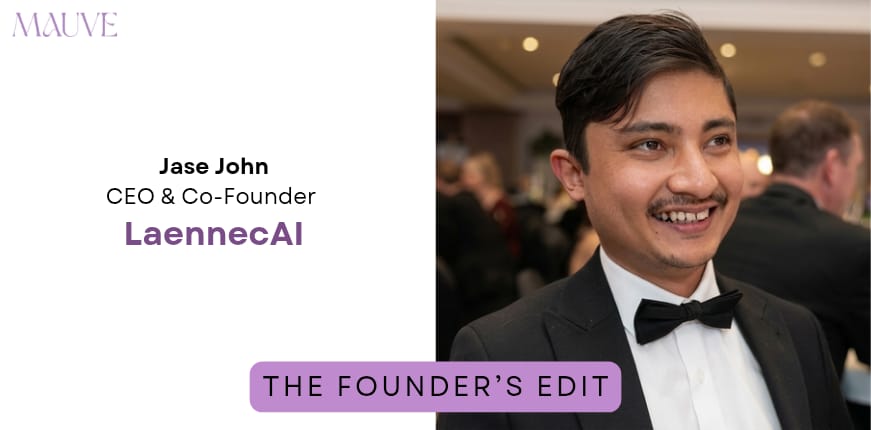
For the CEO and Co-founder of LaennecAI, the future of healthcare AI isn’t about replacing doctors—it’s about giving them faster access to evidence they can verify.
By Journalist Priya Lalwani
Artificial intelligence is transforming healthcare at an unprecedented pace. Yet as more clinicians turn to AI for answers, one question has become increasingly important: Can those answers actually be trusted? For Jase John, CEO and Co-founder of LaennecAI, that question became the foundation for building ZORGM Pro—an AI-powered clinical knowledge platform designed specifically for doctors. Rather than generating confident responses from the open internet, the platform delivers evidence-based answers grounded in doctor-curated medical literature, ensuring every recommendation can be traced back to its source. At The Founder’s Edit, Jase John shares insights on building trustworthy healthcare AI, why evidence matters more than speed, and how technology can strengthen—not replace—clinical judgment.
The idea behind ZORGM Pro wasn’t born inside a boardroom.
It emerged inside hospitals.
As practising doctors, John and his team experienced the same challenge every clinician faces: medical knowledge is expanding faster than anyone can realistically absorb. New research papers, revised treatment guidelines and updated clinical protocols appear every single day, making it impossible for even the most committed physician to remain completely current through traditional continuing medical education alone.
At the same time, doctors had already begun turning to generic AI chatbots for quick answers.
That was the real concern.
Those systems responded with confidence, but rarely with reliable evidence.
Watching colleagues rely on AI-generated information that couldn’t always be verified became the defining moment.
ZORGM Pro was created to close that gap.
Building the company required significant personal sacrifice.
Leaving behind the certainty and stability of conventional medical careers meant embracing the uncertainty that accompanies healthcare entrepreneurship. Time, capital, patience and long-term discipline became essential parts of the journey.
Yet one principle remained entirely non-negotiable.
Trust.
Unlike conventional AI systems, ZORGM Pro was deliberately built using Retrieval-Augmented Generation (RAG), allowing it to answer questions exclusively from a doctor-curated medical knowledge base rather than the open internet. If verified information does not exist within its curated sources, the system is designed not to invent an answer.
For John, a slower but truthful response will always be more valuable than an impressive hallucination.
One misconception about healthcare AI particularly concerns him.
Many people assume artificial intelligence exists to replace doctors.
He believes the opposite.
Clinical judgment belongs to clinicians.
Technology should simply help place trusted evidence behind that judgment within seconds. By providing transparent, verifiable references rather than unsupported conclusions, AI becomes a tool that strengthens medical professionals instead of attempting to substitute them.
The motivation for building LaennecAI was also shaped by mathematics.
Modern medicine produces thousands of new research papers and updated clinical guidelines every day.
No doctor, regardless of experience or dedication, can manually absorb that volume of information.
Generic AI platforms attempted to solve this challenge, but they were never designed around clinical trust.
ZORGM Pro became the answer to that arithmetic.
Its objective is simple: help doctors keep pace with modern medical knowledge while ensuring every response remains grounded in evidence that can be independently verified.
That philosophy continues guiding every strategic decision the company makes today.
The founding belief remains unchanged.
Doctors do not need another chatbot.
They need answers that show their working.
Every new feature, every partnership and every addition to the platform’s medical knowledge base is evaluated through one question: Does this make trusted evidence easier for doctors to access and verify?
If the answer is no, the feature simply isn’t built.
In an increasingly crowded AI marketplace, LaennecAI’s differentiation lies in precisely that commitment.
While many AI platforms prioritise conversational fluency, ZORGM Pro prioritises evidence. Every response is linked to clickable sources drawn exclusively from doctor-curated medical literature rather than random online information. Whether supporting continuing medical education, clinical updates or postgraduate examination preparation, its value proposition remains consistent.
Speed that doctors can verify.
Growth, however, has never meant compromising quality.
Healthcare, John believes, cannot tolerate shortcuts.
The quality of the answer received by the ten-thousandth doctor must remain identical to the first. Rather than scaling through reduced standards, LaennecAI scales access to trusted knowledge while preserving the integrity of its evidence layer.
That evidence itself is the product.
Its users are also defined less by age or geography than by professional intent.
The platform serves doctors committed to remaining current within rapidly evolving specialties, pursuing lifelong learning or preparing for advanced examinations. Importantly, it is not designed as a clinical decision-making or diagnostic system.
Those decisions remain firmly in the hands of clinicians.
What unites its users is a shared refusal to accept answers they cannot independently verify.
Listening closely to those doctors fundamentally shaped the platform’s evolution.
One recurring insight emerged repeatedly.
Clinicians didn’t simply want faster answers.
They wanted to know exactly where those answers originated.
That observation transformed source transparency into ZORGM Pro’s defining feature, permanently establishing trust above speed within the company’s design philosophy.
Speed may encourage first-time use.
Trust creates long-term adoption.
Community, John believes, follows the same principle.
Unlike many consumer platforms, ZORGM Pro deliberately avoids gamification, engagement streaks or behavioural incentives. Doctors return for one reason alone: consistent usefulness.
If the platform repeatedly delivers reliable, evidence-backed answers to complex medical questions, loyalty develops naturally.
Much of the company’s growth has therefore occurred through professional recommendations between doctors themselves—a metric John values far more highly than conventional marketing reach.
Looking ahead, he expects healthcare AI to become increasingly specialised, regulated and evidence-driven.
Regulators will demand stronger transparency, source traceability and clearly defined system limitations. Healthcare professionals will expect AI tools capable of integrating safely into clinical education without relying on unfiltered internet content.
Fortunately, he believes, those changes align perfectly with the principles upon which LaennecAI was founded.
Although financial growth remains important, John evaluates success differently.
Doctor trust remains the company’s strongest indicator of health.
Do users return?
Do they ask increasingly complex questions?
Do they open the supporting references?
Do they recommend the platform to colleagues?
A doctor’s attention, he argues, is among the most valuable and difficult forms of trust any technology company can earn.
As the organisation has grown, John’s own leadership has naturally evolved.
Where he once focused primarily on product vision, he now concentrates increasingly on building teams, systems and governance capable of delivering that vision responsibly. In an industry moving rapidly and often noisily, leadership has become less about chasing every technological trend and more about protecting clarity, discipline and the company’s original promise to clinicians.
Reflecting on his entrepreneurial journey, one lesson continues shaping every decision.
Clarity matters more than speed.
Within healthcare AI, moving quickly without evidence, trust or clinical alignment does not create innovation—it creates risk.
The setbacks encountered along the way reinforced the importance of remaining patient, disciplined and deeply focused on solving the right problem rather than simply building the fastest technology.
Ironically, John believes, the slower and more honest path is also the one most capable of lasting.
Because in medicine, confidence alone has never been enough.
Evidence is what truly saves lives.