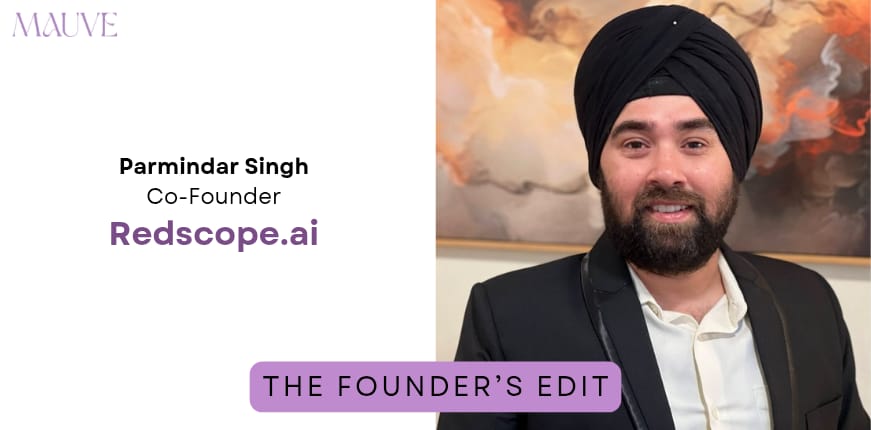
For the Co-founder of Redscope.ai, the future of artificial intelligence isn’t about generating more content. It’s about completing real work, reducing operational friction and giving people back their time.
By Journalist Priya Lalwani
Artificial intelligence has become remarkably good at writing, analysing and recommending. Yet for many businesses, the real work still begins after the AI finishes generating an answer. Marketing teams continue formatting content, sales teams manually follow up on leads, and operators spend hours moving information between disconnected systems. For Parminder Singh, Co-founder of Redscope.ai, that gap between AI capability and business execution represented one of the biggest opportunities in enterprise technology. Today, through products like LazySquid and Tempera, Redscope is building AI agents that move beyond conversation and actively complete operational workflows. At The Founder’s Edit, Parminder Singh shares insights on building outcome-driven AI, why human judgment remains irreplaceable, and how the next generation of intelligent software will quietly disappear into the background while making businesses dramatically more productive.
The story behind Redscope didn’t begin with a single flash of inspiration.
It began after Singh left Scaler in 2023, just as artificial intelligence was beginning to reshape the technology industry.
While many founders rushed to launch AI products—or chose to wait until the technology matured—Singh chose a different path.
Over the next two years, he worked as an AI consultant across multiple organisations, helping businesses understand how emerging AI systems could function inside real operational environments.
One pattern quickly became impossible to ignore.
At one client, publishing a single article required an AI-generated draft, manual review, image selection, internal linking, editing the tone to sound less artificial, formatting and finally publishing.
Artificial intelligence had completed the writing in minutes.
People still spent three to four hours completing everything around it.
The same problem appeared repeatedly across different industries.
AI could generate.
It could reason.
But it rarely executed.
Each client exposed another version of the same operational gap.
Rather than treating those as isolated consulting projects, Singh began building tools to eliminate the repetitive work surrounding AI output.
One publishing workflow eventually became LazySquid, reducing hours of manual effort to roughly twenty minutes.
Another observation around audience segmentation and remarketing became Tempera, enabling AI agents to understand visitor intent and automatically deliver personalised campaigns without requiring marketers to manually define countless rules.
Eventually, the pattern became clear.
These weren’t separate products.
They were all solving the same underlying problem.
That realisation led to Redscope.ai—a company focused on building AI agents capable of carrying work through to completion instead of simply generating recommendations.
Building that vision required significant personal sacrifice.
After relocating to the United States in 2019 to establish his previous company, Hansel.io, Singh entered entrepreneurship while navigating the additional uncertainty many immigrant founders experience.
Alongside leaving behind senior leadership opportunities, predictable career progression and financial stability, he also accepted the challenge of building a company while balancing teams across multiple time zones and living without a proven roadmap for what AI could ultimately become.
Yet throughout that uncertainty, one commitment remained unchanged.
Purpose.
Having previously witnessed technology transform the daily work of customers—and businesses reshape people’s lives—he refused to build products that were merely fashionable or technically impressive.
If his family was embracing uncertainty alongside him, the outcome had to matter.
Technology, he believed, should remove real work rather than simply create new tools.
One misconception about artificial intelligence particularly stands out to him.
Many people continue measuring AI’s success by asking how many human jobs it can replace.
Singh believes that question fundamentally misses the point.
The more meaningful question is how much more capable technology can make people.
He points to organisations that have rediscovered the value of experienced human judgment after attempting to automate complex work entirely. AI excels at repetition, processing information and executing structured tasks.
People remain essential wherever creativity, empathy, accountability and nuanced decision-making are required.
That philosophy now defines every AI agent Redscope builds.
The objective isn’t replacing marketers, operators or sales teams.
It’s eliminating repetitive operational work so people can focus on the decisions that genuinely require human intelligence.
The market itself repeatedly reinforced that direction.
Businesses weren’t struggling because AI lacked intelligence.
They were struggling because AI stopped before the work was finished.
Publishing content, running campaigns and managing customer journeys still required countless manual steps after AI had produced its initial output.
Redscope was created to close that execution gap.
That founding insight continues shaping every strategic decision the company makes today.
Rather than building AI that simply advises people, Redscope develops AI capable of understanding context, taking meaningful action and reducing the operational friction between intention and execution.
Importantly, autonomy never comes at the expense of human oversight.
The company’s philosophy remains consistent.
Artificial intelligence should automate repetition.
People should continue owning strategy, judgment and accountability.
In an increasingly crowded AI marketplace, Singh believes Redscope competes differently.
Most companies sell software.
Others sell AI models or individual features.
Redscope sells outcomes.
Its products aren’t measured by the sophistication of their algorithms but by whether businesses publish faster, convert more qualified leads, reduce manual effort and simplify operational complexity.
Accountability, rather than features, has become the company’s defining value proposition.
Growth follows a similar philosophy.
Rather than standardising every customer experience, Redscope builds contextual intelligence directly into its AI agents.
Tempera learns how individual businesses define successful customer engagement.
LazySquid preserves each organisation’s editorial voice while automating publishing workflows.
The repetitive mechanics become automated.
The distinct identity of each business remains untouched.
Scalability, Singh argues, should never erase individuality.
Interestingly, Redscope defines its customers less through demographics than through responsibility.
Its ideal users aren’t simply marketers, founders or content creators.
They are people accountable for business outcomes who spend too much of their time trapped between intention and execution.
Many don’t even consider themselves AI buyers.
They simply want broken workflows fixed.
That observation has fundamentally shaped the company’s product development.
Rather than focusing on what AI can generate next, Singh and his team continually ask a different question.
What work is still left for the human to do?
Watching those remaining manual handoffs has proven more valuable than traditional customer surveys.
Often, the most important product insight isn’t what customers request explicitly.
It’s the invisible workaround they’ve quietly built around existing software.
Beyond technology itself, Singh believes loyalty is built through reliability.
Customers don’t remember software during routine days.
They remember it during urgent moments.
Whether helping a marketing team adjust campaign logic before a major launch or responding quickly when an AI workflow behaves unexpectedly, Redscope treats customer urgency as its own.
Support, responsiveness and thoughtful problem-solving have become just as important as product functionality.
Looking ahead, Singh expects artificial intelligence to undergo a fundamental shift.
The conversation will move away from asking whether AI can perform tasks towards asking whether it can perform them responsibly, repeatedly and transparently.
As AI regulations continue evolving—from Europe’s AI Act to India’s emerging governance frameworks—trust, explainability, auditability and human oversight will become central competitive advantages.
Businesses will increasingly demand AI systems capable of clearly defining permissions, documenting decisions and allowing meaningful human intervention.
Far from limiting innovation, Singh believes those developments will accelerate responsible adoption.
Culturally, customers will also become more discerning.
Novelty alone won’t impress them.
Dependability will.
Although commercial metrics remain important, Singh measures Redscope’s success differently.
The strongest signal is the tangible value customers create with its products.
Publishing faster.
Converting better.
Reducing operational effort.
Saving meaningful amounts of time.
Even more powerful, however, are moments that never appear inside dashboards.
When customers call because they trust Redscope to solve urgent problems.
When they enthusiastically recommend the company during reference calls.
When they begin viewing the business not as another software vendor but as a genuine operational partner.
Those moments, he believes, represent the clearest evidence that the company is creating something truly valuable.
Because in the age of artificial intelligence, the companies that endure won’t necessarily build the smartest algorithms.
They’ll build the ones people trust to quietly get important work done.