
The New Language of Customer Experience Is Continuity
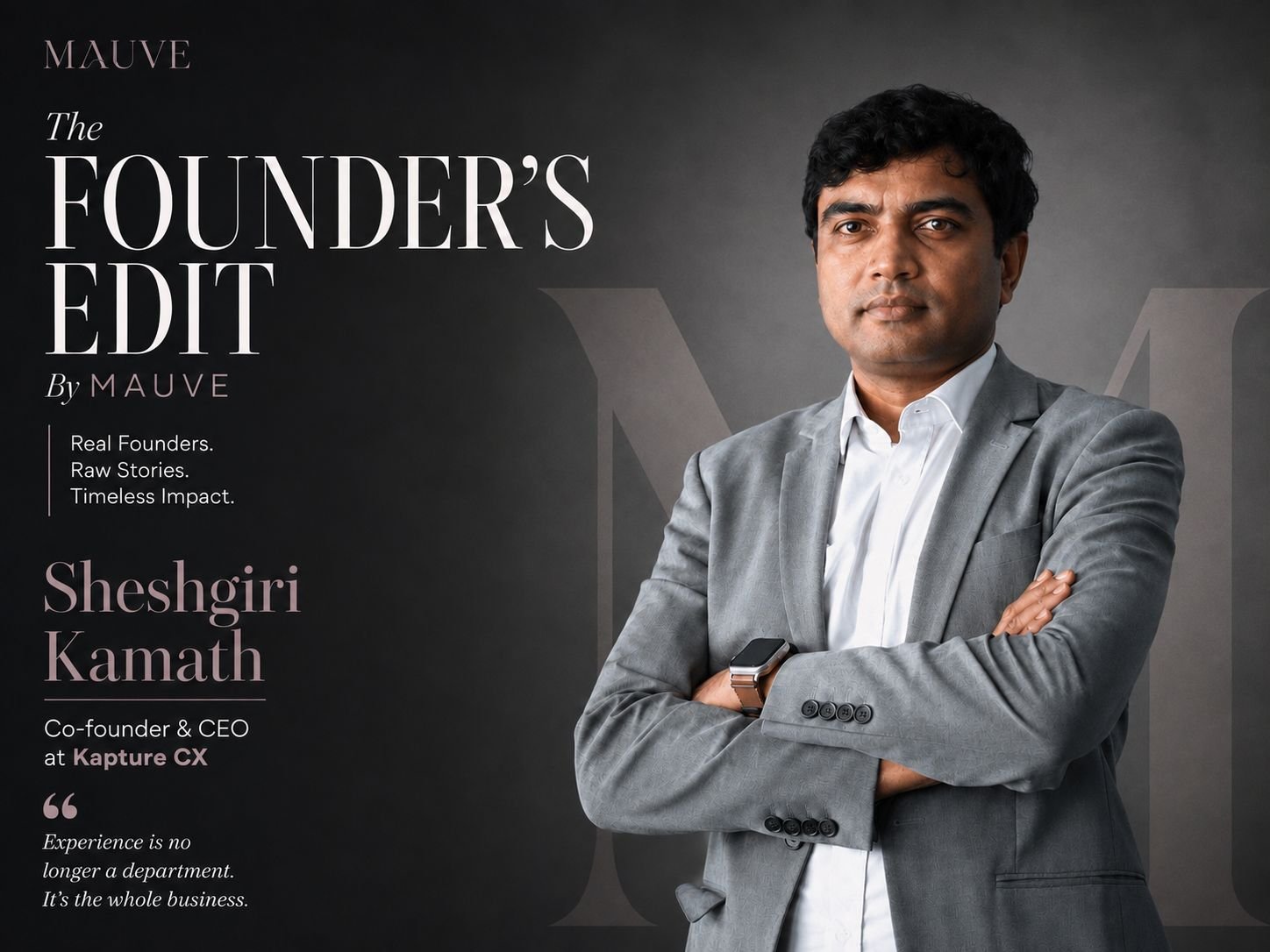
For Sheshgiri Kamath, Co-founder & CEO of Kapture CX, the evolution of customer experience can be summed up in one fundamental shift: brands are no longer competing across channels; they are competing on how well they remember.
A decade ago, having a call centre, an email address and perhaps a chatbot was considered a sophisticated multichannel strategy. Today, consumers expect something far more seamless. They move from WhatsApp to an app, from an app to a voice call, and sometimes into a physical store, without considering those interactions separate.
The expectation is simple: the brand should remember.
“If I’ve messaged a brand on WhatsApp about a delayed order, I expect whoever or whatever I speak to next, an hour later on the app, to already know that,” Kamath explains.
It is this shift—from channels to continuity—that sits at the centre of Kapture CX’s evolution and Kamath’s understanding of where customer experience is heading.
From Multichannel to One Continuous Conversation
The customer no longer experiences a company through its internal departments or communication channels. They experience one relationship.
That has fundamentally changed the role of customer experience. What was once considered a support function is increasingly becoming a defining part of brand identity, particularly as products and pricing become increasingly difficult to differentiate.
Kamath sees CX as the differentiator when products themselves begin to look alike.
“When quality and price across a category are broadly similar,” he says, “the deciding factor becomes how a brand makes you feel when something goes right, and especially when something goes wrong.”
The implication is significant. Customer service is no longer simply about resolving complaints. It is about building confidence in the relationship between a consumer and a brand.
The companies that understand this are beginning to treat customer experience not as a cost centre, but as a growth lever.
Personalisation Has Become the Baseline
For years, personalisation was positioned as a premium feature. Today, Kamath believes that expectation has fundamentally changed.
Consumers don’t consider it exceptional when a brand remembers their previous order, complaint or interaction. They consider it frustrating when they have to explain themselves again.
But there is a delicate line.
The future of personalisation, Kamath argues, is not about knowing everything about the customer. It is about knowing what is useful to remember.
There is a difference between remembering someone’s order history so they don’t have to repeat themselves and creating the uncomfortable sensation that they are being watched.
“Customers want to be recognised, not surveilled,” he says.
That distinction may become one of the most important challenges for AI-powered customer experience: making interactions more intelligent without making them feel invasive.
AI That Works Best When You Don’t Notice It
Kamath’s vision for AI is almost paradoxical.
The better it works, the less visible it becomes.
AI can already operate behind the scenes in ways consumers barely notice: identifying potentially fraudulent transactions, anticipating why someone is contacting support, retrieving previous interactions, updating delivery estimates or resolving routine requests.
The goal isn’t necessarily to tell customers that AI is involved.
It is to remove friction.
At Kapture, this philosophy has translated into a broader shift towards agentic AI—technology that can move beyond answering questions to actually taking action.
The distinction matters.
A chatbot that tells a customer where to find their order is useful. An AI agent that understands the context, identifies a delay and proactively resolves the issue is operating at an entirely different level.
“Good agentic AI just removes the step where you’d have had to ask,” Kamath says.
The ideal customer reaction isn’t that was impressive AI.
It is simply:
“That was easy.”
Knowing What AI Should—and Shouldn’t—Handle
Kamath doesn’t believe the future of customer service is a completely automated one.
Instead, he sees a division of labour.
AI is particularly well suited to interactions that are repetitive, time-sensitive and low in emotional stakes: checking order status, processing returns, changing addresses, rescheduling appointments or answering straightforward policy questions.
Humans remain essential when judgement, empathy or discretion are involved.
A denied insurance claim. A serious grievance. A difficult personal situation. A customer who needs someone to understand the nuance rather than simply process the request.
For Kamath, the test for AI isn’t whether it reduces human involvement.
It is whether it produces a better outcome.
“Does it get the customer to a good outcome faster,” he asks, “or does it just get them away from a human faster?”
The distinction captures the larger philosophy behind Kapture’s approach.
AI should be a bridge to better service, not a wall between the customer and the organisation.
India and the GCC: Two Very Different CX Equations
Kapture’s growing presence in the Middle East has also given Kamath a front-row view of how customer expectations change across markets.
India, he explains, is fundamentally a scale challenge.
Brands deal with enormous transaction volumes, intense price sensitivity and significant linguistic diversity. Customer experience has to work across metropolitan consumers and first-time digital users, while remaining economically viable at enormous scale.
The GCC presents a different equation.
Markets such as the UAE and Saudi Arabia are being shaped by government-led digital transformation, strong AI ambitions, sophisticated digital infrastructure and a consumer culture influenced by hospitality and luxury.
Here, the expectation is often more premium and concierge-like.
Data residency, sovereignty, compliance and localisation become critical considerations alongside speed.
WhatsApp remains important across both markets, but the underlying priorities differ.
India has had to master scale and cost without losing warmth.
The GCC is increasingly demanding trust, compliance and polish without losing speed.
And Kamath believes the two markets are gradually moving towards each other.
The Customer Experience Challenge of Scale
Serving one customer exceptionally well is relatively straightforward.
Doing it for millions simultaneously is another matter.
Large consumer businesses must accommodate everything from tier-three digital shoppers to sophisticated metro users, often during the same sale or festival surge.
Add multiple languages, unpredictable demand spikes and highly regulated sectors such as healthcare, banking and financial services, and CX becomes an organisational challenge rather than simply a technology problem.
“Scale exposes every inconsistency,” Kamath says.
The real challenge isn’t creating a great experience once.
It is creating the same standard of experience ten million times.
That requires the backend to work as intelligently as the customer-facing interface. Data, teams, systems and channels must communicate with one another.
Otherwise, consumers experience the cracks.
From Systems of Record to Systems of Action
Perhaps the most significant change Kamath has witnessed through Kapture’s evolution is the transformation of CRM itself.
Early CRM platforms were fundamentally systems of record.
They documented what had happened.
The next generation, he argues, needs to become systems of action.
They should understand what has happened and determine what needs to happen next.
That represents a profound change in the mental model of customer support.
Instead of:
Customer reports problem → company investigates → company responds
the emerging model is:
System detects problem → system understands context → brand acts → customer may never need to ask.
This is where Kamath sees the future of CX moving.
Not from human service to machine service, but from reactive service to proactive resolution.
The Middle East and the Opportunity Ahead
For technology companies, Kamath sees the GCC as one of the world’s most receptive environments for AI-led customer experience.
Government investment, digital transformation programmes, sophisticated infrastructure and digitally fluent consumers are converging at an unusual speed.
Retail, travel, hospitality and aviation are all undergoing significant transformation.
But localisation will determine who succeeds.
Arabic-first experiences, WhatsApp-first engagement and in-country data residency cannot simply be added to a product designed elsewhere. They have to be part of the architecture.
For Kamath, the opportunity isn’t merely to sell technology into the Gulf.
It is to participate in defining what AI-native customer experience looks like in a region building significant parts of its digital infrastructure from the ground up.
The Founder as a Customer
Building a CX company has inevitably changed the way Kamath experiences brands himself.
He admits that he probably notices customer experience more than is healthy for casual shopping.
But what impresses him isn’t necessarily spectacular service.
It is the absence of friction.
An airline that sends a rebooking option before the customer has to call. A hotel that remembers a room preference across properties and countries. A delivery app that understands a repeat order without requiring another explanation.
These moments reveal something deeper.
The company has organised its systems around the customer’s continuity rather than its own internal structure.
For Kamath, that is the real mark of a mature CX organisation.
The best customer experience often begins long before the customer reaches the customer-service team.
Listening Before Broadcasting
If Kamath could change one thing about how brands communicate with consumers, it would be deceptively simple:
Listen before you broadcast.
Too much brand communication remains driven by campaign calendars rather than customer context.
A promotional message arriving immediately after someone has filed a complaint is not necessarily a failure of intention. It is often a symptom of fragmented systems.
Marketing knows one thing.
Customer service knows another.
Sales knows something else.
The consumer is left to connect the dots.
The solution, therefore, isn’t simply better messaging.
It is better organisational integration.
The Future: When Customer Service Disappears
Kamath’s most compelling prediction is that customer service itself may eventually become almost invisible.
The next evolution is proactive, invisible resolution: problems identified and fixed before customers even realise something has gone wrong.
The idea of raising a support ticket could eventually feel as outdated as writing a formal letter of complaint.
And beyond that lies another shift: AI agents acting on behalf of consumers themselves.
Instead of a person interacting directly with a brand’s AI, a customer’s AI agent could negotiate, compare, book and transact with a brand’s AI agent.
That would fundamentally alter the relationship between consumers and businesses.
Trust, transparency and security would become even more important because consumers would increasingly delegate decisions rather than make every decision themselves.
For Kamath, however, the end goal remains surprisingly human.
The best customer experience of the future won’t necessarily feel futuristic.
It will feel effortless.
It will be the problem that never became a problem. The question that never needed to be asked. The explanation that never had to be repeated.
And when something genuinely requires judgement, there will still be a person on the other side.
AI handling the predictable at genuine scale. Humans owning the moments that require judgement and warmth.
That, ultimately, is the future Kamath is building towards at Kapture CX—and perhaps the clearest definition yet of where customer experience itself is headed.