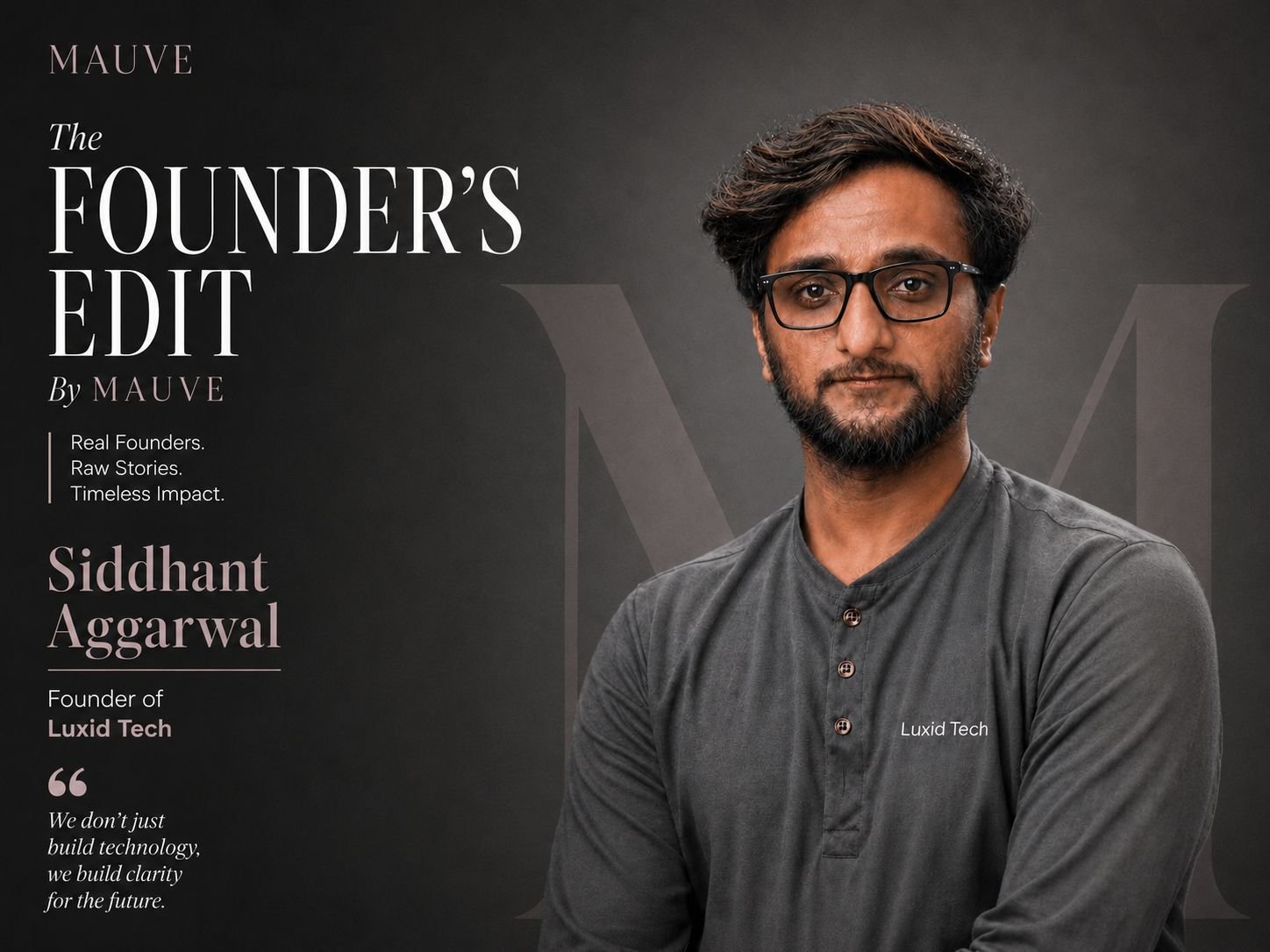
By Siddhant Aggarwal, Founder, Luxid Tech
India has never lacked skilled hands. What it has often lacked, Siddhant Aggarwal believes, is a shared visual language—one that allows the person building something on the ground to see the same complexity that may otherwise remain confined to an engineer, architect or specialist.
Before founding Luxid Tech, Aggarwal spent time as a digital nomad, moving through Indian cities and construction sites. It was there that he repeatedly encountered a contradiction: extraordinary craftsmanship operating alongside incomplete visual information.
“I kept watching skilled masons work with extraordinary precision, yet still limited by the fact that only the engineer could fully visualise the finished building,” he recalls.
That observation became the beginning of a much larger question: what if spatial computing could democratise the ability to visualise?
For Aggarwal, Luxid Tech is ultimately an attempt to answer that question.
From Construction Sites to the Physical Economy
The company’s founding idea extends beyond augmented reality as a consumer technology.
Aggarwal saw a broader problem across India’s physical economy: incomplete information slows down movement, decision-making and execution.
“A truck waiting for the next instruction, a container stuck at customs, or a warehouse full of produce whose optimal path is not visible” may appear to be separate problems. To him, they represent the same underlying friction.
The ambition, therefore, is to create a visual layer that can sit over existing systems and make complex information immediately understandable.
The objective isn’t technology for technology’s sake.
It is clarity.
Building for the Real India
Developing AR hardware brought another reality into focus.
A product can look extraordinary in a demonstration and still fail completely in the environments where it is actually needed.
For Luxid, defence environments became an important proving ground.
“The deepest challenge was making something that could survive the real India—not the demo India,” Aggarwal says.
Heat, dust, long outdoor shifts and demanding operational environments forced every design decision to answer a practical question: will this still work when the conditions are harsh and the stakes are high?
That discipline changed the way the product was built.
Every gram mattered. Every seal mattered. Every decision about on-device processing mattered.
Reliability wasn’t an additional feature.
It became the foundation.
When Technology Stops Feeling Like a Gadget
Aggarwal believes the real test of spatial computing happens when the technology disappears into the task itself.
He describes the example of a cold-storage supervisor putting on Luxid’s glasses.
Instead of moving through aisles carrying a phone or clipboard, the supervisor can see information such as temperature, priority and dispatch routes directly over the crates in front of them.
The same visual logic can extend from warehouses to construction sites, logistics networks and infrastructure projects.
“The technology stops feeling like a gadget and starts feeling like missing infrastructure.”
That may be the most revealing way to understand Aggarwal’s approach to AR.
He isn’t interested in creating another screen.
He is interested in changing how people perceive the physical world around them.
The Visual Layer of India’s Next Decade
For Aggarwal, the transformative potential of AR lies in its ability to connect physical objects with the information surrounding them.
Customs and GST clearances offer one example.
Imagine an officer being able to see a container’s history, risk profile and compliance information overlaid directly onto the physical object.
The implications extend beyond convenience.
Faster clearance can mean reduced congestion, released working capital and fresher goods reaching consumers sooner.
The same principle can be applied across warehouses, construction, agriculture and infrastructure.
The technology becomes valuable precisely because it shortens the distance between information and action.
Designing for Cognitive Relief
Aggarwal’s philosophy around innovation is grounded in a deceptively simple question: does the technology make difficult work easier to understand?
In healthcare, for instance, AR could allow doctors and nurses to access critical information or visualise a procedure without repeatedly looking away from the patient.
The same principle applies across industries.
“We balance by asking whether the technology reduces cognitive load for people who already carry heavy responsibility.”
For Aggarwal, practicality isn’t the enemy of deep tech.
“It is the only version that matters for India.”
Building AR for the Systems That Move a Nation
Much of the world’s consumer-facing AR conversation has focused on entertainment, social interaction and personal computing.
Aggarwal sees another opportunity.
India’s physical infrastructure is expanding at extraordinary scale, and some of the country’s biggest challenges remain physical.
Agriculture is one of them.
Post-harvest losses represent not simply economic inefficiency, but wasted labour and diminished income for millions of people.
A visual system that helps farmers and aggregators understand what action should come next could potentially transform how produce moves from farm to market.
“Western AR was largely built for consumers. We have the chance to build it for the systems that actually feed and move a nation.”
That distinction defines Luxid’s larger proposition.
The Setback That Became a Standard
There was a point when the hardware still wasn’t robust enough for real manufacturing environments.
The feedback from supervisors was straightforward: if the device couldn’t survive an eight-hour industrial shift, it didn’t belong on the factory floor.
For a deep-tech company developing hardware, that kind of feedback can be uncomfortable.
For Aggarwal, it became clarifying.
The setback forced Luxid to confront the distance between a functioning prototype and technology that could operate reliably in the real world.
The same toughness demanded by factories, he realised, would eventually be demanded by defence teams and outdoor infrastructure projects.
The limitation became the benchmark.
Leadership Is the Protection of Clarity
Entrepreneurship has also reshaped Aggarwal’s understanding of leadership.
For him, leadership isn’t primarily about having all the answers.
It is about protecting clarity when pressure increases.
Whether working alongside security teams protecting critical infrastructure or project teams working against monsoon deadlines, he sees the same underlying challenge: people often possess the skill required to perform the task, but lack a shared and immediate understanding of what matters most.
“Technology that restores that shared picture earns trust. Technology that adds noise loses it.”
That idea extends beyond product philosophy.
It has become part of how he thinks about leading teams as well.
Choosing Infrastructure as the Proving Ground
One of Luxid’s most consequential decisions was to make large infrastructure projects a primary proving ground.
Once the company committed to making its technology useful for people coordinating roads, bridges and urban corridors, the standards changed.
Reliability could no longer be optional.
Multi-user coordination couldn’t be an afterthought.
Long-duration outdoor performance had to be fundamental.
The decision effectively pushed Luxid towards the standard that Aggarwal believes India requires—not the standard that a technology demonstration can get away with.
A Different Kind of Technology Future
Aggarwal’s vision for the future isn’t centred entirely on artificial intelligence.
In fact, he approaches the AI conversation with caution.
What excites him more is the possibility of sensory technologies expanding how humans experience information.
He points to Braille as an enduring example.
It was not created to impress. It was created to allow someone without sight to access information in a different way.
He sees a similar possibility in spatial computing.
“AR, when built with discipline, can become a similar layer for complex physical data.”
For Aggarwal, the deeper opportunity is not technology replacing human judgement.
It is technology strengthening human perception and judgement.
His Most Important Mentors Were Never in a Boardroom
Perhaps the most personal dimension of Aggarwal’s philosophy comes from where he finds his mentors.
Not necessarily in books or business schools, but among the millions of Indians who possess extraordinary practical skill without formal education.
He returns repeatedly to the image of a mason who can construct with remarkable precision but may not have the same ability to visualise the final structure that an architect has.
Education, he observes, can provide the ability to visualise complex outcomes.
Then comes the bigger question:
What if technology could extend that ability to more people?
That question became central to Luxid.
The company isn’t simply building AR hardware, in Aggarwal’s view.
It is attempting to widen the circle of people who can see—and therefore shape—the future of India.
The Larger Unlocking
For Aggarwal, success cannot simply be measured in devices shipped, deployments completed or commercial milestones achieved.
It lies in whether technology can remove an invisible barrier that has existed for generations: the gap between skill and access to information.
“When the skill that already exists in this country can operate with the clarity, speed and shared vision that was once limited to a few, then the work will have mattered.”
That is the larger ambition behind Luxid Tech.
Not to make technology more spectacular.
But to make human capability more visible.
And perhaps, in doing so, to give India’s most skilled hands something they have long needed: the ability to see the future they are already capable of building.