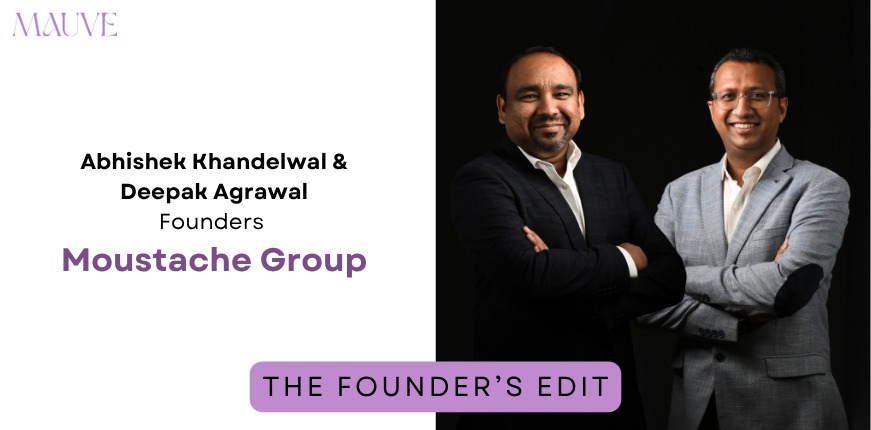
For founders Abhishek Khandelwal and Deepak Agrawal, hospitality isn’t measured by the room a guest books—it’s defined by the memories they take home.
By Journalist Priya Lalwani
The hospitality industry has traditionally competed on location, amenities, room categories, and occupancy. But Abhishek Khandelwal and Deepak Agrawal, founders of Moustache Group, believe the most memorable part of a stay often has nothing to do with the room itself.
It lies in the conversations, the people, the destination, and the moments that cannot be captured in a booking confirmation.
At The Founder’s Edit, Abhishek Khandelwal and Deepak Agrawal share how a decision to leave successful careers, an untapped opportunity in Jaipur, and a belief in “unreasonable hospitality” transformed a hostel into one of India’s most distinctive experience-led hospitality brands.
Moustache began with two life decisions unfolding at the same time.
While working in Canada, Abhishek Khandelwal realised he wanted to return to Jaipur before his young son became permanently rooted abroad.
Having already walked away from one secure career, he found himself ready to embrace another entrepreneurial leap.
Around that period, a property developed by his father on Jaipur’s MI Road presented an unexpected opportunity.
As he researched the emerging hostel industry, he discovered a category with significant potential but remarkably few organised operators.
A conversation with longtime friend and fellow Chartered Accountant Deepak Agrawal, who was returning from Indonesia, confirmed what both already sensed.
The opportunity extended far beyond accommodation.
Together, they envisioned a hospitality brand centred around people, experiences, and genuine human connection rather than simply rooms and itineraries.
They believed hospitality could build community.
That conviction eventually became Moustache.
Leaving established careers meant replacing certainty with constant uncertainty.
Both founders traded predictable professional trajectories for a business where each day introduced entirely unfamiliar challenges.
Yet neither views that decision as sacrifice alone.
Building something meaningful demanded difficult years, personal trade-offs, and unwavering commitment, but it also brought the excitement of creating an organisation entirely from scratch.
One principle, however, remained non-negotiable.
Work ethic.
Alongside financial discipline and guest trust, the founders refused to compromise on solving problems themselves.
Rapid growth through shortcuts or generic experiences never aligned with the company they wanted to build.
Every expansion had to remain commercially responsible while honouring the trust every guest placed in the brand.
One misconception about hospitality is something they particularly enjoy correcting.
Hotels and hospitality, they explain, are not the same thing.
A hotel provides a room, amenities, and expected services.
Hospitality begins after those basics are delivered.
It is reflected in the employee who notices a solo traveller settling in for the first time, the thoughtful recommendation offered to a visiting family, or the way an unexpected challenge is handled with empathy rather than procedure.
Guests pay for the room.
They remember everything around it.
This philosophy inspired what Moustache internally calls “unreasonable hospitality.”
It represents the willingness to go beyond standard operating procedures whenever a guest’s experience genuinely calls for it.
Because ultimately, memorable hospitality is rarely created through checklists.
It is created through thoughtful human gestures.
The founders also recognised another gap in the market.
Traditional hotels focused on accommodation.
Budget hostels focused largely on affordability.
Very few operators viewed hospitality itself as a cultural and social experience.
As domestic travel increased, another insight emerged.
Indian travellers appreciated the community-driven atmosphere of hostels but increasingly desired greater comfort, stronger facilities, and thoughtfully curated experiences.
That observation gradually transformed Moustache’s evolution.
What began as a community-first hostel brand eventually expanded into Select and Luxuria, allowing different travel occasions to coexist under one hospitality philosophy.
Despite growing into multiple verticals, the company’s origins continue influencing every strategic decision.
Each property must remain rooted in its destination.
Rather than creating identical hotels across locations, the founders insist every stay should possess its own identity, character, and reason to exist beyond accommodation.
For Moustache, consistency lies in values—not sameness.
In an increasingly competitive hospitality landscape, the founders define their value proposition through one word.
Recall.
Competent rooms have become common.
Memorable experiences remain rare.
Whether guests remember a meaningful interaction, the atmosphere of a property, or a team member’s thoughtful response to an unexpected request, those emotional moments create lasting relationships far beyond a single booking.
Their vision becomes especially visible when guests naturally transition across brands.
Someone may discover Moustache through a hostel during solo travel, later choose Select for business or family holidays, and eventually experience Luxuria for a private celebration.
When travellers remain loyal across entirely different formats, the founders believe the relationship belongs to the brand—not simply the room.
Scaling such a business requires careful balance.
Certain standards—hygiene, safety, service responsiveness, and operational discipline—must remain identical everywhere.
Everything else should reflect the destination itself.
Architecture, local materials, food, art, activities, and partnerships are intentionally designed around each location.
As the founders describe it:
The checklist can travel. The character should remain local.
Rather than segmenting customers by age or income, Moustache understands travellers through the purpose behind each journey.
The same guest may seek vibrant social interactions during a solo backpacking trip, comfort while travelling with family, or curated luxury during a special celebration.
What unites them is not demographics.
It is their appreciation for thoughtful, experience-led hospitality.
One of the company’s most important strategic pivots emerged after the pandemic.
Historically dependent on international travellers, Moustache suddenly found itself serving a rapidly growing domestic audience.
The founders discovered Indian travellers valued hostel communities not because they were inexpensive, but because they offered meaningful experiences.
They were equally willing to invest in better comfort and stronger facilities.
That behavioural insight fundamentally reshaped the company’s expansion strategy and ultimately accelerated the creation of Select and Luxuria.
For Moustache, community itself cannot be manufactured digitally.
It begins inside each property.
Shared cafés, rooftops, common spaces, local walks, and carefully designed activities encourage genuine human interaction without forcing it.
Digital platforms simply continue conversations that have already begun offline.
Looking ahead, the founders expect hospitality to evolve across three major dimensions.
Stronger sustainability standards, growing expectations around responsible data management, and greater technological integration will reshape operations.
Artificial intelligence will increasingly personalise bookings, pricing, and guest communication.
Yet despite those advancements, they believe the industry’s future remains fundamentally human.
Travellers increasingly expect destinations themselves—not merely hotel rooms—to become central to their journeys.
Properties capable of combining operational excellence with authentic local experiences will define the next generation of hospitality.
While occupancy and revenue remain important commercial indicators, the founders measure success through something far more personal.
Reviews that mention individual employees.
Stories describing meaningful conversations.
Guests remembering how a challenge was handled.
Even more importantly, travellers returning to experience entirely different Moustache properties across multiple journeys.
Those behaviours reveal emotional connection rather than transactional satisfaction.
As the organisation continues expanding, preserving culture has become increasingly intentional.
The founders distinguish clearly between non-negotiable operating standards and the creative freedom individual properties require.
Dedicated quality teams, operational reviews, and decentralised leadership ensure growth strengthens rather than dilutes the brand.
Their own leadership roles have evolved dramatically.
Where they once managed nearly every operational decision themselves, they now focus on long-term direction, brand architecture, and building leaders capable of making thoughtful decisions independently.
For them, true leadership increasingly means creating clarity—not control.
Perhaps their most transformative lesson arrived during the pandemic.
Heavy operational commitments, declining international tourism, and difficult financial decisions forced the business to question many of its core assumptions.
Instead of merely solving immediate problems, the founders re-examined the very market they were serving.
That period eventually redirected Moustache toward domestic travellers and experience-led hospitality.
It also reinforced a lesson they continue carrying forward.
Every setback exposes assumptions.
The organisations that survive are those willing to recognise which beliefs still hold true—and which have quietly become obsolete.