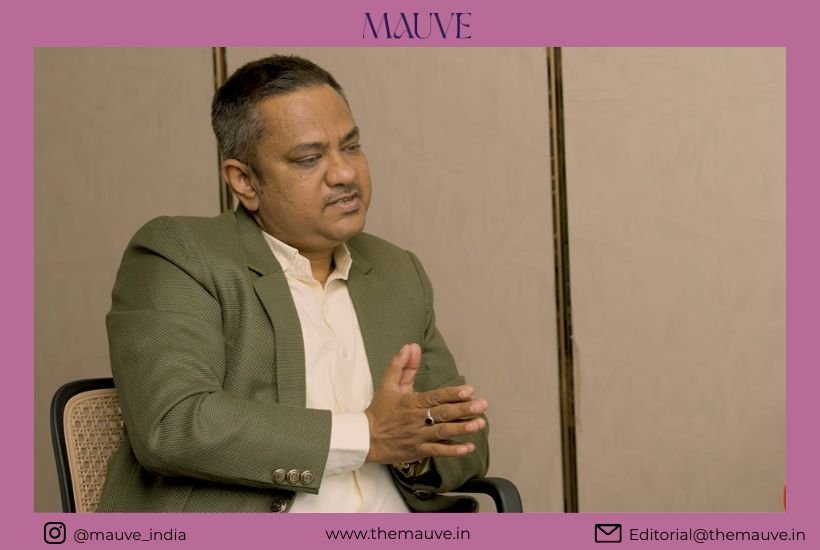
In an episode of Mauve’s Happened Over Coffee, host Priya Lalwani sits down with business coach Vivek Sharma for a conversation about entrepreneurship, leadership, business systems and why the biggest obstacle to scaling a company is often the founder themselves.
Every entrepreneur dreams of building a successful business.
In the early days, the founder does everything.
They make sales.
They answer customer calls.
They manage operations.
They solve problems.
They even handle tasks that have little to do with growing the business.
At first, this level of involvement feels necessary.
Eventually, it becomes the biggest roadblock.
The conversation explores leadership, delegation, company culture and the mindset required to transform a business from a founder-dependent venture into an organization that can grow independently.
The Trap That Most Founders Don’t Realise They’re In
According to Vivek Sharma, most businesses begin as what he calls individual-driven companies.
The founder becomes the salesperson, operations manager, accountant, marketer and customer support all rolled into one.
In the beginning, this feels like commitment.
Over time, it becomes exhaustion.
The founder slowly becomes the bottleneck.
Every decision needs approval.
Every problem lands on one desk.
Every employee waits for instructions.
The result isn’t just burnout it is a business that cannot grow beyond the founder’s capacity.
For Vivek, scaling begins with one important shift.
The founder has to stop being the person who does everything and start becoming the person who enables everyone else to perform.
Leadership, in other words, is about multiplication rather than control.
Why the Founder Sets the Energy of the Company
One of Vivek’s most memorable observations is that a founder is much more than the head of the company.
“As an owner of the company, you are the Chief Energy Officer of your company; the energy you have will be reflected by your team.”
Businesses often mirror the behaviour of their leaders.
A calm leader usually builds a calmer workplace.
A constantly stressed founder often creates anxious teams.
Optimism, accountability and discipline travel through an organisation much faster than people realise.
Employees don’t only listen to what leaders say.
They observe how leaders react to challenges, celebrate victories and handle failures.
That energy gradually becomes part of the company’s identity.
The Six Stages of Building a Scalable Business
One of the most practical parts of the discussion is Vivek’s framework for business growth.
He explains that companies evolve through multiple stages.
The first stage is founder-driven, where everything revolves around one person.
The next stage is people-driven, where responsibilities begin to shift to capable team members.
From there, businesses become systems-driven, replacing dependency on individuals with clear processes and standard operating procedures.
As organisations mature, they become data-driven, making decisions based on measurable insights instead of assumptions.
Finally, truly sustainable businesses become culture-driven.
At this stage, the organisation no longer depends on constant supervision because the values and systems have become part of the way people naturally work.
For Vivek, this progression is what separates businesses that survive from businesses that scale.
Why Delegation Is a Growth Strategy
Entrepreneurs often believe that no one can do a task as well as they can.
While that may be true initially, it also limits growth.
Vivek encourages founders to ask themselves an important question before taking on any task.
“I am a ₹10,000 person doing a ₹10,000 job. Shouldn’t I delegate this task so I can focus on growing the business?”
The statement is not about undervaluing work.
It is about understanding opportunity cost.
When founders spend hours on routine operational work, they lose time that could be invested in strategy, partnerships, innovation and revenue generation.
Delegation is not about doing less.
It is about doing what only the founder can do.
Everything else should gradually move into capable hands.
Systems Build Freedom
Many entrepreneurs believe growth comes from working longer hours.
Vivek challenges that belief.
He refers to the idea popularised by The 4-Hour Workweek not as a literal target, but as a reminder that founders should spend most of their time creating value rather than constantly managing operations.
The objective is not laziness.
It is efficiency.
When systems are built properly, businesses become less dependent on constant supervision.
Employees understand their responsibilities.
Processes become repeatable.
Problems are solved consistently.
And the founder gains the freedom to focus on the future instead of constantly firefighting the present.
Culture Is What Happens When Nobody Is Watching
As systems become stronger, they eventually evolve into culture.
According to Vivek, culture isn’t created through posters on office walls or motivational speeches.
It develops when people consistently follow the same values, behaviours and standards without being reminded.
A company with a healthy culture doesn’t need the founder to monitor every decision.
The organisation begins to regulate itself.
People understand expectations.
They support one another.
They make decisions aligned with the company’s purpose.
This is why systems matter.
Not because they create bureaucracy.
But because they eventually create trust.
Happy Teams Build Successful Businesses
For Vivek, business success always begins with people.
His philosophy is straightforward:
“Happy team equals happy customer; happy customer equals happy organization; happy organization equals happy entrepreneur.”
The sequence is important.
Many businesses focus first on customer satisfaction.
But customer experiences are largely shaped by employees.
A motivated team is more likely to provide better service.
Satisfied customers are more likely to stay loyal.
A healthy business is more likely to grow sustainably.
And in the end, the entrepreneur benefits too.
Growth, therefore, is not only about increasing revenue.
It is about creating an environment where everyone succeeds together.
Criticism Is Often a Sign of Growth
Every growing business eventually attracts criticism.
Rather than fearing it, Vivek sees it differently.
“If you have negative publicity, it means you are growing. As they say, the elephant keeps walking, while the dogs keep barking.”
His point is not that criticism should always be ignored.
Constructive feedback remains valuable.
But entrepreneurs must also recognise that visibility naturally attracts opinions.
Every successful founder faces scepticism at some stage.
The key is to remain focused on purpose rather than distractions.
Leadership Begins With Trust
Towards the end of the conversation, Vivek reflects on what leadership truly means.
He believes that businesses grow when founders trust their teams, trust their customers and remain committed to honest intentions.
“If your intention is pure, nothing will harm you. You have to believe in your team members and your customers.”
Great Businesses Outgrow Their Founders
The conversation between Priya Lalwani and Vivek Sharma offers an important reminder for every entrepreneur.
The goal of building a business is not to become indispensable.
It is to create something that continues to thrive because of strong people, reliable systems and a healthy culture.
The founder’s greatest achievement is not being involved in every decision.
It is creating an organisation where good decisions continue to happen even when they are not in the room.
Because businesses don’t truly scale when founders work harder.
They scale when founders learn to lead differently.
This conversation with business coach Vivek Sharma is featured on Mauve’s Happened Over Coffee, hosted by Priya Lalwani, founder of Mauve.