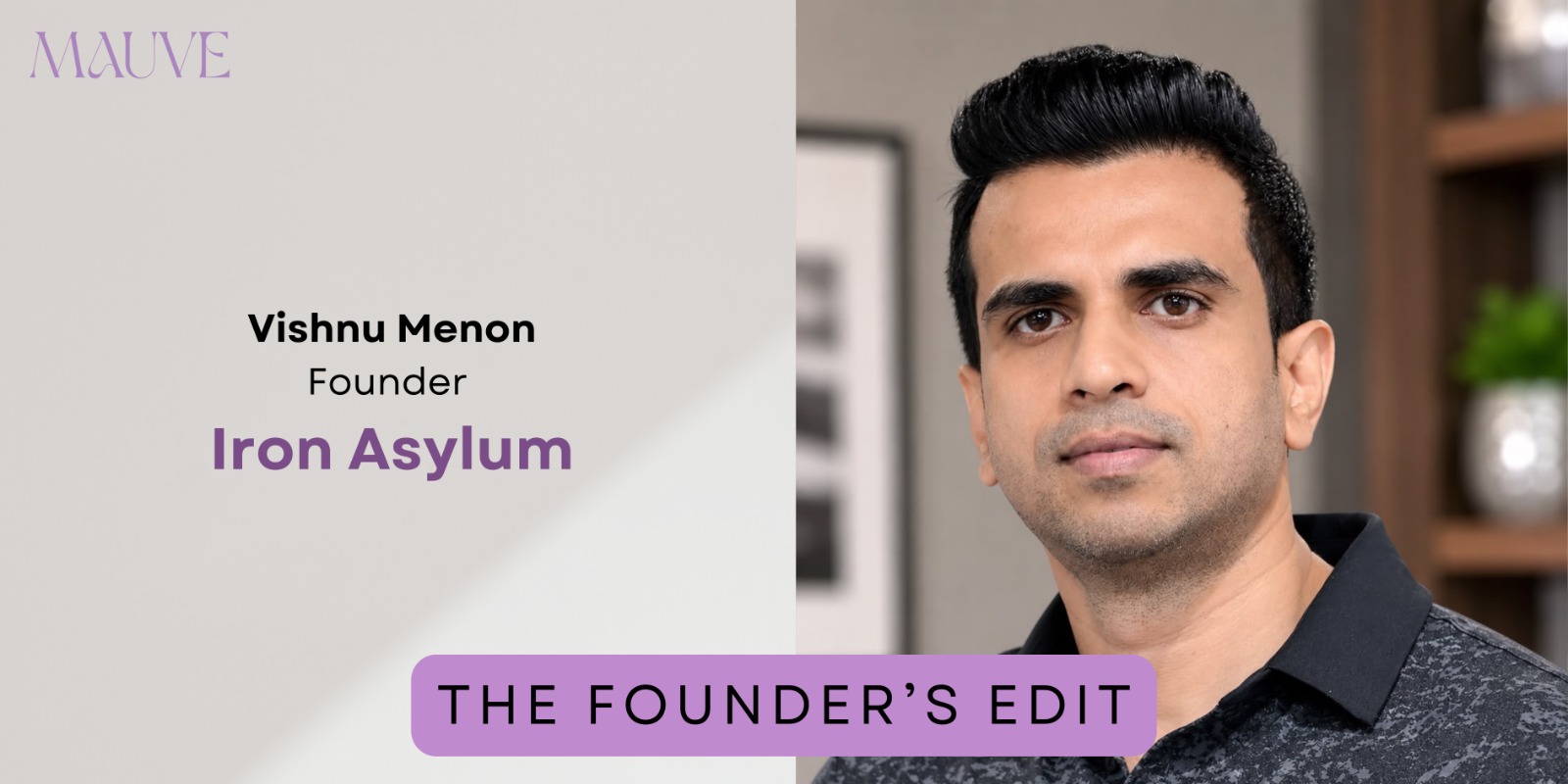
For the Founder of Iron Asylum, the future of sports nutrition isn’t about louder marketing—it’s about giving consumers absolute confidence in what they’re putting into their bodies.
By Journalist Priya Lalwani
The sports nutrition industry has never been more crowded. Shelves are lined with promises of better performance, faster recovery and bigger results. Yet beneath the marketing, one question continues to concern consumers: Can I trust what’s inside the product? For Vishnu Menon, Founder of Iron Asylum, that question became the foundation of an entire business. Built without outside investors or a financial safety net, Iron Asylum has grown into one of India’s trusted names in authentic sports nutrition by prioritising transparency over trends. At The Founder’s Edit, Vishnu Menon shares insights on building trust in a sceptical industry, protecting quality while scaling, and why authenticity remains the company’s greatest competitive advantage.
Unlike many entrepreneurial stories that begin with a single breakthrough moment, Iron Asylum emerged through years of observation.
While spending time in gyms and speaking with fitness enthusiasts, Menon noticed a recurring contradiction. People were disciplined with their workouts, careful about their diets and deeply committed to improving their health. Yet many remained uncertain about the supplements they were consuming.
The effort they invested in themselves wasn’t being matched by confidence in the products they relied upon.
That disconnect stayed with him.
It eventually became clear that the real opportunity wasn’t simply selling supplements—it was restoring trust between consumers and the products they put into their bodies.
Building that vision came without external support.
There were no investors, no backup plans and no financial cushion waiting in the background. The business was funded through personal savings, requiring years of patience, persistence and delayed gratification.
Yet one principle remained entirely non-negotiable.
Every product carrying the Iron Asylum name had to be something Menon would confidently consume himself.
He believes profitability should never come before product integrity. If a supplement failed to meet his own standards, he would rather walk away from the opportunity than compromise customer trust.
That philosophy became especially important in an industry often misunderstood.
Many consumers associate sports nutrition with little more than protein powders, flashy marketing campaigns and exaggerated claims. Menon argues that what customers rarely see is the far more demanding work taking place behind the scenes—building relationships with international manufacturers, ensuring regulatory compliance, verifying sourcing and maintaining rigorous quality standards throughout the import process.
As the official importer of globally recognised brands such as ProSupps and Cellucor, Iron Asylum’s work begins long before products reach store shelves.
The company was born from recognising another significant gap in the Indian market.
Counterfeit supplements, misleading labels and poorly handled imported products had become increasingly common. Even genuine products often reached consumers after being improperly transported or stored, compromising their effectiveness.
For Menon, the real challenge wasn’t simply identifying authentic products—it was ensuring they remained authentic from manufacturing to consumption.
That commitment continues to shape every strategic decision the company makes.
Whenever Iron Asylum evaluates a new partnership, one question remains central: Would this be a decision I could confidently explain to a customer face-to-face?
Only brands meeting those standards become part of the company’s portfolio. The same philosophy that guided Iron Asylum during its earliest days continues to define its operations today.
In an increasingly saturated marketplace, Menon believes authenticity has become the company’s strongest differentiator.
Rather than selling promises printed on labels, Iron Asylum focuses on guaranteeing that every product is genuine, properly imported, carefully verified and consistently handled throughout its journey. In an industry where customers often struggle to distinguish authentic products from counterfeits, becoming a trusted source has proven more valuable than simply offering another supplement.
Growth, however, has never come at the expense of quality.
Despite selling millions of units, the company has deliberately invested in logistics, storage infrastructure and verification systems rather than increasing speed through shortcuts. Every expansion decision is weighed against one fundamental consideration: if greater scale compromises trust, it isn’t worth pursuing.
Interestingly, Iron Asylum defines its customers less by age or fitness level than by experience.
Its ideal customer is someone who has already encountered disappointment—whether through counterfeit products, ineffective formulations or unreliable retailers. They are no longer searching for the cheapest option. They are searching for certainty.
Whether competitive athletes, working professionals or retail partners, they all share one characteristic: they have learned to question what they buy.
That scepticism has become one of the company’s greatest strengths.
Some of Iron Asylum’s most important improvements have emerged directly from its community. Feedback around flavours, sourcing transparency, repeat purchases and delivery experiences continues to influence product decisions. A network of more than 1,800 fitness advocates now functions as an early feedback system, allowing the company to identify issues before they become larger problems.
Community, Menon believes, cannot be sustained through marketing alone.
While digital engagement plays an important role, lasting loyalty is built through consistency. Reliable products, accessible customer support, dependable retailer relationships and predictable quality create far stronger connections than advertising campaigns ever could.
In sports nutrition, loyalty is earned one product at a time.
Looking ahead, Menon welcomes the tightening of India’s supplement regulations.
Greater scrutiny surrounding product labelling, dosage claims and import compliance, he believes, will strengthen the industry rather than hinder it. At the same time, consumers themselves are becoming increasingly informed—checking batch numbers, verifying sourcing information and comparing international pricing before making purchasing decisions.
For companies already committed to transparency, that cultural shift represents an opportunity rather than a challenge.
Although revenue remains an important business metric, Menon measures success differently.
Repeat purchases—and even more importantly, unsolicited customer recommendations—represent the strongest indicator of Iron Asylum’s health. While advertising can generate sales, genuine word-of-mouth requires something far more valuable: trust.
As the organisation has expanded, Menon’s leadership has evolved alongside it.
Where he once handled sourcing, sales, logistics and even warehouse operations himself, his attention today is centred on protecting the company’s standards and culture. Every new employee first learns why Iron Asylum operates the way it does before learning how to perform their role. Quality, he believes, cannot simply be delegated; it must remain embedded within leadership itself.
Reflecting on his entrepreneurial journey, one lesson stands above all others.
Trust is far easier to lose than to rebuild.
An early sourcing decision that failed to meet expectations affected far more than finances—it challenged customer confidence. Recovering financially took months. Rebuilding trust took considerably longer.
That experience fundamentally changed the way Menon approaches every business decision.
Because in the world of sports nutrition, products may drive purchases—but trust is what ultimately builds a brand.
And for Iron Asylum, that trust remains the strongest ingredient in everything it creates.