
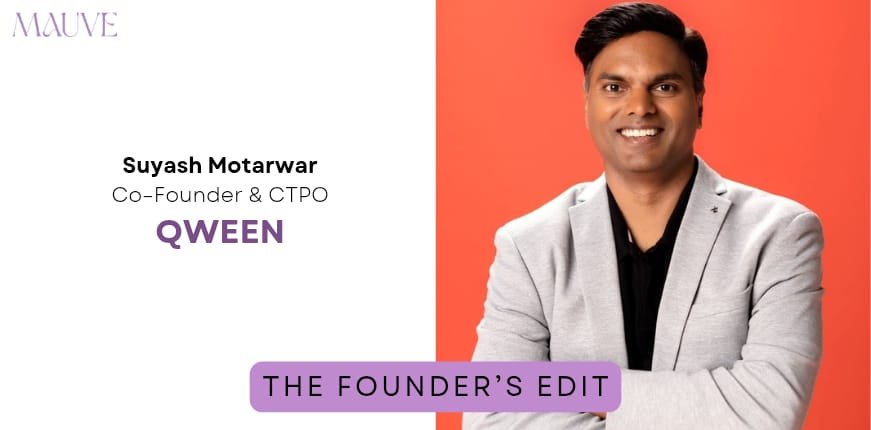
At QWEEN, Suyash Motarwar believes jewellery shouldn’t begin with a salesperson—it should begin with self-discovery.
By Priya Lalwani
For decades, luxury jewellery retail has followed a familiar script.
A customer walks into a showroom.
Within moments, someone asks what occasion she’s shopping for, what her budget is, whether she’s looking for diamonds or gold, and then begins unlocking glass counters one by one.
Suyash Motarwar believes that sequence is fundamentally broken.
As Co-Founder of QWEEN, India’s first self-discovery experiential luxury jewellery brand, he isn’t trying to replace jewellery retail with technology. He’s trying to redesign the very psychology of buying jewellery.
“The problem isn’t human interaction,” he says. “The problem is that selling begins before discovery.”
That single observation has shaped everything QWEEN is building.
Rather than leading customers through counters organised by metal or price, QWEEN invites them to discover jewellery through identity, emotion and personal expression. Instead of asking, What are you buying?, the brand asks a far more personal question:
Who are you today?
The idea emerged from watching how younger luxury consumers behave.
They don’t enter stores uninformed.
They research extensively, compare products, save inspiration, understand materials, and arrive with opinions long before speaking to a salesperson.
Yet traditional jewellery retail still expects discovery to happen only after assistance begins.
For Motarwar, technology isn’t replacing trust.
It’s allowing trust to develop differently.
Inside QWEEN’s upcoming flagship experience store in Noida, customers won’t begin their journey at a jewellery counter.
Using a personalised Access Card, they’ll move independently through the space, unlocking displays themselves and exploring products through RFID-powered discovery stations. Every piece becomes digitally interactive, allowing visitors to instantly access pricing, craftsmanship details, certifications, styling inspiration and availability without depending on a salesperson.
Human expertise doesn’t disappear.
It simply arrives later—when the customer chooses it.
“The future isn’t self-service,” Motarwar explains. “It’s self-discovery.”
That distinction defines the company’s entire philosophy.
Behind this experience lies an equally ambitious technology ecosystem.
Every jewellery piece has its own digital identity.
Digital twins, virtual try-ons, item-level inventory, real-time customisation and connected commerce create a continuous journey from online discovery to physical ownership.
Instead of restarting the buying process every time someone enters a showroom, QWEEN allows customers to continue exactly where they left off.
The infrastructure isn’t being built for operational efficiency alone.
It’s being built to eliminate friction.
“A customer doesn’t experience a brand in departments,” Motarwar says. “She experiences one relationship.”
That relationship extends beyond technology into transparency itself.
Historically, jewellery has relied heavily on inherited trust—family jewellers, reputation and tradition.
QWEEN wants trust to become evidence-based.
Every product is designed to carry a complete digital journey, connecting certification, provenance, craftsmanship, service history and future ownership into one accessible record.
Motarwar believes luxury’s next generation won’t simply accept claims.
They’ll expect to verify them.
Interestingly, while QWEEN positions itself as a technology-first luxury brand, Motarwar repeatedly insists the company is not competing with craftsmanship.
India, he argues, already possesses extraordinary jewellery-making capability.
The real opportunity lies in reinventing how consumers discover that craftsmanship.
This philosophy extends into design itself.
Traditional jewellery often revolves around occasions—weddings, anniversaries, festivals and family milestones.
QWEEN is responding to a different cultural shift.
Today’s luxury consumer buys jewellery for promotions, dinners, travel, celebrations with friends, or simply because a particular piece reflects who she wants to be.
Jewellery is moving from social validation towards personal identity.
That behavioural change influences every collection the brand develops.
The company’s credibility has also been strengthened by strategic investors Aamir Khan and Ranbir Kapoor, though Motarwar is careful not to let celebrity define the business.
Their involvement, he explains, reflects belief rather than endorsement.
That trust became deeply personal when Aamir Khan commissioned QWEEN to create bespoke jewellery for one of life’s most intimate milestones.
Yet Motarwar insists celebrity can only open the first conversation.
The product must sustain every conversation after that.
Ultimately, he wants QWEEN to be remembered not because famous people invested in it, but because consumers felt something fundamentally different while discovering jewellery.
Looking ahead, Motarwar sees luxury retail evolving across four major shifts.
Digital twins will allow customers to experience jewellery long before physically wearing it.
Artificial intelligence will understand personal taste with increasing nuance rather than simply recommending products.
Every jewellery piece will carry its own digital identity, recording provenance, ownership, servicing and authenticity.
And stores themselves will become immersive experience centres instead of transactional showrooms.
Yet despite all the innovation, his ambition remains surprisingly human.
“I hope we move beyond the belief that luxury has to be intimidating to be aspirational.”
It’s a philosophy that perhaps best captures what QWEEN is trying to build.
Not simply a jewellery brand.
But a world where discovery belongs to the consumer long before the sale does.

 Jeffreynoina says:
  GUM says:
  Robinblues says:
  Robinblues says:
  WilliamTub says:
  Robinblues says:
  Robinblues says:
  Robinblues says: