
Indian travellers are becoming more confident about going overseas, but
many still do not have a clear view of what they actually pay when they spend abroad. Passport & Paisa:
India Travel Money Report 2026, a report surveying more than 1000 Indian international travellers across
generations and geographies by Wise, the global technology company building the best way to move and
manage the world’s money, finds that a travel money blind spot is costing Indians more than they realise,
long before the holiday has even begun.
Southeast Asia remains India’s favourite international destination
The destinations where India’s travel money blind spot will play out this season are already set.
Southeast Asia leads at 34%: Thailand, Bali, and Singapore remain perennial favourites, but the map is
shifting.
Gen Z’s pull toward Japan and South Korea (13%, the highest of any generation) is likely driven entirely
by K-pop and anime. Gen X is heading to Europe (18%) and Australia & New Zealand (17%), while
millennials show the strongest pull toward the Middle East (16%), reflecting professional and family ties to
the Gulf.
India is digital at home, but still cash-heavy abroad
Despite India’s rapid adoption of digital payments at home, 38% of travellers still exchange cash before
departure – making it the single most popular method internationally. International debit and credit cards
follow, while digital multi-currency accounts account for just 9% across all generations, with no
meaningful variation by age.
Behaviour does shift with experience. Gen Z remains the most cash-dependent cohort. Millennials show
greater openness to cards and mixed methods. Gen X are the only generation where card usage has
overtaken cash (31% versus 25%) with more experienced travellers increasingly using a combination of
methods. The more Indians travel, the more deliberate they become about managing money abroad.
This creates a sharp contrast between how Indians pay at home and how they spend abroad. In India,
consumers are used to instant, digital and transparent payments. But while travelling internationally,
many continue to depend on cash, traditional forex products and payment methods where the final cost is
not always clear upfront.
Hidden forex costs are creating uncertainty for Indian travellers
India’s outbound travel momentum is real. 78% of travellers plan to increase international travel spending
following the TCS reduction to 2% that came into effect following Budget 2026. Yet managing the travel
budget is the #1 anxiety for Indian international travellers – ranking significantly higher than navigating
visa queues, flight delays, language barriers, and mobile connectivity.
Beneath the confidence lies a persistent gap: travellers may spend days comparing flight fares, hotel
prices, and itineraries in detail, but often have far less visibility into the exchange rate, markup, or fee
applied when they swipe, tap, or withdraw money abroad.
Hidden exchange rate markups and non-transparent pricing are the top two forex frustrations. Difficulty
comparing exchange rates across providers is a third. Travellers know they are paying for foreign
exchange; however, they simply do not know how much of that cost is buried inside the rate itself. For a
budget-conscious traveller, this matters. Nearly half of the respondents spend under ₹1 lakh per person
on an international trip. In that context, even small exchange rate markups or unclear charges can affect
the overall travel budget. Zero forex markup was the only cost-related feature that resonated consistently
across generations, underscoring the growing importance of transparent pricing in international spending.
Reliability beats perks when Indians choose a travel card
When selecting a forex or credit card for international travel, global acceptability emerged as the most
important factor across generations. This ranked ahead of zero forex markup, lounge access, eSIM
perks, low ATM fees and digital wallet storage.
The moment at an izakaya in Tokyo or a taxi in Baku where an Indian traveller’s card simply does not
work is its own form of money anxiety, distinct from not knowing what they paid and equally disruptive.
The finding is clear: when Indians are abroad, they first want confidence that their card will work. Rewards
and lifestyle benefits may matter, especially to younger travellers, but reliability, transparency and ease of
access are the stronger needs.
Wise card: helping Indians spend abroad with full confidence and transparency
The findings underline a simple need: Indian travellers want to know what they are paying when they
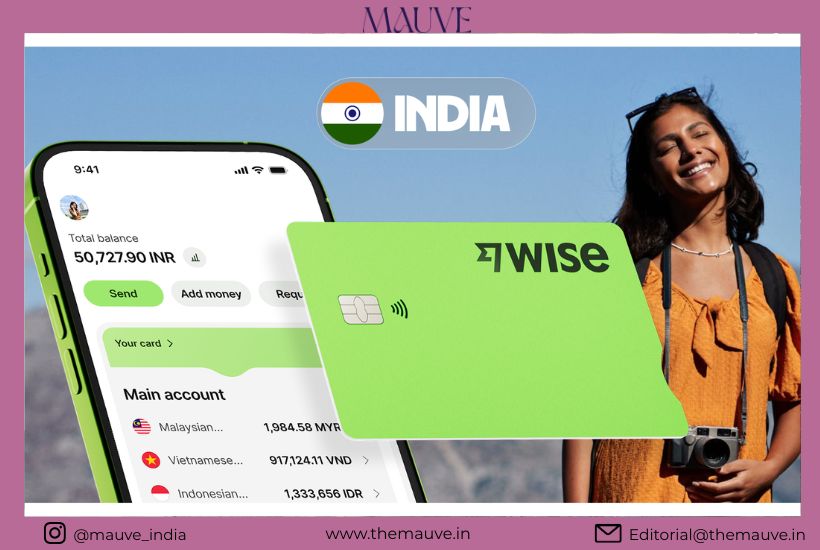
spend abroad. The Wise card, launched in India last year, allows Indians to hold and spend in 40+
currencies across 160+ countries using the mid-market exchange rate with no hidden markups. Users
can apply digitally, access a virtual card instantly, and make free ATM withdrawals up to USD 200 per
month. The card is designed for Indians who need a clearer, more predictable way to spend
internationally, whether they are travelling for leisure, education, work, or to visit family abroad.
Taneia Bhardwaj, South Asia Expansion Lead at Wise, said, “Indian travellers are becoming more
global, but the way they spend abroad is still catching up. What stood out in the report is that people care
deeply about their travel budgets, but often have very little visibility into the exchange rate or markup
applied when they pay overseas.
A traveller can spend days comparing flights and hotels, but lose money quietly at the point of payment
because the forex cost is hidden inside the rate. That lack of transparency is what Wise has always tried
to change.
The mid-market rate is the real exchange rate, the one you see on Google. A good travel money product
should get you as close to that rate as possible and show the fees upfront. The Wise card was built with
that principle: what you see before you spend should be what leaves your account.”
She further added, “Launching the Wise card in India felt personal. I’d been that traveller for years,
mentally converting every cab fare and coffee, with no real way to know what I’d paid until I checked my
statement. Today, the number you see before you tap is the number that leaves your account.”
- ENDS –
Passport & Paisa: India Travel Money Report 2026 Methodology
The Passport & Paisa: India Travel Money Report 2026 was conducted across a representative sample of
1,050+ Indian international travellers. The sample includes respondents from Gen Z (18–29), Millennials
(30–44), and Gen X (45+), with breakdowns by gender (59.56% male, 40.44% female) and region (North,
South, East, West, Central, North-East India). The survey was concluded at the end of April 2026.
About Wise
Wise is a global technology company, building the best way to move and manage the world’s money.
With Wise Account and Wise Business, people and businesses can hold 40 currencies, move money
between countries, and spend money abroad. Large companies and banks use Wise technology too; an
entirely new network for the world’s money.
One of the world’s fastest-growing, profitable tech companies, Wise launched in 2011 and is dual-listed
on Nasdaq under the ticker WSE and the London Stock Exchange under the ticker WISE, with its primary
listing on Nasdaq as of May 2026. In fiscal year 2025, Wise supported around 15.6 million people and
businesses, processing approximately £145.2 billion in cross-border transactions and saving customers
over £2 billion.