
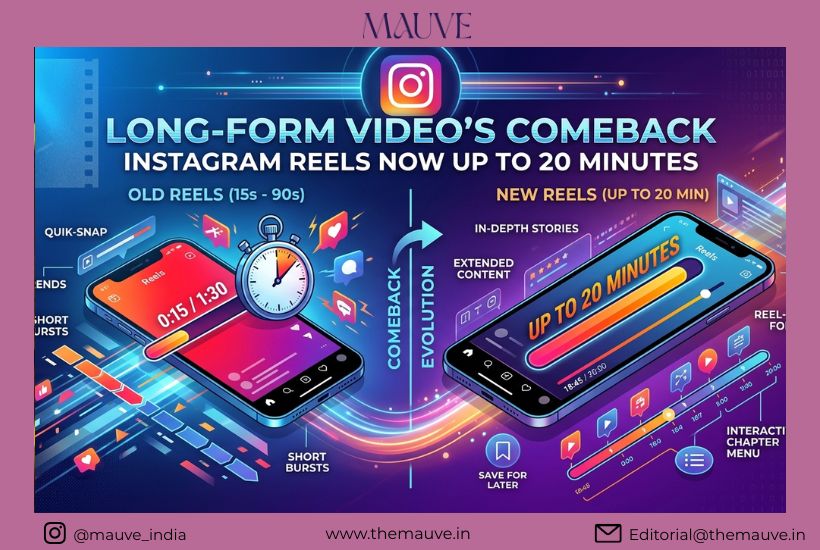
Instagram built its identity on the fleeting scroll — Stories, 15-second clips, and the dopamine hit of the endless feed. So why is it now opening the door to 20-minute Reels? And what does that mean for creators, marketers, and the future of content?
From 15 Seconds to 20 Minutes: What Just Happened?
Not long ago, Instagram’s entire content philosophy could be summarised in one word: brevity. Stories vanished in 24 hours. Reels were designed to be watched, rewatched, and scrolled past in a matter of seconds. The platform’s algorithm rewarded virality, not depth. And that worked — for a while.
But 2026 has brought a striking shift. Instagram has quietly extended Reels to a maximum of 20 minutes, a move that has sent ripples across the creator economy. What was once a feature that defined short-form video is now stepping boldly into territory that YouTube has owned for over two decades.
This isn’t just a feature update. It’s a statement of intent — that Instagram believes audiences are ready to commit, to slow down, to watch something with a beginning, a middle, and an end.
The Instagram vs. YouTube Question
The most obvious conversation this move sparks is the comparison with YouTube. For years, YouTube has been the undisputed home of long-form video — tutorials, documentaries, vlogs, deep dives, and hour-long podcasts. Its creators built loyal audiences precisely because the platform allowed them the time to tell a proper story.
Instagram, by contrast, built its empire on the visual quick hit. A perfectly composed photo. A 30-second Reel that stops the thumb mid-scroll. The platform’s DNA was always about immediacy and aesthetics over depth.
So is Instagram now trying to be YouTube? The answer is nuanced. With 20-minute Reels, Instagram isn’t necessarily abandoning short-form — it’s expanding the canvas. But the move does put it in direct competition with YouTube for creator time, audience attention, and advertising revenue. Creators who once had to choose between platforms may now face a harder decision: stay exclusive to YouTube’s established long-form ecosystem, or experiment with Instagram’s newer, but vastly different, long-form offering.
The key difference remains the audience intent. People open YouTube to watch something — they’ve made a decision before they press play. Instagram users, more often than not, are browsing, discovering, and being surprised. Getting that audience to commit to 20 minutes of content on a platform built for passive discovery is the central challenge — and the central opportunity.
| “Instagram was launched for stories and short-form videos. IG should not copy the USP of YouTube — IG should focus on what they are specialised in.” — Prakhar Agrawal | Founder, GO-TO Friend |
It’s a sentiment that many in the creator community quietly share. Instagram’s power was always its ability to serve the moment — to capture something raw, beautiful, or funny and put it in front of millions instantly. There’s a real risk that chasing YouTube’s long-form format dilutes that magic rather than enhancing it.
The worry isn’t just philosophical. It’s practical. If creators start uploading 20-minute Reels, does the algorithm know how to surface them to the right audience? Does Instagram’s interface — designed for rapid consumption — make sitting through a 20-minute video feel comfortable? These are questions the platform will need to answer through experience and iteration.
How Audiences Are Evolving
Yet to dismiss this shift entirely would be to ignore a broader cultural truth: audiences are changing. The post-pandemic digital landscape has seen a curious reversal. After years of shrinking attention spans and viral 15-second clips, there are growing signs that people are hungry for more — more context, more depth, more connection with the creators they follow.
Much of the conversation around social media has centred on the so-called death of the attention span — the idea that years of short-form content have rewired audiences to be incapable of sitting still. But psychologists are beginning to challenge that narrative. The question, they argue, isn’t whether attention spans have grown; it’s whether the content is good enough to hold them.
| “People’s attention spans haven’t increased; their tolerance for irrelevant content has decreased. If the content is good, they’ll stay for 20 minutes. If it’s not, they’ll scroll in 2 seconds.” — Shreya Chawla | Psychologist |
It’s a reframing that puts the responsibility squarely on the creator, not the audience. Instagram’s 20-minute Reel isn’t a gamble on people becoming more patient — it’s a bet that quality content will always command attention, regardless of platform or format.
Podcast listenership is at an all-time high. YouTube’s most-watched content includes three-hour interview formats. Newsletter platforms like Substack are booming. The data increasingly suggests that short-form and long-form aren’t at war — they serve different emotional needs, and audiences want both.
Instagram’s 20-minute Reels move is, in part, a response to this reality. It’s an acknowledgement that the platform’s users — particularly Gen Z and Millennials — are maturing in their content habits. They’ll still consume short-form by the thousands. But they’re also willing to invest 20 minutes if the content earns it.
| “Instagram’s move to 20-minute Reels proves that content consumption is evolving. Audiences still love short-form content, but they’re increasingly willing to spend more time on stories, insights, and valuable conversations. The future isn’t short-form vs long-form — it’s creating content worth watching, regardless of length.” — Ishani Sharma | HR, My Content Cafe |
Sharma’s framing cuts to the heart of the debate. The binary of short vs. long was always a false one — what matters is value. A 90-second video that wastes your time feels longer than a 15-minute video that teaches you something genuinely useful. The platform’s job is to surface content worth watching; the creator’s job is to make it.
What This Means for Creators
For creators, the 20-minute Reel opens a door that wasn’t there before — but walking through it requires a different skill set entirely.
Short-form content rewards hooks, energy, and pacing. The first second needs to stop the scroll; the next ten need to build enough intrigue to prevent the skip. Long-form content rewards structure, storytelling, and sustained engagement. You need to know how to open, how to build, and how to pay off what you’ve promised. These are different crafts, and not every short-form creator will make the transition smoothly.
For those who can, however, the opportunity is significant. Long-form allows for deeper audience relationships, more substantial brand partnerships, and the kind of authoritative content that builds a creator’s reputation over time. It’s the difference between going viral and building trust.
There’s also the question of monetisation. Instagram has historically lagged behind YouTube in creator revenue programmes. If the platform expects creators to invest more time in 20-minute productions, it will need to offer a compelling financial reason to do so. Creator funds, ad revenue sharing, and brand deal facilitation will all be under scrutiny as this feature rolls out more widely.
The Broader Picture: A Platform in Transition
Zoom out, and Instagram’s move to 20-minute Reels is part of a larger pattern of platform convergence. TikTok has extended video lengths. YouTube has doubled down on Shorts. LinkedIn has embraced video in ways that would have seemed absurd five years ago. Every major platform is trying to be everywhere at once — to own every minute of a user’s attention, regardless of the format.
The risk, as Prakhar Agrawal points out, is that in trying to do everything, a platform stops doing anything particularly well. Specialisation built Instagram’s identity. The question now is whether expansion will strengthen or blur it.
For brands and marketers, the answer is likely measured optimism. The 20-minute Reel creates new opportunities for branded content, documentary-style storytelling, and deeper audience engagement — all things that short-form simply cannot accommodate. But those opportunities will only be realised by creators and brands who approach long-form with the respect and craft it demands.
The Verdict
Instagram’s expansion into 20-minute Reels is not the death of short-form. It is not Instagram becoming YouTube. It is, more accurately, a growing-up — a platform acknowledging that its audience and its ambitions have outgrown the 60-second format.
The future of content is not a single length or a single platform. It’s a spectrum, from the 7-second hook to the 2-hour documentary — and the creators, brands, and platforms that understand how to serve every point on that spectrum will be the ones who thrive.
Whether Instagram can make a 20-minute Reel feel as natural and compelling as a 20-minute YouTube video remains to be seen. But the fact that it’s trying tells you everything about where the industry is headed.
Content worth watching will always find its audience — regardless of length.

 Beşiktaş Termal Kamera ile Su Kaçağı Tespiti says: