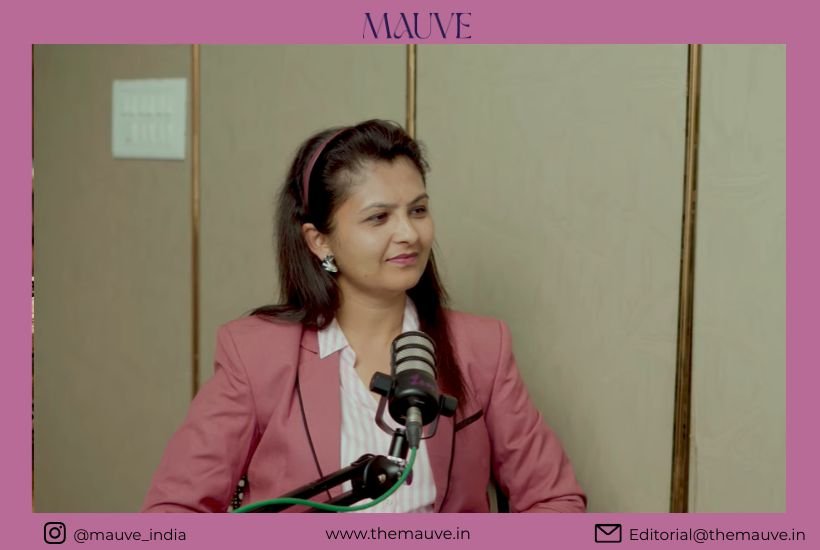
In an episode of Mauve’s Happened Over Coffee, host Priya Lalwani sits down with Dr. Shilpee Lunia, a Women’s Health Physiotherapist with over 12 years of experience, for an important conversation about postpartum recovery, core health, pelvic floor rehabilitation and why new mothers need healing not pressure to “bounce back.”
There is a phrase that has become almost synonymous with motherhood: bounce back.
Lose the weight.
Get your old body back.
Return to work.
Get back to your routine.
Keep up with everyone else.
But somewhere between the photographs of new mothers looking “back to normal” and the pressure to resume life as quickly as possible, an important question often gets forgotten:
What if the body doesn’t need to bounce back? What if it needs to heal first?
That is the conversation Dr. Shilpee Lunia brings to the forefront in an episode of Happened Over Coffee, Mauve’s coffee session series hosted by Priya Lalwani, founder of Mauve.
With more than 12 years of experience in women’s health physiotherapy, Dr. Lunia looks beyond the aesthetics of postpartum recovery to discuss what actually happens to a woman’s body during pregnancy and childbirth and why recovery should be treated as an essential part of the journey rather than an optional extra.
Recovery Is Not About Getting Your Old Body Back
Postpartum recovery is often reduced to one question: How quickly can I lose the pregnancy weight?
But according to Dr. Lunia, that is only a fraction of the story.
Pregnancy and childbirth can affect the core, pelvic floor, posture, strength and stamina. A woman may look perfectly fine from the outside while still struggling with pain, weakness or reduced function.
Recovery, therefore, isn’t simply about appearance.
It is about rebuilding the body’s capacity.
“Recovery is just as important as pregnancy.”
Pregnancy receives months of preparation, medical appointments and attention.
Postpartum recovery deserves that same seriousness.
“Normal After Delivery” Doesn’t Always Mean Normal
One of the biggest problems Dr. Lunia addresses is the tendency to normalise discomfort after childbirth.
Back pain?
“It happens after pregnancy.”
Pelvic floor weakness?
“That’s normal after delivery.”
Difficulty controlling certain movements?
“Give it some time.”
But accepting something as common does not necessarily make it healthy.
Women often ignore these symptoms because they believe motherhood simply comes with discomfort.
And in doing so, they may delay getting the support they need.
The postpartum period is a time of enormous physical change. Pain, weakness or functional difficulties deserve attention rather than dismissal.
A Gym Workout Isn’t the Same as Rehabilitation
Another important distinction in the conversation is between fitness and rehabilitation.
Going to the gym can be an excellent way to become fitter.
But postpartum rehabilitation has a different objective.
The goal initially may be to heal, restore function and gradually rebuild strength.
That requires understanding what the body has been through and progressing in a controlled way.
Dr. Lunia explains why immediately returning to intense workouts can be counterproductive, particularly when the core has not yet recovered.
The question isn’t simply:
“Can I exercise?”
It is:
“What does my body need at this stage of recovery?”
That shift in mindset can make all the difference.
The Core Is More Than a Flat Stomach
The obsession with the postpartum belly often leads women towards aggressive abdominal workouts and fat-loss routines.
But Dr. Lunia points out that what looks like a “belly fat” problem may sometimes involve weakened or separated abdominal muscles.
This is particularly relevant when discussing diastasis recti, a separation of the abdominal muscles that can occur during pregnancy.
“They go for reducing their belly fat, whereas truth is belly fat has nothing to do with it; it is loose muscles.”
The solution, therefore, isn’t necessarily doing more crunches or trying to lose more weight.
It can require proper assessment and targeted rehabilitation.
The larger message is important: what you see in the mirror does not always tell you what is happening underneath.
Diastasis Recti Needs Understanding, Not Guesswork
Diastasis recti is one of the areas where postpartum misinformation can become particularly confusing.
A woman may notice a change in the shape of her abdomen and immediately assume she simply needs to lose weight.
But the issue can be more complex.
The abdominal wall has undergone significant stretching during pregnancy, and recovery may require specific exercises and professional guidance rather than generic fitness routines.
This is why postpartum rehabilitation needs to be individualised.
There is no universal “six-week workout” that can account for every woman’s pregnancy, delivery, body and recovery.
Healing the Body Can Change the Mind
The physical side of postpartum recovery is only one part of the story.
There is also the emotional weight.
A woman may be dealing with pain while simultaneously feeling guilty for not being able to return to her previous routine.
She may compare herself to other mothers.
She may feel frustrated by changes in her body.
And she may believe she should be doing more.
Dr. Lunia connects physical rehabilitation with mental well-being, confidence and a woman’s ability to feel comfortable in her own body again.
Recovery is not a sign that a woman is falling behind.
Recovery is the work.
The Pressure to Be Everything, Immediately
Modern motherhood often comes with an impossible checklist.
Be a good mother.
Take care of the family.
Return to work.
Look good.
Lose weight.
Exercise.
Socialise.
And somehow remain completely unaffected by everything your body has just experienced.
Dr. Lunia offers a different perspective: mothers need permission to take time for themselves.
“Give yourself a little time. You will automatically be able to work better for others.”
There is no selfishness in recovery.
Taking care of yourself is not taking time away from your family.
It is part of being able to show up for them.
“Heal First, Then Hustle”
Perhaps the simplest way to understand Dr. Lunia’s philosophy comes down to four words:
“Heal first, then hustle.”
In a culture that celebrates productivity, the idea of slowing down can feel uncomfortable.
But the postpartum body is not a productivity project.
It is a body that has experienced an extraordinary physical transformation.
Healing requires patience.
Strength needs to be rebuilt.
The core needs to be understood.
The pelvic floor needs attention.
And confidence needs time to return.
There is no prize for rushing through recovery.
Moving Beyond the “Bounce Back” Culture
The idea of “bouncing back” creates an unrealistic expectation that the ideal postpartum woman should look as though pregnancy never happened.
But perhaps the goal shouldn’t be to return to the exact body that existed before.
Perhaps it should be to build a body that is strong, functional and confident now.
That distinction is powerful.
Because recovery isn’t about erasing motherhood from the body.
It is about helping the body adapt, heal and become strong again.
A New Definition of Postpartum Strength
Dr. Lunia’s conversation with Priya Lalwani ultimately asks us to reconsider what strength looks like after childbirth.
Strength isn’t rushing back to the gym.
It isn’t hiding pain.
It isn’t starving yourself to lose weight.
It isn’t comparing your recovery timeline with someone else’s.
Sometimes strength is asking for help.
Sometimes it is resting.
Sometimes it is beginning with small, controlled movements.
And sometimes, it is simply accepting that healing takes time.
Postpartum recovery deserves to be seen as a phase of healthcare not a race towards an aesthetic ideal.
Because a mother doesn’t need to “bounce back.”
She needs the opportunity to move forward, stronger and healthier.
And perhaps the most important reminder from Dr. Shilpee Lunia’s conversation is one every new mother deserves to hear:
You don’t have to rush your recovery to prove that you are strong.
This conversation with Dr. Shilpee Lunia, Women’s Health Physiotherapist, is featured on Mauve’s Happened Over Coffee, hosted by Priya Lalwani, founder of Mauve.