
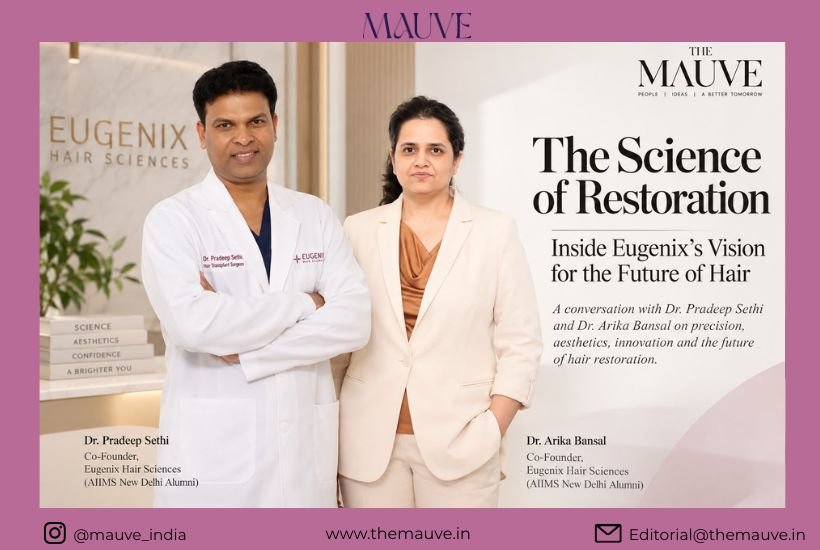
Inside Eugenix’s Vision for the Future of Hair
For Eugenix founders Dr. Pradeep Sethi and Dr. Arika Bansal, hair restoration is not simply about replacing what has been lost. It is about understanding individuality, respecting biology and creating results that become almost invisible. As the category evolves through technology, artificial intelligence and greater patient awareness, the founders share their philosophy on precision, artistry, leadership and the future of restoration.
In an interaction with Mauve, Dr. Pradeep Sethi and Dr. Arika Bansal shared their views on the evolving science of hair restoration, the importance of natural-looking results and the role of technology, artistry and patient trust in shaping the future of the field.
Hair loss is rarely just about hair.
For many, it intersects with identity, confidence, ageing and the way they perceive themselves. A changing hairline can alter how someone sees their reflection, how they appear on camera, how they carry themselves professionally or simply how comfortable they feel in their own skin.
It is this understanding that sits at the heart of Eugenix, founded by Dr. Pradeep Sethi and Dr. Arika Bansal.
There was no single dramatic moment that led to its creation. Instead, Dr. Pradeep describes a gradual realisation that hair restoration deserved greater medical rigour, precision and innovation. Dr. Arika’s motivation came from the patients themselves — witnessing how profoundly hair loss could affect confidence, alongside the fear created by unnatural restoration results.
Together, they envisioned a practice where transplantation would be treated not merely as surgery, but as an intersection of science, aesthetics, individuality and trust.
When Restoration Becomes an Art
One of the most persistent misconceptions surrounding hair transplantation is that a successful procedure should visibly look like a procedure.
For Dr. Pradeep, the opposite is true.
The ultimate achievement is a restoration that does not announce itself — one where the hairline, direction and density integrate so naturally with the individual’s facial structure, age and anticipated future hair loss that the intervention becomes almost imperceptible.
“A hairline is not a straight border,” is the philosophy underpinning this approach.
The distinction is important. Hair restoration is not simply about adding maximum density. It is about making intelligent decisions with a finite biological resource.
Dr. Arika describes every graft as having value. The donor area is limited, which means planning has to extend beyond the immediate result and account for the patient’s future.
The objective, therefore, is not simply more hair. It is the right hair, in the right direction, at the right density, distributed with an understanding of how the individual will age.
The Eugenix Philosophy: Precision, Speed, Punctuality and Kaizen
The philosophy behind Eugenix draws inspiration from the teachings of Yogi Paramahansa Yogananda, alongside four principles that continue to influence the organisation: Punctuality, Precision, Speed and Kaizen.
For Dr. Pradeep, these are not merely operational principles.
Precision means respecting every graft and every decision. Speed means moving with purpose rather than compromising care. Punctuality reflects respect for the patient’s time. And Kaizen — the philosophy of continuous improvement — means never treating an established process as the final version of what is possible.
That mindset has encouraged Eugenix to continually question accepted practices and explore how technology, research, training and clinical systems can improve outcomes.
It also reflects a larger belief: science creates the foundation, but artistry creates the magic.
For Dr. Arika, Kaizen also has a deeply human dimension. Every patient is different, and every patient’s expectations, concerns and emotional journey require attention.
The procedure may be clinical, but the experience is deeply personal.
Beyond “More Hair”
The modern hair-restoration patient is changing.
Age and gender alone no longer adequately explain why people seek treatment. For a younger patient, hair loss may intersect with identity, social confidence and professional presence. For someone experiencing hair loss later in life, restoration may be connected to ageing and the desire to look more refreshed or reconnect with an earlier sense of self.
But across these different motivations, the underlying desire can be remarkably similar.
Patients often want to feel like themselves again.
Today’s patients are also more informed. They arrive with questions, references and expectations shaped by greater access to information.
Dr. Arika sees this as an opportunity rather than a challenge. Greater awareness creates a greater responsibility for doctors to educate patients, understand the motivation behind their decisions and establish what constitutes a realistic outcome.
Choosing Expertise Over the Cheapest Option
As hair restoration becomes increasingly accessible, patients are confronted with an expanding number of clinics, techniques and treatment choices.
For Eugenix, the decision should extend beyond price.
Hair restoration is a long-term investment involving a finite donor supply. A decision made purely on cost can have consequences that extend far beyond the initial procedure.
For Dr. Pradeep, the philosophy remains straightforward:
“Do it once, do it right.”
The differentiation, he believes, lies not simply in a particular technique, but in the depth of expertise, discipline of execution and thinking behind every decision.
Dr. Arika similarly points to something that is harder to replicate: clinical judgement and aesthetic sensibility.
Technology and techniques can increasingly be adopted across the industry. The ability to understand what will look natural on a particular person — today and years from now — requires a different kind of expertise.
The Next Chapter: AI, Robotics and Regenerative Science
The future of hair restoration is likely to become increasingly technology-enabled.
Dr. Pradeep points to AI already being incorporated into Eugenix’s training modules and anticipates robotic assistance becoming part of surgical practice as the technology matures.
But technology, in his view, remains an enabler rather than a replacement for the surgeon.
Robotics may contribute to efficiency and consistency, while AI and advanced imaging can strengthen diagnosis and planning. Yet the final outcome still depends on human judgement, precision and aesthetic understanding.
Dr. Arika anticipates an industry that becomes increasingly evidence-driven, regulated and data-enabled, with AI, advanced imaging and regenerative therapies potentially broadening the ways in which hair loss can be managed.
Regulation will form another important part of this evolution, particularly around qualifications, infrastructure, transparency and patient safety.
From Doctors to Institution Builders
The growth of Eugenix has also transformed the roles of its founders.
Dr. Pradeep’s journey has moved from focusing primarily on individual procedures to building an institution capable of delivering consistent standards of excellence at scale.
For him, leadership is deeply connected to service.
His belief that every patient is an opportunity to serve has shaped his approach to building systems, developing people and embedding the founding philosophy throughout the organisation.
Dr. Arika describes a similar evolution — from being individual practitioners to becoming custodians of the patient experience and the culture they have created.
As the organisation has grown across cities, the challenge has been to ensure that scale does not make healthcare impersonal.
Growing Without Losing the Human Connection
Perhaps the most revealing part of the Eugenix story is that its greatest challenge has not simply been technological or surgical.
It has been growth.
Building a multi-city medical organisation introduces complexity. Systems become essential. Teams become larger. Processes need to be standardised.
But healthcare cannot become entirely standardised because patients cannot.
Each person arrives with a different story, expectation and understanding of confidence.
For Dr. Arika, this has reinforced the importance of listening — to patients, colleagues and the changing needs of the industry.
For Dr. Pradeep, it has strengthened the role of Kaizen: growth should bring complexity, but it should also create opportunities to build stronger systems, develop talent and continuously raise standards.
The Future of Restoration Is Personal
The conversation around hair restoration is gradually moving beyond the question of “How much hair can be restored?”
The more meaningful questions are becoming:
Will it look natural?
Will it work with my facial structure?
Will it remain appropriate as I age?
Will I feel like myself again?
And perhaps most importantly, can the procedure respect both the biology of the donor area and the individuality of the person?
For Eugenix, the answer begins with a philosophy that combines medical discipline with aesthetics, continuous learning with technology, and surgical precision with an understanding of human confidence.
Because ultimately, restoration is not about creating someone new.
It is about helping someone recognise themselves again.
THE MAUVE TAKE
The future of hair restoration may be increasingly technological, but the principles at its core remain remarkably human: precision, trust, individuality and the ability to listen.
Eugenix’s journey offers a perspective on what happens when a medical practice chooses to specialise deeply, question established methods and continuously refine its craft — while keeping the patient at the centre of every decision.
For Dr. Pradeep Sethi and Dr. Arika Bansal, the philosophy remains simple: do it once, do it right — and never stop finding ways to do it better.