
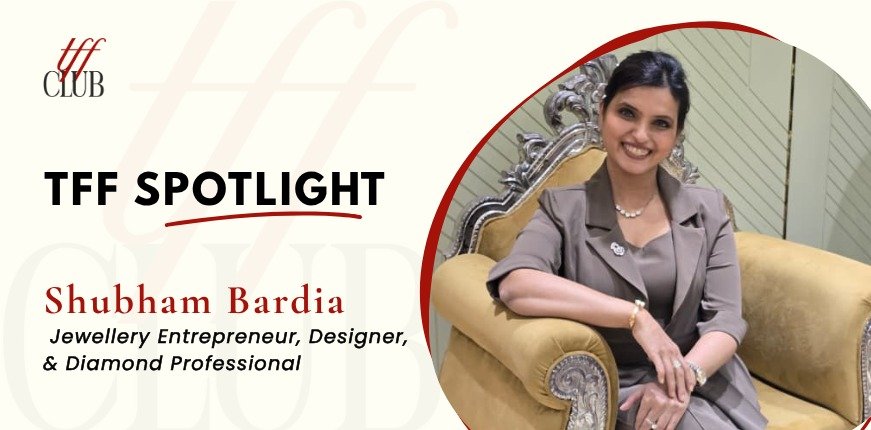
Because permission was never something she was going to wait for.
There is a moment many women in male-dominated industries quietly face.
Walking into a room to do business and realising there’s no one who looks like them already doing it. Being mistaken for someone else’s assistant, or simply overlooked, because the space wasn’t built with them in mind.
The industry doesn’t say it outright, but the message is clear:
“This isn’t really a place for you.”
For Shubham Bardia, that message was never going to be the final word.
A jewellery entrepreneur, designer, and diamond professional, she started her business in 2005 with ₹60,000. Today, alongside her work with the family business, Anopchand Tilokchand Jewellers, she runs Reya, a 9K gold diamond jewellery line built for everyday wear, not just for the locker.
Her work begins where most women in this industry are told to stop.
The Problem Was Never Just Design
The challenge wasn’t creating beautiful jewellery.
It was entering a part of the business almost no woman had entered before.
For years, diamond sourcing and trading remained entirely male territory. Women existed in the industry as designers or salaried professionals, but not as buyers walking into the market themselves.
When Shubham started doing exactly that, she couldn’t find a single other woman doing the same.
She chose not to accept that absence as permanent.
Instead of staying in the parts of the business considered acceptable for women, she moved into sourcing, trading, and manufacturing—spaces that hadn’t been built to include her.
Building Expertise as the Answer to Being Underestimated
There was no goodwill waiting for her in that market.
Being young and a woman meant being underestimated by default. People weren’t used to seeing women operate independently in buying and trading, and that unfamiliarity showed up as doubt, sometimes openly, in an environment that remains difficult even now.
Her response was knowledge, not confrontation.
She learned the business thoroughly, building real expertise in diamonds, sourcing, and trading, until she was recognised not just as a designer, but as a knowledgeable diamond professional in her own right.
She didn’t ask the industry to make space for her.
She built the expertise that made the space impossible to deny.
Finding the Space Between Locked Away and Lived In
Among the pieces she has designed, one belief keeps showing up.
Jewellery was traditionally treated as something to protect, not to wear.
Very few brands questioned why fine jewellery had to stay locked in a safe rather than part of everyday life.
That question became the foundation of Reya.
She designed it to be fluid and personal, jewellery women could wear daily, mix, stack, and style in different ways, rather than saving for occasions that rarely come often enough.
The result isn’t simply a new product line.
It’s a shift in how jewellery is used.
Pieces that once stayed locked away start becoming part of how women dress every single day.
Innovating Beyond the Expected, One Idea at a Time
Recognition in this industry doesn’t only come from design awards.
Sometimes it comes from responding to a moment no one else thought to address.
Alongside Reya, she created Zevaari, an interchangeable jewellery concept praised for its innovation and practicality, and during COVID, a Corona preventive pendant that earned appreciation from Anandiben Patel, then Governor of Uttar Pradesh.
The impact isn’t only in the pieces themselves.
It’s an industry recognising ideas it didn’t expect from her.
It’s innovation showing up in moments other designers weren’t addressing at all.
It’s a body of work that keeps expanding what her role in this industry is allowed to look like.
Finding Community Through TFF
Operating in a space with almost no other women in it can feel isolating, even after two decades of proving herself.
For Shubham, being part of The Female Founders (TFF) introduced her to women building meaningful things across entirely different industries.
She found value in hearing different stories, realising that every woman is navigating her own version of the same resistance, while still trying to create something meaningful.
Communities like TFF matter because they turn individual persistence into shared encouragement.
Sometimes what keeps a founder going isn’t more strategy.
It’s watching other women dream bigger, and being reminded to do the same.
The Mauve Take
Industries like diamond trading have long operated on the quiet assumption that some rooms simply aren’t built for women.
The problem with that assumption is it was never based on capability, only on unfamiliarity.
Shubham Bardia is challenging that belief.
Not by asking to be let in, but by walking in anyway, building real expertise, and creating brands that reflect a vision the industry hadn’t considered until she brought it in herself.
Being underestimated was never a reason to step back.
An empty room was never proof she didn’t belong in it.
And building a path outside the expected one should never be treated as a lesser kind of achievement.
Founder’s Note
“If you have an idea and you believe in it, just go for it. Don’t spend too much time thinking about the restrictions, what people will say, or whether the environment is made for you. You are stronger and more capable than you think. Learn, keep improving yourself, surround yourself with the right people, and don’t be afraid to enter spaces where you don’t see many women. Believe in yourself, especially when others don’t yet see what you see. You don’t need to wait for permission to build the life or business you want. Just take the first step.” — Shubham Bardia