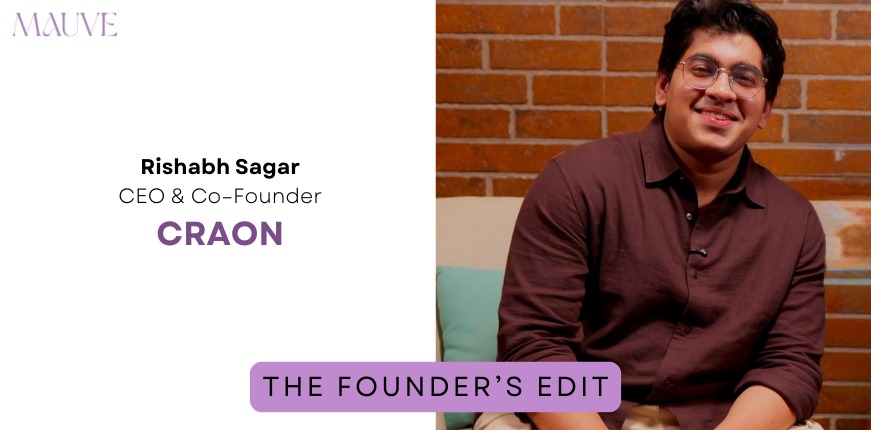
For Mauve’s The Founder’s Edit, Rishabh Sagar, CEO & Co-Founder of CRAON, shares the vision behind transforming video editing through AI, the lessons learned while building a creator-first company, and what the next chapter of the creator economy looks like.
By Journalist Priya Lalwani
Artificial intelligence has changed the way the world creates. Images are generated in seconds, scripts are written with a prompt, and videos can be produced faster than ever before. Yet, according to Rishabh Sagar, one crucial part of the creative process has remained surprisingly unchanged: editing.
After years of working with video, Sagar found himself returning to the same question. “Why is editing still so hard?” Cameras had evolved. AI had become remarkably capable. But creators were still spending countless hours navigating complex timelines and repetitive workflows. It wasn’t content creation that had become the bottleneck—it was everything that happened afterwards.
That realisation became the foundation of CRAON, an AI-powered platform built to simplify the editing process without compromising creativity.
Unlike many AI companies racing to introduce the latest feature, CRAON was born from a more practical observation. Sagar recognised that while the industry was focused on generating content, very few companies were solving the everyday problems faced by creators who consistently publish videos. Rather than asking what artificial intelligence could do, he chose to ask what creators actually needed.
Building the company demanded the sacrifices familiar to most entrepreneurs. Financial stability gave way to uncertainty, weekends disappeared, and personal time became a luxury. Yet one thing remained non-negotiable: the product vision.
Sagar believes it would have been easy to launch another AI editing tool by replicating what already existed. Instead, the team deliberately chose the harder path—building a product that genuinely removes friction from the creative process rather than simply adding another layer of automation.
That philosophy continues to influence every strategic decision inside the company. Before any feature is built, the team asks a single question: Does this genuinely save creators time while improving quality? If the answer is no, the idea doesn’t move forward.
In a marketplace crowded with AI products promising efficiency, CRAON positions itself differently. Sagar doesn’t describe it as another editing application. Instead, he sees it as the easiest way to transform raw footage into a finished story.
The distinction matters.
For him, automation alone isn’t innovation. The real value lies in making professional editing feel accessible through natural conversation, allowing creators to spend less time learning software and more time refining ideas.
Despite widespread fears surrounding artificial intelligence, Sagar remains optimistic about its relationship with creativity. He believes one of the industry’s biggest misconceptions is that AI will eventually replace creative professionals.
Instead, he argues that creativity has never depended on technical tools alone. Storytelling, taste and emotional understanding remain uniquely human qualities. Artificial intelligence should simply remove repetitive tasks, allowing creators to focus on the work that truly requires imagination.
Listening has also become one of CRAON’s greatest competitive advantages.
Some of the company’s most significant product decisions emerged not from internal brainstorming sessions but from conversations with early users. One insight, in particular, changed the direction of the platform. Rather than requesting more editing controls or increasingly sophisticated features, creators repeatedly expressed something simpler—they wanted greater creative confidence.
That feedback ultimately shifted CRAON away from becoming another traditional timeline editor enhanced with AI. Instead, the platform evolved towards prompt-led editing, enabling creators to communicate their intentions rather than manually executing every technical step.
For Sagar, community extends beyond customer acquisition. He believes that when users actively contribute to shaping a product, they stop behaving like customers and begin acting like collaborators. That relationship, he says, creates loyalty that no marketing campaign can manufacture.
As the company grows, maintaining culture remains equally important. Sagar dismisses the idea that organisational culture can be defined through mission statements or office walls. Instead, he believes culture is reflected in what leaders consistently reward. Hiring people who genuinely care about creators, keeping decision-making close to users and protecting the original vision are priorities he considers more important than scaling at any cost.
Looking ahead, Sagar expects artificial intelligence to lower the barriers to content creation even further. More people than ever before will become creators, making attention—not production—the scarcest resource. At the same time, he anticipates greater regulatory focus around transparency, copyright and responsible AI development, believing companies that embrace responsible innovation today will be better positioned tomorrow.
Interestingly, the metric he values most isn’t revenue.
While revenue can fluctuate with pricing or marketing strategies, Sagar believes returning users reveal something far more meaningful. Every creator who comes back to edit another story signals that the product has become an integral part of their creative workflow—and, ultimately, that’s the measure of long-term success.
Reflecting on his entrepreneurial journey, Sagar admits his role has changed dramatically. Where he once managed product design, hiring and operations simultaneously, his focus today lies in providing direction, building exceptional teams and ensuring that every decision aligns with the company’s larger vision. Leadership, he has learned, isn’t about having every answer; it’s about creating an environment where talented people can produce their best work.
Perhaps his most valuable lesson, however, is also his simplest.
Technology alone doesn’t build enduring companies. Solving genuine human problems does.
For Sagar, every setback reinforced one truth: it’s far more important to build something people truly need than something that’s merely technically impressive. In an industry captivated by rapid innovation, that mindset may prove to be CRAON’s greatest advantage.