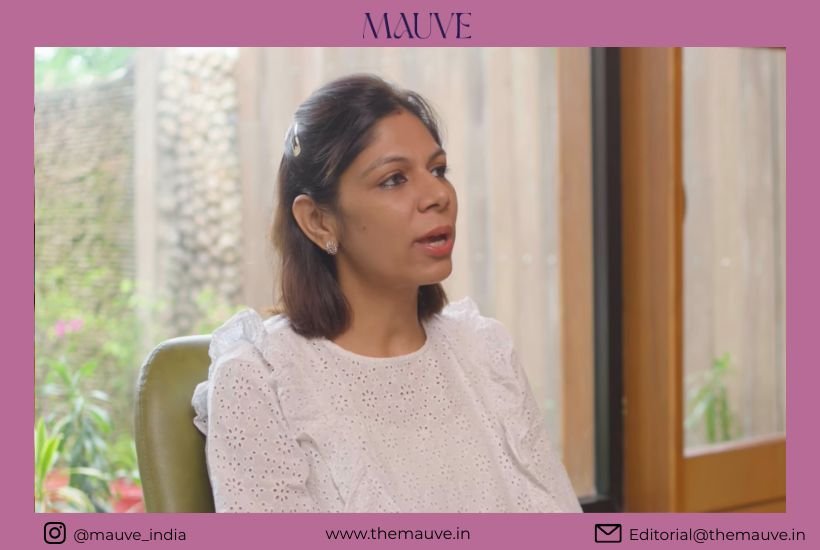
In an episode of Mauve’s Happened Over Coffee, host Priya Lalwani sits down with Dr. Kanika Mehra, a dentist based in Raipur, for a conversation about modern dentistry, patient awareness, ethical practice and why a healthy smile is about far more than how it looks.
by Khizra Khan
What makes a smile perfect?
Is it perfectly aligned teeth?
A particular shade of white?
A symmetrical set of veneers?
Or is it simply the confidence with which someone smiles?
For Dr. Kanika Mehra, the answer begins somewhere else entirely.
It begins with the person wearing the smile.
The conversation moves from aesthetics and implants to ethics, family legacy and a surprisingly important question: what happens when the internet becomes the first place we go for a diagnosis?
A Journey That Began With an All India Examination
Dr. Kanika Mehra’s professional journey began after she cleared her All India Examination in 2002.
Her career took her through different cities, including Delhi and Nagpur, before eventually bringing her to Raipur, where she established her own clinic.
Over the years, dentistry itself has evolved significantly.
The profession today extends well beyond traditional dental procedures.
Aesthetic dentistry, laser treatments and implants have opened up new possibilities for both treatment and smile enhancement.
For Dr. Mehra, however, modern dentistry is not about chasing every new technology simply because it exists.
It is about understanding what the patient actually needs.
Because sometimes, the most important part of dentistry is not changing a smile.
It is helping someone feel comfortable with the smile they already have.
What Does a “Perfect Smile” Really Mean?
The idea of a perfect smile has become increasingly commercialised.
Social media feeds are filled with perfectly aligned teeth, dramatic transformations and before-and-after photographs.
But Dr. Mehra offers a different definition.
“My idea of a perfect smile is, first of all, the confidence of the person if he or she can carry it confidently, if he or she is happy in their skin.”
It is a deceptively simple thought.
A smile is not perfect because it meets an objective aesthetic standard.
It is perfect when the person behind it feels good about it.
That does not mean dental treatment is unnecessary.
If someone is unhappy with their teeth, there are modern treatments that can help.
But the goal should not always be to recreate someone else’s smile.
It should be to find the right treatment for the individual.
When Patients Become “Doctor Shoppers”
One of the more complex issues discussed in the conversation is the phenomenon of “doctor shopping.”
With multiple clinics offering different treatments and prices, patients can easily find themselves comparing costs without necessarily understanding what lies behind those differences.
Why does one treatment cost one amount at one clinic and something dramatically different at another?
The answer, Dr. Mehra explains, is not always as simple as one doctor charging more than another.
Materials differ.
Technology differs.
Experience differs.
The expertise required for a particular procedure differs.
And the quality of care can differ too.
The challenge is that patients may not always be equipped to understand these distinctions.
When healthcare is reduced to a price comparison, the cheapest option can appear to be the smartest option.
But in dentistry, as in many areas of healthcare, cost and value are not necessarily the same thing.
Dr. Mehra advocates for greater standardisation and ethical practices across the dental fraternity so that patients can make decisions based on quality and informed understanding rather than price alone.
A Family Legacy Comes With Responsibility
Dr. Mehra’s connection to medicine in Raipur is also deeply personal.
She comes from a family of established doctors and a medical legacy that stretches back decades, with a 47-year-old institute forming part of that history.
A legacy can be a privilege.
But it can also be a responsibility.
For Dr. Mehra, carrying forward that legacy means maintaining the values that created it in the first place ethical practice, quality care and putting the patient before everything else.
In an industry where technological advancements and aesthetic treatments continue to grow, that grounding becomes even more important.
Because no matter how advanced dentistry becomes, the fundamental relationship between doctor and patient remains the same.
It is built on trust.
The Google Doctor Is Not Your Doctor
Perhaps the most relevant part of the conversation for today’s digitally connected patient is Dr. Mehra’s warning about online health information.
We live in an age where symptoms can be searched within seconds.
A toothache can become a Google search.
A swelling can become a social media query.
A medication recommendation can come from a stranger online.
And suddenly, a patient believes they know what is wrong.
Dr. Mehra strongly cautions against this kind of self-diagnosis and the casual use of over-the-counter medication without professional guidance.
Her sarcasm makes the point memorable:
“I always say, if you can get the diagnosis from Google, please go ahead with the treatment also as prescribed.”
The statement is deliberately ironic.
Because knowing a list of possible symptoms is not the same as knowing what is actually happening inside a patient’s body.
Search engines can provide information.
They cannot examine you.
They cannot take your medical history.
They cannot interpret your specific condition.
And they cannot take responsibility for the treatment they suggest.
Your Health Starts With Your Mouth
The conversation also expands the discussion from dentistry to overall health.
The mouth is not an isolated part of the body.
It is connected to how we eat, digest and nourish ourselves.
As Dr. Mehra puts it:
“The health, the energy, or the vitality of a person starts from the mouth. If you can’t chew, the food is not going to digest; you are not going to be energetic.”
It is a reminder that oral health is often treated as an aesthetic concern when it is fundamentally a health concern as well.
A healthy mouth affects something as basic as the ability to eat comfortably.
And when something as basic as eating is compromised, the effects can extend beyond the teeth.
This is why dental care should not begin and end with wanting a better-looking smile.
It should also be about function, health and long-term well-being.
Treatment, Yes. Insecurity, No.
Perhaps the most beautiful takeaway from Dr. Mehra’s perspective is that seeking treatment and accepting yourself do not have to be contradictory.
Someone can want braces.
Someone can choose implants.
Someone can explore aesthetic dentistry.
Someone else may be perfectly happy with their natural teeth.
None of these choices should determine a person’s confidence or worth.
Dr. Mehra puts it simply:
“Be confident, be happy about it… If you are happy with the set of teeth you have, give a bright smile. If you are not, go for the right treatments, but learn to be happy with whatever we have been given.”
In a world that constantly tells people what needs to be fixed, this becomes an important distinction.
Treatment should be a choice not a consequence of feeling inadequate.
The New Age of Dentistry Needs Better Awareness
Dr. Kanika Mehra’s conversation with Priya Lalwani ultimately reveals that the future of dentistry is not only about better technology.
It is also about better awareness.
Patients need to understand what they are paying for.
They need to ask questions.
They need to understand that different materials and expertise can influence the cost and quality of treatment.
And perhaps most importantly, they need to know when to stop searching online and start talking to a professional.
The responsibility, however, does not rest entirely with patients.
Healthcare professionals also have a role to play in creating transparency, maintaining ethical standards and helping people make informed choices.
Because dentistry is not simply about creating beautiful smiles.
It is about protecting health.
The Perfect Smile May Simply Be a Confident One
The conversation begins with dentistry but ends somewhere much more human.
A smile does not have to be perfect by someone else’s definition.
It simply needs to belong to you.
If you are happy with your teeth, smile brightly.
If something is affecting your confidence or health, seek the right professional advice.
If you need treatment, take it for the right reasons.
And if the internet tells you that you have a rare condition because you searched one symptom at 2 a.m., perhaps close the browser before reaching for the medicine cabinet.
Because when it comes to health, information is useful.
But expertise matters.
And sometimes, the healthiest thing you can do is trust the person who has spent years learning how to care for the smile you were born with.
This conversation with Dr. Kanika Mehra, dentist and healthcare professional based in Raipur, is featured on Mauve’s Happened Over Coffee, hosted by Priya Lalwani, founder of Mauve.