
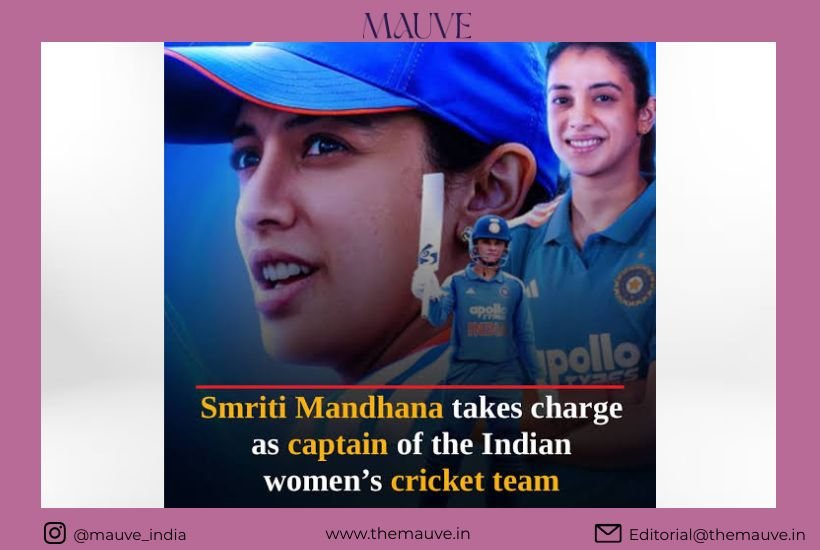
The star opener has been appointed India’s full-time white-ball captain, succeeding Harmanpreet Kaur and stepping into one of the most significant leadership roles in Indian sport.
Indian women’s cricket has entered a new chapter.
On October 6, the Board of Control for Cricket in India (BCCI) announced Smriti Mandhana as the new captain of the Indian Women’s Cricket Team, handing one of the country’s most recognisable cricketers the responsibility of leading India’s white-ball sides.
The appointment follows Harmanpreet Kaur’s decision to step down as India captain across formats, bringing an end to a significant phase of Indian women’s cricket.
For Mandhana, however, the moment represents the culmination of years of experience in the Indian dressing room and a leadership journey that has steadily developed across international, domestic and franchise cricket.
From Young International to India Captain
Mandhana has been part of the Indian team since 2013, growing from one of the country’s most promising young batters into one of its established international stars.
She has already led India on several occasions, having captained the side in 18 T20Is and four ODIs before taking on the full-time white-ball role.
Her appointment therefore does not represent an entirely unfamiliar transition. Instead, it formalises a leadership responsibility she has already experienced in flashes.
The BCCI said Mandhana’s experience and understanding of the game will be valuable as India enters its next phase.
The RCB Chapter
Mandhana’s leadership credentials have also been strengthened by her time in the Women’s Premier League.
As captain of Royal Challengers Bengaluru, she led the franchise to WPL titles in 2024 and 2026, adding franchise success to her international experience.
That combination gives her a distinctive leadership profile: an established international player who has also experienced the pressures and expectations of leading a high-profile franchise.
The move to the national captaincy now places those experiences in an entirely different context.
A Respectful Change of Guard
Mandhana’s first statement as captain also acknowledged the person whose role she is taking over.
She expressed gratitude to the BCCI, selectors, teammates and supporters, while specifically recognising Harmanpreet Kaur’s contribution as captain.
The change comes after Kaur stepped down from the leadership role following a period in which Indian women’s cricket achieved several major milestones. BCCI has formally acknowledged her contribution to the team’s journey.
The transition is therefore less about closing one story than opening another.
Kaur remains part of Indian cricket as a player, while Mandhana now takes responsibility for leading the team forward.
What Mandhana Brings to the Role
Mandhana enters the captaincy at a time when Indian women’s cricket has considerable momentum.
India recently won the 2026 Women’s Asia Cup, defeating Sri Lanka by 72 runs in the final and securing the tournament title for a record eighth time. Mandhana also surpassed Mithali Raj to become the leading run-scorer in international women’s cricket during the tournament.
The challenge for the new captain will be to translate that individual experience and team momentum into sustained performances across international cricket.
And Mandhana appears conscious of the scale of that responsibility.
“To be given the responsibility of leading India is a very special honour,” she said following her appointment, describing the opportunity to represent and lead India as something she will value deeply.
A New Era, Without Losing the Past
The symbolism of Mandhana taking over is significant.
She belongs to a generation of Indian women cricketers that grew up alongside the rapid expansion of women’s cricket — from limited television coverage and fewer professional opportunities to packed stadiums, franchise leagues and increasingly global visibility.
Now, one of the faces of that generation will lead India.
Her captaincy will inevitably be measured by results, but the significance of the appointment extends beyond the scorecard. It represents another stage in the evolution of Indian women’s cricket, where leadership is increasingly being shaped by players who have experienced the sport’s transformation firsthand.
BCCI President Mithun Manhas said the board has full confidence in Mandhana and highlighted her experience and ability to lead from the front. BCCI Honorary Secretary Devajit Saikia similarly pointed to her years with the national team and her success leading RCB in the WPL.
The Mandhana Era Begins
Every captain inherits a team shaped by the leaders who came before them.
Mandhana inherits an Indian side with significant experience, ambition and expectations — and a women’s cricket ecosystem that has expanded dramatically over the past decade.
Now, the responsibility shifts to her.
From making her international debut in 2013 to leading India more than a decade later, Smriti Mandhana’s journey mirrors the transformation of Indian women’s cricket itself.
The next chapter has her name on it.
And Indian cricket will be watching.