
By- Ms. Yogita Tulsiani, Director & Co-founder, iXceed Solutions (Global Tech-Recruiter Provider).
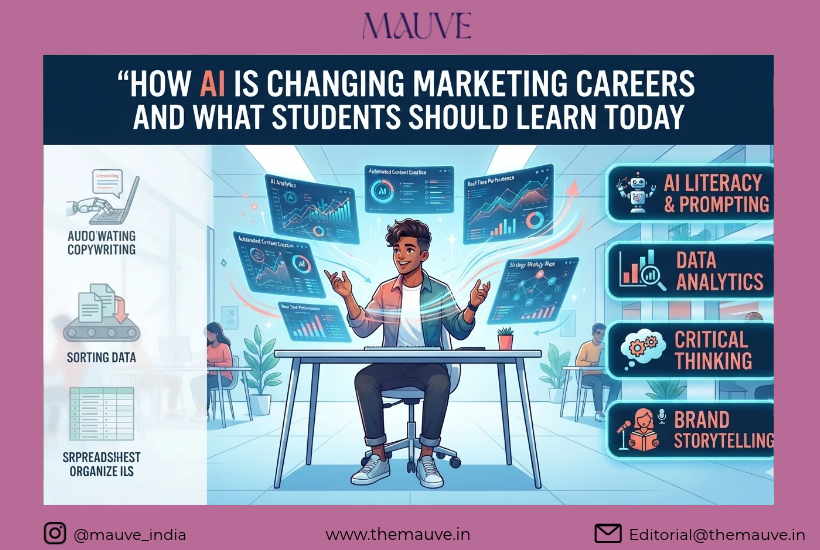
Artificial intelligence is changing how brands understand consumers, develop campaigns and measure marketing performance. Tasks that once required hours of manual research, content development and data analysis can now be completed faster with AI powered tools. For students preparing to enter the marketing industry, this shift presents both an opportunity and a challenge. While technology is changing the skills employers look for, creativity, strategic thinking and an understanding of consumer behaviour remain essential.
The role of a marketer is gradually moving beyond executing campaigns to making informed decisions, interpreting data and creating meaningful connections between brands and their audiences. Understanding this shift can help students prepare for a career in a field where technology and human judgement increasingly work together.
From Campaign Execution to Strategic Thinking
Traditionally, marketing roles involved activities such as writing promotional content, conducting market research, planning advertisements and tracking campaign performance. AI tools can now support many of these tasks by generating content ideas, identifying audience patterns, summarising research and automating repetitive processes.
This does not mean that marketing professionals are becoming less relevant. Instead, their responsibilities are evolving. Marketers must determine which insights matter, whether AI generated content is appropriate for a particular audience and how a campaign contributes to broader business objectives.
For instance, an AI tool can help a team analyse customer feedback and identify recurring concerns. However, translating those findings into a relevant campaign requires an understanding of the brand, its customers and the wider market. The ability to connect technological outputs with business decisions will therefore become increasingly valuable.
Data Literacy Is Becoming a Core Marketing Skill
Marketing decisions are increasingly influenced by data. From website traffic and customer engagement to conversion rates and purchase patterns, professionals need to understand what the numbers indicate and how they can inform strategy.
AI tools can simplify data analysis, but students still need to develop the ability to interpret results critically. This includes understanding key performance indicators, recognising patterns, asking the right questions and distinguishing meaningful insights from misleading correlations.
Students should become familiar with analytics platforms, campaign dashboards, spreadsheets and basic data visualisation. Learning how to evaluate campaign performance and communicate findings clearly can provide a practical advantage when entering the job market.
The objective is not to turn every marketing student into a data scientist. It is to help future marketers make better decisions using evidence rather than relying entirely on assumptions.
Creativity Still Matters, but Its Application Is Changing
As AI makes content generation more accessible, the ability to produce large volumes of text or images may become less of a differentiator on its own. What matters is the thinking behind the content: the idea, the audience insight, the brand voice and the relevance of the message.
Students should continue developing their writing, storytelling, design and creative problem solving skills. They should also learn to use AI as a support system for brainstorming, exploring different campaign directions and refining early drafts.
At the same time, AI generated content requires human review. It can produce generic ideas, inaccurate information or messaging that does not reflect a brand’s identity. Marketers must be able to assess quality, maintain originality and ensure that the final output meets the needs of its intended audience.
The strongest professionals will be those who combine creative judgement with the ability to use technology effectively.
Understanding Consumers Is as Important as Understanding Technology
Marketing ultimately revolves around people. Although AI can process large amounts of customer information, understanding why people make decisions involves context, empathy and cultural awareness.
Students should learn the fundamentals of consumer behaviour, audience segmentation, customer journeys, positioning and brand strategy. These concepts help marketers understand what motivates a purchase, what influences customer loyalty and how communication can address different audience needs.
They should also understand how personalisation works and where it can become intrusive. As brands use AI to deliver more targeted experiences, questions around customer consent, data privacy and responsible communication will become increasingly important.
A strong foundation in marketing principles will help students evaluate AI tools more effectively instead of relying on technology to make every decision.
Learning to Work With AI Tools
Familiarity with AI is becoming a useful addition to a marketer’s professional toolkit. Students do not need to master every new platform, but they should understand how to select tools based on the task at hand.
Practical learning can include using AI to develop campaign briefs, research competitors, organise customer feedback, generate content variations and analyse campaign results. Students should also learn prompt writing, fact checking, editing and the limitations of automated outputs.
Importantly, learning should extend beyond using tools to complete individual tasks. Students should understand how AI can fit into an end to end marketing workflow, from research and planning to execution and evaluation.
This approach builds adaptability, which is particularly important in a field where tools and working practices continue to evolve.
What Students Should Learn Before Entering the Industry
Preparing for an AI influenced marketing career requires a combination of foundational knowledge and practical experience.
First, build strong marketing fundamentals. Learn brand management, digital marketing, public relations, consumer behaviour, market research and campaign planning. Technology can support execution, but these principles provide the context for effective decisions.
Second, develop analytical skills. Understand marketing metrics, spreadsheets, customer insights and performance reporting. Being able to explain why a campaign performed well is often more valuable than simply reporting its results.
Third, become comfortable with AI tools. Experiment with content generation, research assistance, analytics and workflow automation. Focus on understanding their strengths, limitations and appropriate applications.
Fourth, strengthen communication and collaboration. Marketing professionals regularly work with creative teams, sales departments, clients and business leaders. Clear writing, presentation skills, listening and the ability to explain recommendations remain important.
Finally, gain practical experience. Students can create sample campaigns, develop brand strategies for hypothetical businesses, conduct small audience surveys or analyse publicly available campaign examples. Building a portfolio that demonstrates the problem, the approach, the use of AI and the final outcome can help communicate their capabilities to potential employers.
The Importance of Ethics and Responsible AI Use
The growing use of AI also makes ethical judgement an important part of marketing education. AI tools can generate misleading claims, reproduce biases or process information in ways that raise privacy concerns. Content may also create copyright and authenticity questions.
Students should learn to verify information, protect confidential data, disclose AI use when appropriate and follow relevant organisational policies. They should understand that speed and efficiency are not sufficient measures of success if the output compromises trust.
As consumers become more aware of how brands use technology, responsible AI practices can help protect credibility and strengthen long term relationships.
Preparing for the Future of Marketing
AI is unlikely to make marketing a purely technical profession. Instead, it is changing how marketers work, the tasks they prioritise and the capabilities they need to develop. Some activities will become increasingly automated, while the demand for people who can interpret insights, develop effective strategies and understand customers will remain important.
For students, the priority should not be to chase every new AI tool or assume that technical expertise alone will guarantee career success. It should be to build a strong foundation in marketing, develop analytical and creative thinking, gain hands on experience and learn to use AI responsibly. The future of marketing will favour professionals who can combine technological fluency with human understanding. Students who begin developing these capabilities today will be better prepared to adapt as the industry continues to evolve.




 JenniferVew says:
 Ta,Ric says: