
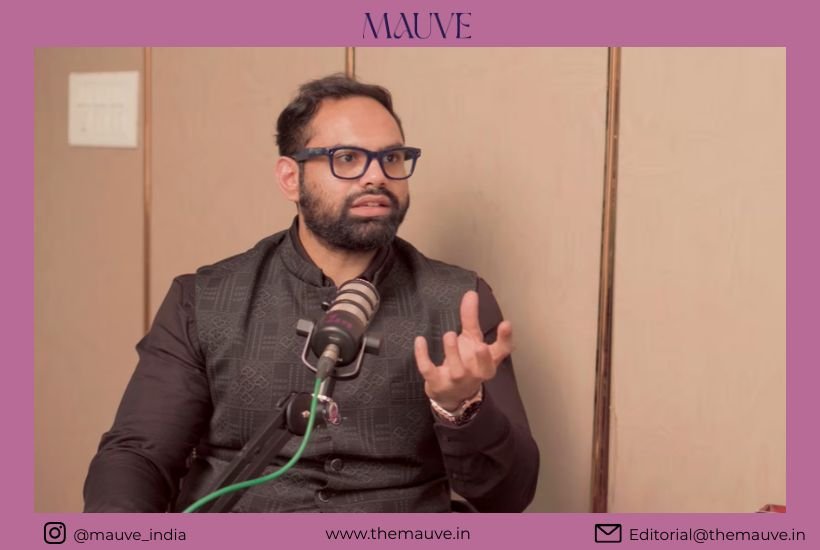
In an episode of Mauve’s Happened Over Coffee, host Priya Lalwani sits down with orthopaedic surgeon Dr. Pratik Dhabalia for an insightful conversation about joint health, knee problems, robotic knee replacement and why modern orthopaedic care is increasingly focused not just on surgery, but on helping patients return to movement.
For many people, the word knee replacement immediately brings to mind a long hospital stay, painful recovery and weeks or even months of limited movement.
And then there is another word that has entered the conversation around modern joint surgery: robotic.
But what does robotic knee replacement actually mean?
Does a robot perform the surgery?
Is it safer?
Is it suitable for everyone?
And perhaps most importantly, what happens after the operation?
These are some of the questions explored by Dr. Pratik Dhabalia in an episode of Happened Over Coffee, a coffee session series by Mauve, hosted by Priya Lalwani, founder of Mauve.
The conversation goes beyond technology to discuss something much more fundamental: how we can recognise joint problems earlier, protect our knees through everyday habits and understand what modern surgery can actually offer.
The Robot Isn’t the Surgeon
One of the biggest misconceptions surrounding robotic knee replacement is right there in the name.
People imagine a robot performing the procedure.
Dr. Dhabalia makes it clear that this isn’t how the technology works.
“Robotic surgery does not mean a robot is doing the surgery. The surgeon is in complete control; the robot helps us very precisely and accurately place the implant based on each person’s unique bone structure.”
The robot functions as a precision tool.
It helps the surgeon plan and execute the procedure with a high degree of accuracy, while allowing the surgical plan to be customised according to the patient’s individual anatomy.
Every person’s bones are different.
Every knee has its own structure.
And that means knee replacement cannot simply be treated as a one-size-fits-all procedure.
Technology, in this case, is not replacing the surgeon.
It is helping the surgeon make more precise decisions.
Precision Meets Personalisation
The real advantage of modern surgical technology lies in its ability to bring greater precision to an already highly specialised procedure.
According to Dr. Dhabalia, robotic systems can help surgeons work with millimetre-level accuracy and customise implant positioning according to a patient’s anatomy.
For patients, this distinction matters.
The goal isn’t simply to replace a damaged joint.
It is to restore function in a way that is appropriate for the individual.
That is where technology becomes meaningful not because it sounds futuristic, but because it can support more precise, personalised surgical planning.
Your Knees May Be Trying to Tell You Something
Joint problems rarely appear out of nowhere.
Often, the body gives signals long before a patient decides to seek medical attention.
Persistent pain while walking.
Difficulty climbing stairs.
Trouble sitting cross-legged.
Or even recurring popping and cracking sounds.
These symptoms do not automatically mean that someone needs surgery.
But they can be reasons to seek professional evaluation rather than simply accepting pain as a normal part of ageing or daily life.
Dr. Dhabalia encourages people not to ignore persistent symptoms.
“If you have an injury, don’t wait. People often ignore pain for years, and by the time they see a doctor, their condition has significantly worsened. Don’t let your lifestyle be limited by something that can be managed.”
The message is simple: pain deserves attention.
Not every ache requires a major intervention.
But persistent problems should not be normalised indefinitely.
The Sedentary Lifestyle Problem
Modern work has changed the way people use their bodies.
For many office workers, an entire day can pass with very little movement.
Hours at a desk.
Long commutes.
Screens.
Meetings.
And very few opportunities to stand or walk.
Dr. Dhabalia highlights sedentary behaviour and high BMI as important contributors to knee problems.
The solution does not necessarily require an extreme fitness routine.
Sometimes, it starts with something much simpler.
Move regularly.
Take breaks from prolonged sitting.
Stay physically active.
Maintain a healthy weight.
And don’t wait until pain appears before paying attention to joint health.
The body was designed to move.
And joints, like the rest of the body, benefit from regular activity.
Surgery Is Not the End of the Story
One of the most striking changes in modern orthopaedics is the approach to recovery.
Traditionally, the idea of knee replacement often came with images of prolonged bed rest.
But modern minimally invasive approaches have changed that picture considerably.
Dr. Dhabalia discusses techniques such as the subvastus approach, which can support faster mobilisation after surgery.
In appropriate cases, patients may be able to begin walking within just a few hours after the procedure.
“We don’t do surgery to keep a patient in bed for days. We do it to mobilize the patient. With modern techniques, patients are often walking within four to five hours of their procedure.”
That sentence captures a fundamental shift in surgical philosophy.
The objective isn’t simply to successfully complete the operation.
It is to help the patient get back to life.
Walking.
Moving.
Using the stairs.
Returning to daily activities.
And regaining independence.
The Fear Around Knee Replacement
Despite advances in technology and surgical techniques, fear remains one of the biggest reasons people delay treatment.
The fear of pain.
The fear of surgery.
The fear of being unable to walk normally again.
The fear that life will become more restricted after the procedure.
Some of that fear comes from outdated ideas about recovery.
Others come from stories shared by friends or family members who underwent surgery years ago, when techniques and rehabilitation protocols were different.
Dr. Dhabalia’s perspective offers a more modern understanding.
Orthopaedic surgery has evolved.
Technology has evolved.
Surgical approaches have evolved.
And recovery protocols have evolved with them.
That doesn’t mean every patient has the same experience.
It means patients should understand their individual options rather than making decisions based solely on old assumptions.
Prevention Still Matters
Technology may be transforming surgery, but Dr. Dhabalia’s message is not simply about replacing damaged knees.
It is also about protecting them.
Movement remains one of the most important parts of joint health.
For people who spend long hours sitting, regular movement breaks can make a meaningful difference.
Weight management matters too, particularly because excess body weight can place additional stress on the knees.
And perhaps most importantly, problems should be addressed before they become unnecessarily severe.
The best outcome isn’t always a better surgery.
Sometimes, it is avoiding the need for one by taking action early.
A Surgeon Is Also Carrying Trust
Behind all the technology and surgical precision is something that cannot be measured in millimetres.
Trust.
When someone agrees to undergo surgery, they are placing an enormous amount of faith in their doctor.
Dr. Dhabalia describes this responsibility beautifully:
“For the patient, it is a knee replacement, but for the surgeon, it is a responsibility. That trust is the most rewarding part of the job.”
It is a reminder that medicine is not only about procedures.
A successful outcome involves a relationship between doctor and patient built on communication, confidence and responsibility.
The patient brings their fears and expectations.
The surgeon brings expertise.
And somewhere between the two lies trust.
Don’t Let Pain Define Your Life
Perhaps the most important message from Dr. Pratik Dhabalia’s conversation with Priya Lalwani is that joint pain should not automatically be accepted as something one simply has to live with.
Getting older does not mean giving up movement.
An injury does not necessarily mean permanent limitation.
And needing surgery, when it is medically appropriate, does not necessarily mean the end of an active life.
Modern orthopaedics is increasingly focused on restoring mobility and helping people return to the activities that matter to them.
The technology may be sophisticated.
The surgical techniques may be advanced.
But the goal remains remarkably simple.
To help people move again.
The Future of Knee Care Is About Movement
The conversation ultimately brings the focus back to where it belongs: the patient’s quality of life.
Robotic technology can improve precision.
Minimally invasive techniques can support recovery.
Early medical attention can prevent problems from worsening.
And everyday movement can help protect joint health.
But none of these should be viewed in isolation.
Good orthopaedic care is about understanding the whole journey from prevention and diagnosis to treatment and rehabilitation.
Because a knee replacement is not really about replacing a knee.
It is about giving someone the opportunity to walk without fear again.
To climb the stairs.
To sit comfortably.
To return to the activities they love.
And, most importantly, to keep moving.
This conversation with orthopaedic surgeon Dr. Pratik Dhabalia is featured on Mauve’s Happened Over Coffee, hosted by Priya Lalwani, founder of Mauve.