
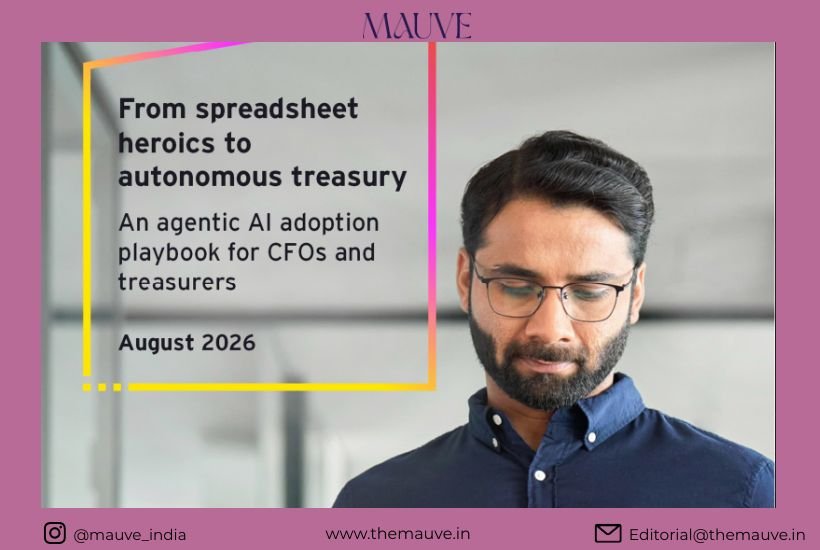
According to EY India’s latest report, ‘An Agentic AI Adoption Playbook for
CFOs and Treasurers’, treasury functions continue to spend 60%-70% of their bandwidth on manual
and low-value activities, limiting their ability to focus on strategic priorities. Forecast variance in
spreadsheet-led treasury environments often exceeds 20%, highlighting the challenges of managing
liquidity using fragmented systems and legacy processes. The report finds that agentic AI-enabled
treasury models can improve forecast accuracy to as much as 90% across 30-, 60- and 90-day
liquidity horizons, helping organizations make faster and more informed decisions.
Spreadsheets continue to dominate treasury operations
Despite significant investment in treasury technologies, spreadsheets continue to underpin critical
treasury activities across many organizations. A mature treasury function may manage between 50
and 100 interconnected spreadsheets covering cash positioning, foreign exchange exposure,
investments and regulatory reporting.
More than 50% of corporates globally continue to rely on manual reconciliation processes, creating
inefficiencies and increasing operational risk. According to the EY report, this presents a significant
opportunity for organizations to modernize treasury operations through workflow automation,
trusted data foundations and agentic AI.
Commenting on the findings, Hemal Shah, Partner, Risk Consulting, EY India, said: “Many treasury
teams continue to rely heavily on spreadsheet-based processes at a time when organizations are
seeking greater visibility, agility and control. Agentic AI presents an opportunity to move treasury
from a reactive function to a predictive and intelligent operating model. However, realizing this
potential will require strong data foundations, robust governance and clearly defined workflows.”
A clear case for treasury transformation
The report identifies workflow transformation as the critical first step in successful agentic AI
adoption. Organizations that implement digital breaks and workflow automation are already
realizing measurable outcomes, including 80%-90% auto-match rates in reconciliation processes, as
per EY India analysis. One of the most common reasons AI initiatives fail to scale in treasury
functions is the absence of a reliable and governed data architecture.
EY’s recommended approach centers on building a treasury data-lake that serves as a single source
of truth by bringing together structured and unstructured data from ERP systems, banking platforms,
contracts, emails and market information.
High-impact use cases emerge for early adoption
The EY report identifies cash forecasting, reconciliation and KYC/AML exception handling as the most
promising starting points for agentic AI adoption. Among these, cash forecasting offers the greatest
potential business impact, with AI-enabled models capable of significantly improving forecasting
accuracy and liquidity visibility. The report also finds that AI agents can manage 70%-80% of routine
KYC/AML exception cases with full auditability, enabling treasury and risk teams to focus on higher-
value activities.
The role of the Treasury Center of Excellence
To support long-term transformation, the report advocates the establishment of a Treasury Center
of Excellence (CoE), responsible for managing datalake pipelines, workflow libraries and data
governance frameworks
As treasury functions become increasingly data-driven and interconnected, organizations have an
opportunity to reimagine how liquidity, risk and operational efficiency are managed. The report
suggests that companies that combine workflow automation, trusted data foundations and strong
governance frameworks will be best positioned to realize the benefits of agentic AI and build more
resilient treasury operations
About the report
The report is informed by EY India’s work with treasury functions across manufacturing, financial services and
infrastructure organizations. The findings combine EY observations on treasury operating models, workflow
inefficiencies and emerging AI adoption practices to provide a practical roadmap for CFOs and treasurers.
About EY
EY is building a better working world by creating new value for clients, people, society, and the planet, while
building trust in capital markets. Enabled by data, AI and advanced technology, EY teams help clients shape the
future with confidence and develop answers for the most pressing issues of today and tomorrow.
EY teams work across a full spectrum of services in assurance, consulting, tax, strategy, and transactions.
Fueled by sector insights, a globally connected, multi-disciplinary network and diverse ecosystem partners, EY
teams can provide services in more than 150 countries and territories.
All in to shape the future with confidence.
EY refers to the global organization and may refer to one or more of the member firms of Ernst & Young Global
Limited, each of which is a separate legal entity. Ernst & Young Global Limited, a UK company limited by
guarantee, does not provide services to clients. Information about how EY collects and uses personal data and
a description of the rights individuals have under data protection legislation are available via ey.com/privacy.
EY member firms do not practice law where prohibited by local laws. For more information about our
organization, please visit ey.com. This news release has been issued by EYGM Limited, a member of the global
EY organization that also does not provide any services to clients.