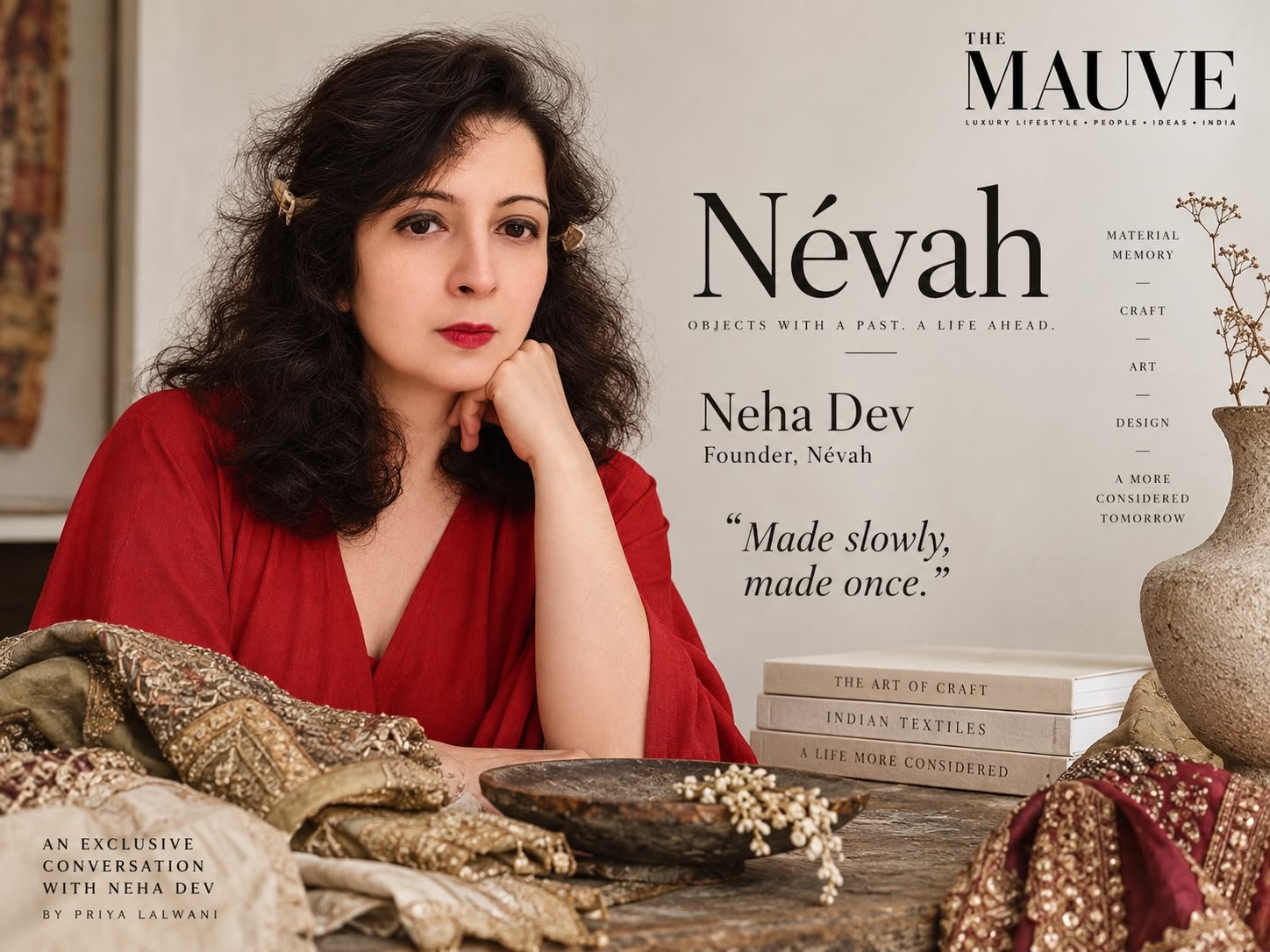
Neha Dev on one-of-one objects, the poetry of old textiles, and creating pieces designed to be lived with, not simply displayed
By Priya Lalwani | The Mauve
In an age of endless reproduction, there is something quietly radical about making something only once.
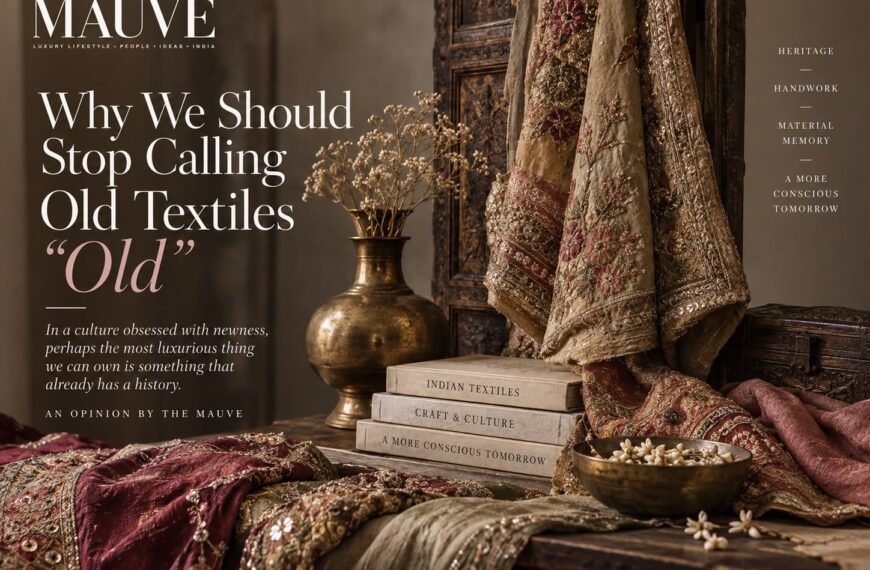
For Neha Dev, founder of Névah, the value of an object lies not in how perfectly it can be replicated, but in the traces that make it impossible to reproduce. A fragment of aged silk. An old neckline. A piece of zari. The irregularity of handwork. The softness a textile acquires with time.
These aren’t imperfections to be corrected. They are stories to be preserved.
Névah emerged from Dev’s instinctive attraction to objects, textiles and spaces. What began with one-of-a-kind handmade centrepieces gradually evolved into a broader creative practice, including Vastra, where historic textile fragments become the foundation for contemporary works.
At the heart of it all is a deceptively simple philosophy: made slowly, made once.
“I simply wanted to create objects that felt considered and personal, things that could hold a room rather than merely decorate it,” Dev says.
It is this distinction—between decoration and presence—that defines Névah.
The Beauty of the Unrepeatable
For Névah, one-of-one is not a positioning exercise. It is a consequence of the making process.
Dev does not recreate a completed work. Even when two pieces begin with similar materials or an overlapping idea, they are allowed to evolve independently. Proportions shift, compositions change and the handwork takes its own direction.
“With many of the materials I use, repetition would almost defeat their character anyway,” she explains.
The result is design that feels personal rather than manufactured. Each piece carries the circumstances of its own making, making its individuality intrinsic rather than imposed.
When Materials Remember
Perhaps the most evocative idea within Névah’s vocabulary is material memory.
Dev sees textiles not as blank surfaces, but as objects that have already lived.
“A worn piece of silk, an old neckline, a fragment of zari or handwork carries evidence of having existed somewhere before,” she says.
Rather than stripping these materials of their history in the pursuit of newness, she allows their traces to remain visible.
There is a philosophy of preservation embedded within this approach. The objective is not to make something old appear new, but to give it another life without disguising where it came from.
In Dev’s hands, an aged textile becomes neither purely archival nor conventionally contemporary. It becomes something in between: an object carrying its past into a new context.
Craft, Without the Costume of Tradition
Dev’s relationship with traditional craftsmanship is equally considered.
She is drawn to the irregularities of the human hand—the slight variation in stitching, the ageing of a surface, a bead placed individually, the way a textile changes with use.
“I love imperfection when it comes from the hand,” she says.
For Névah, craftsmanship is not an embellishment added after the design has been conceived. It is part of the design itself.
The Atelier pieces are made by Dev herself, while Vastra incorporates the skills of artisans whose individual techniques become part of the final composition.
This creates an interesting tension between authorship and collaboration. The work remains distinctly Névah, yet its identity is shaped by the people and processes involved in making it.
Letting Heritage Exist in the Present
There is no deliberate attempt to make traditional craft appear “modern” at Névah.
Dev questions the very idea that heritage and contemporary design need to be balanced against one another.
“I don’t see them that way,” she says.
An old ceremonial textile can exist naturally within a contemporary home. A piece of traditional handwork does not necessarily need to be stripped of its visual language to feel current.
Instead, Dev brings her own vocabulary of composition, restraint and form to materials that already possess their own identity.
It is a quieter approach to contemporary design—one that does not require the past to be reinvented in order to remain relevant.
Goa and the Art of Looking Longer
Goa has played a subtler role in shaping Dev’s practice.
Rather than influencing the aesthetic of Névah in an obvious, geographic sense, the place has influenced her relationship with time.
“Goa gave me space to look longer,” she says.
The changing light, weathered materials, layered homes and slower rhythm of life have encouraged a greater sense of restraint.
“I’ve become less interested in filling every surface or every idea,” Dev explains. “There is more restraint now, more trust in leaving something unfinished enough to breathe.”
That sentiment perhaps explains the quietness of Névah itself. The pieces do not appear designed to demand attention. They invite it.
Somewhere Between Art and Design
Névah does not sit comfortably inside a single category—and Dev prefers it that way.
Vastra carries the memory of clothing and adornment, yet it is not fashion. The Atelier pieces can inhabit a table or a room, but they are not simply décor.
The brand exists somewhere between art and design, with function, memory and materiality overlapping.
“I like that Névah can move between those definitions,” Dev says.
That fluidity also allows the work to resist the pressure of belonging to a particular trend or design movement.
Beyond the Idea of Luxury
The language of collectible design can often become intertwined with rarity, exclusivity and price.
For Dev, however, collectibility is more emotional than commercial.
“A collectible should deepen with time rather than become irrelevant when the next trend arrives,” she says.
The true measure of a collectible, in her view, is whether someone wants to keep it—not because it is difficult to acquire, but because it has developed meaning.
It is the difference between owning an object and forming a relationship with one.
“I hope they stop noticing it as something newly purchased and begin to think of it as something that belongs to them,” Dev says.
That idea feels particularly relevant in contemporary interiors, where the language of quiet luxury is increasingly shifting away from visible status and towards provenance, craftsmanship and emotional permanence.
What Comes Next for Névah
The next chapter of Névah continues along both of its existing paths.
With Vastra, Dev is exploring more textile compositions, allowing the works to become increasingly individual. Meanwhile, the Atelier is moving towards a new body of work inspired by fragrance, following an earlier collection shaped by ragas, hours and moods.
There are also plans for carefully chosen spaces and collaborations.
But growth, for Dev, is not synonymous with scale.
“I want each new chapter to feel like Névah, but not like something we’ve already made.”
It is perhaps the most fitting philosophy for a brand built around the unrepeatable.
In a culture increasingly accustomed to instant production, endless choice and algorithmic sameness, Névah proposes something slower: the value of the hand, the dignity of an old material, the beauty of restraint—and the possibility that an object can become more meaningful precisely because it cannot be made again.
Tactile. Intimate. Unrepeatable.
Three words Dev uses to describe Névah. And, perhaps, three words that capture the quiet power of its world.