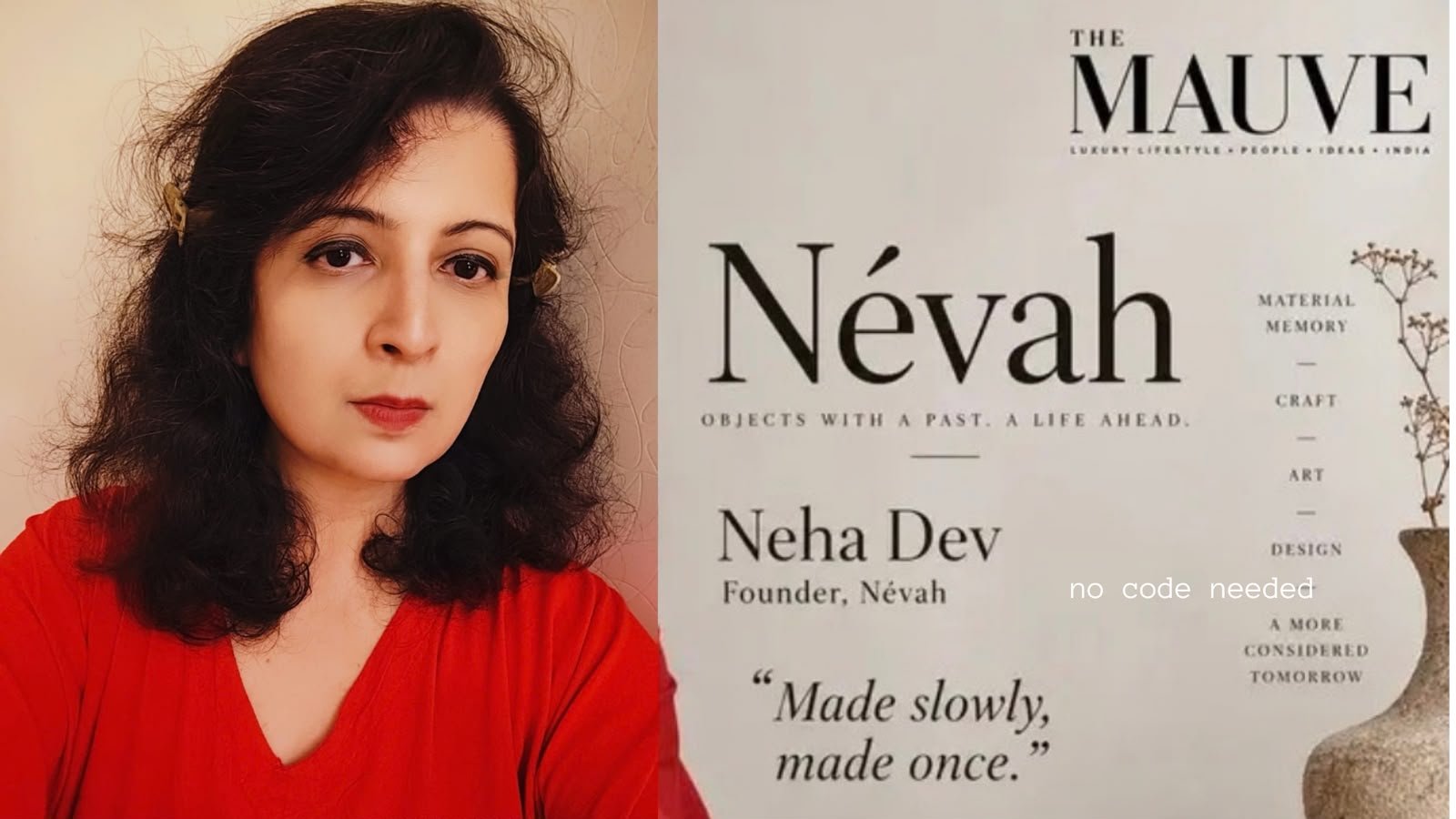
In Goa, Neha Dev has built Névah around an increasingly rare idea: that beautiful things do not need to be made quickly, repeatedly or perfectly.
Névah could only have begun in Goa.
For Neha Dev, moving to Goa changed the pace at which she began to see, collect and make. Life became quieter, closer to trees, changing light, rain, old homes, weathered surfaces and the small imperfections that usually disappear when everything is made too quickly.
That rhythm found its way into Névah.
The pieces are not designed around seasons or production schedules. They evolve slowly, often beginning with a material, a colour, an old textile or an object that catches Neha’s attention. Some are made entirely by her hand; others, particularly within Vastra, bring her into conversation with artisans whose embroidery, mirror work, zari and aari become part of a larger composition she conceives and directs.
Goa also gave Névah the freedom not to become a conventional design brand.
There are no identical runs, no pressure to reproduce a successful piece, no attempt to erase the marks of age or handwork. A piece can remain irregular, worn, unexpected.
In that sense, Goa is more than Névah’s address. It is part of its philosophy: make less, look longer, keep what has a story, and allow beauty to remain slightly imperfect.
When Materials Remember
Névah began instinctively.
Neha has always been drawn to objects, textiles, spaces and the small details that give something presence. Her first works emerged as one-of-one centrepieces made entirely by hand, without the intention of building a conventional product line.
The impulse was more personal: to create objects that felt considered and intimate, things that could hold a room rather than simply decorate it.
From there, Névah expanded naturally.
At its centre is an idea Neha calls material memory.
For her, materials remember.
A worn piece of silk, an old ceremonial textile, a fragment of zari, an aged neckline, a section of aari work or a piece of mirror work carries evidence of having existed somewhere before. It may not reveal its entire history, but there is something in the surface, texture and wear that suggests it has already lived a life.
Neha is not interested in disguising that history.
“I don’t want to erase that in order to make something look new,” she explains. “I’m interested in allowing those traces to remain visible and giving the material another life without disguising where it has come from.”
That philosophy gives Névah a distinctive relationship with newness.
The material does not have to look untouched to be beautiful.
Its previous life is part of its beauty.
Vastra: Giving Old Textiles Another Life
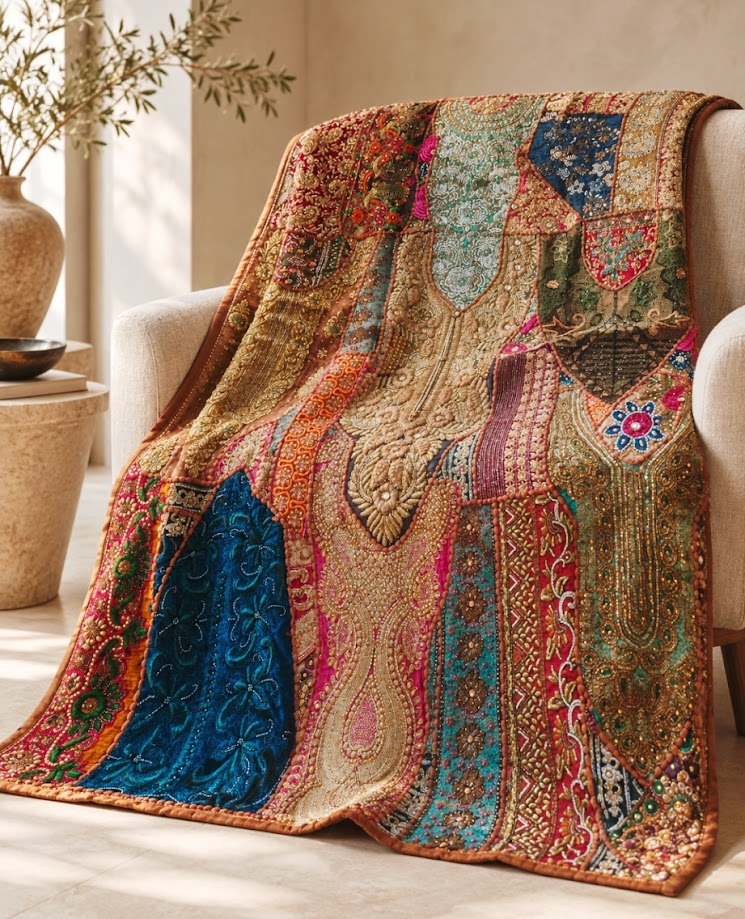
This philosophy finds perhaps its clearest expression in Vastra, where old textile fragments and material memory become another language for Névah.
Neha is drawn to fragments that carry character — old ceremonial and bridal textiles, zari, aari work, mirror work, beadwork, silk, velvet and sometimes an old neckline or imperfect section that might otherwise be overlooked.
She rarely begins with a predetermined shopping list.
Instead, the material itself often suggests what the work wants to become.
A fragment can determine a colour palette. A piece of embroidery can influence a composition. An old textile can lead the work somewhere entirely different from where Neha initially imagined it going.
That freedom is important.
Neha does not see heritage and contemporary design as opposing worlds. She does not believe traditional craft needs to be “modernised” simply to belong in a contemporary home.
An old ceremonial textile can retain its integrity while becoming part of something entirely new.
The material remains recognisable.
The handwork remains visible.
But the context changes.
And in that transformation, Névah gives the material another life without asking it to forget the one it had before.
The Hand Is Part of the Design
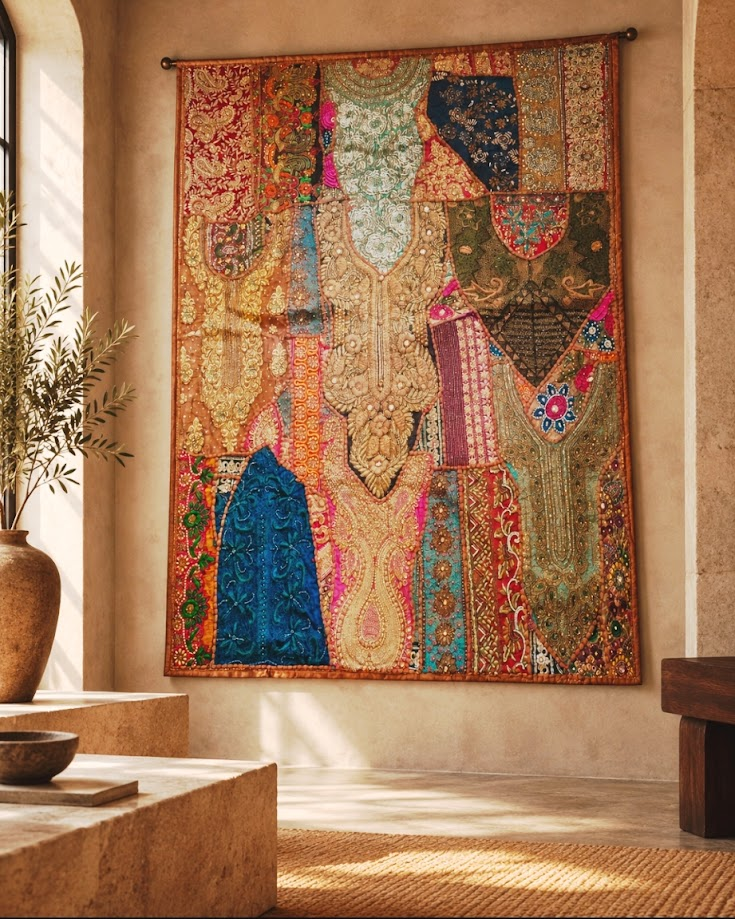
Craftsmanship is central to Névah, but it is never treated as an embellishment added after the design has been conceived.
The way something is made is part of the idea itself.
The Atelier pieces are made by Neha by hand. Within Vastra, she works with artisans whose particular skills and techniques become part of bringing a composition together.
Embroidery, zari, aari, mirror work and beadwork are not simply decorative elements.
They carry human presence.
“I love imperfection when it comes from the hand,” Neha says.
That philosophy is visible in the work.
A stitch may not be identical to the next. A textile may have softened with age. A bead may sit slightly differently from another. A surface may reveal the irregularities of the person who made it.
Névah does not attempt to correct these traces.
It preserves them.
In a world where almost anything can be reproduced perfectly and endlessly, the evidence of the hand becomes increasingly precious.
The Art of the Platter
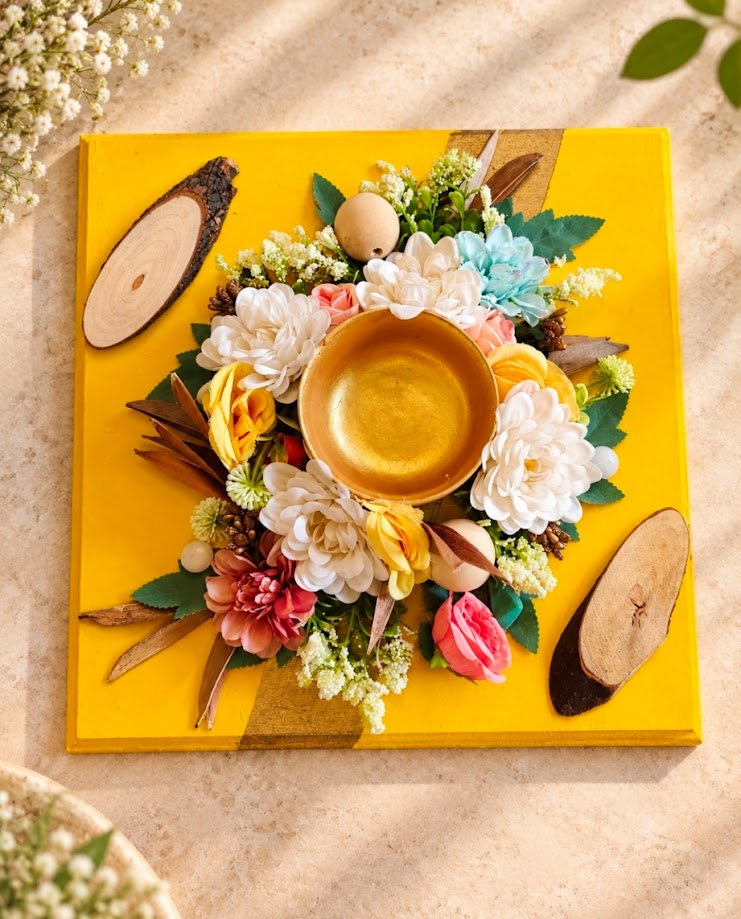
Perhaps one of the most intriguing aspects of Névah’s Atelier is the way its platter-like pieces resist being assigned a single purpose.
They are not serving platters in the conventional sense.
They are art pieces — objects that begin without a fixed form or prescribed destination, allowing the person who acquires them to decide what they become within their own space.
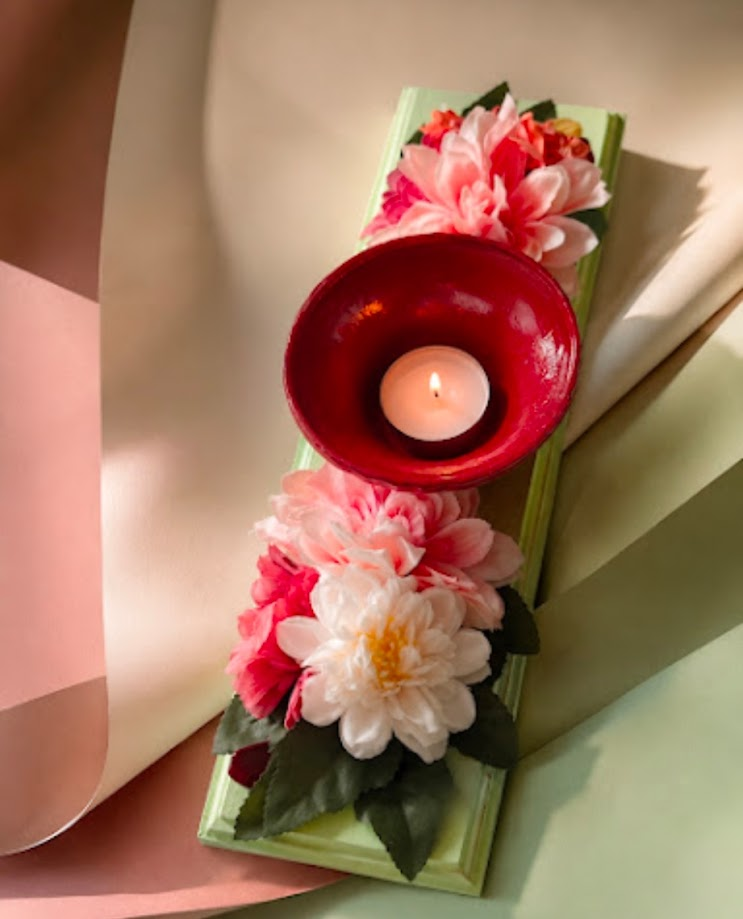
A piece can become a centrepiece on a dining table, find a place on a bedside table, sit within a bathroom, bring character to a tea corner, occupy a kitchen shelf or simply become a decorative presence in an otherwise quiet corner of a home.
The object does not dictate its role.
The collector does.
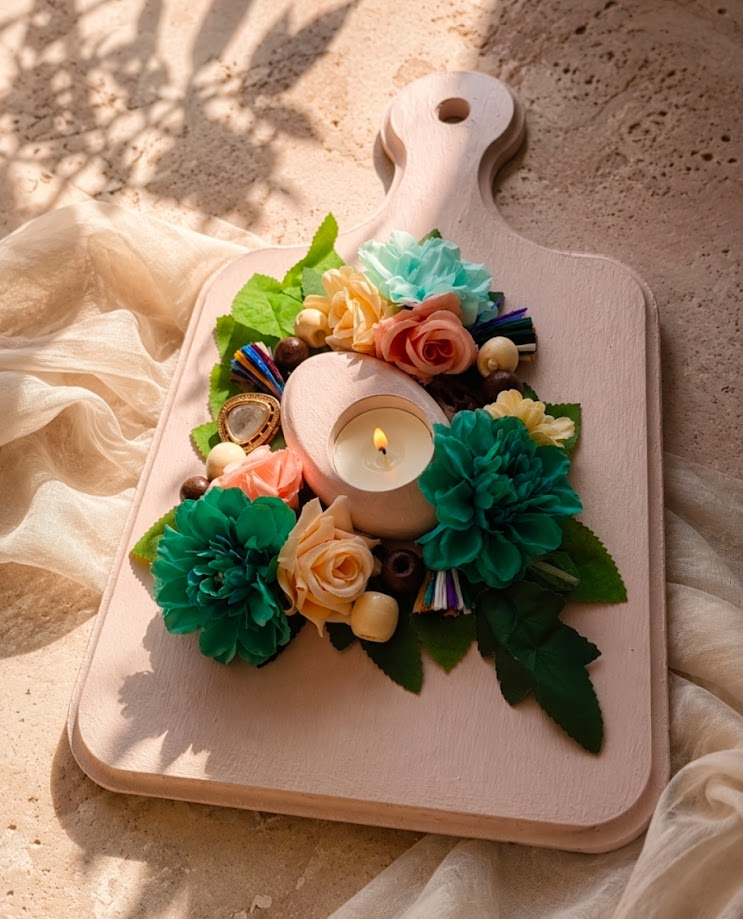
That openness is fundamental to Névah’s design language.
Rather than creating an object around a predetermined function, Neha creates a piece that can be interpreted and given form by the person who lives with it.
It is this dialogue between maker and collector that makes the pieces particularly personal.
Two people may acquire works from the same creative universe and live with them in entirely different ways. One might use a piece as a striking table centrepiece; another might place it on a console or side table, allowing its materiality and craftsmanship to speak for itself.
The piece becomes part of the collector’s visual language.
And while Vastra and Atelier explore different material and creative directions, they share an essential Névah principle:
Nothing is repeated.
Every piece is one-of-one.
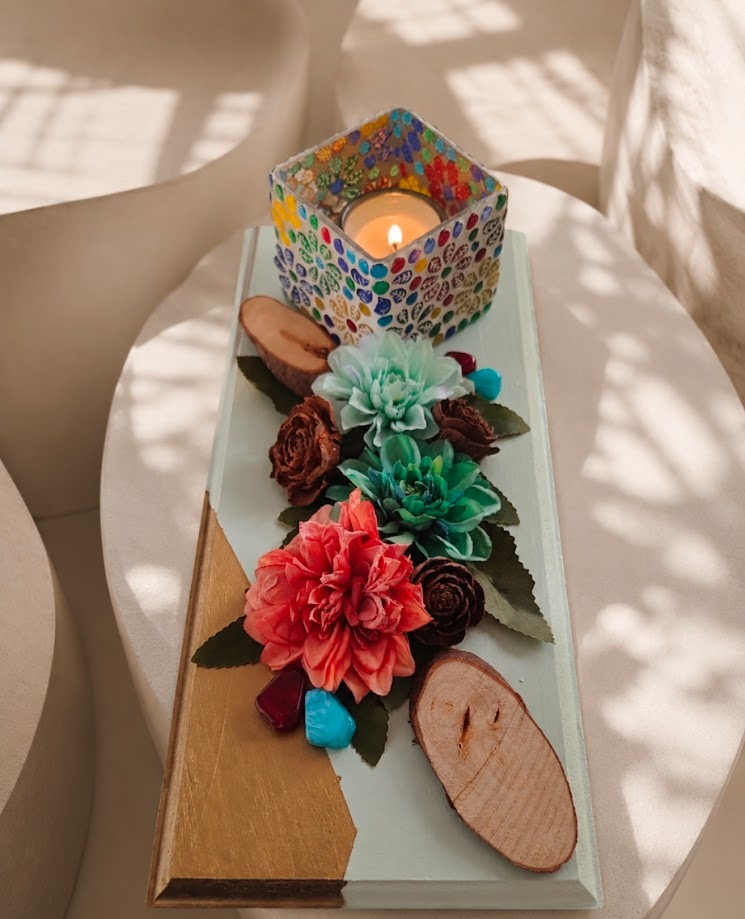
Once a composition is complete, it is not reproduced simply because it has found an audience. The next work may begin with a similar material, technique or sensibility, but it is allowed to evolve independently — with different proportions, textures, handwork and composition.
That makes every Névah piece less like an item from a collection and more like an individual work.
There is no predetermined “right” way to live with it.
The collector gives it that.
A Creative Practice Without Fixed Boundaries
So, is Névah fashion, art or design?
Neha does not feel the need to place it neatly inside one category.
It sits somewhere between them.
Vastra carries memories of clothing and adornment because of the textiles Neha works with, but she is not making fashion. The Atelier pieces can inhabit a table, a shelf or a room, but she does not think of them simply as décor.
That ambiguity is part of Névah’s identity.
It allows the practice to move between functional and purely visual, between textile and object, between heritage and contemporary expression.
For Neha, the category matters less than the relationship people develop with the work.
The ambition is not simply to create something beautiful.
It is to create something with enough presence to remain.
Where the Creative Process Begins
Neha’s creative process rarely starts with a conventional drawing.
Often, it starts with an atmosphere.
It could be a raga, a colour, a textile, a fragrance, a memory or simply an unusual combination of materials that stays in her mind.
She lives with that thought for a while.
Then comes the process of arranging, removing, adding and looking again.
“I don’t like overworking a piece,” she says. “A large part of the process is knowing when to stop.”
That restraint is visible across Névah.
The pieces do not appear desperate to communicate every idea at once. There is room for the material to breathe.
With Vastra especially, Neha often allows the textile to lead. The final work may be quite different from what she first imagined, and she welcomes that uncertainty.
For Névah, the unexpected is not a problem to solve.
It is often where the work begins to become interesting.
From Ragas to Fragrance
This instinctive process has also shaped the themes within Atelier.
An earlier body of work drew inspiration from ragas and different hours and moods, translating something auditory and temporal into objects.
Now, Neha is beginning a new body of work inspired by fragrance.
It feels like a natural progression for a practice already interested in memory.
A fragrance cannot be held in the same way as a textile or an object. It exists through association — a place, a person, a season, a room, a particular moment.
For Neha, that sensory connection opens another creative language.
It is less about illustrating fragrance and more about exploring the emotions and memories it can evoke.
The work continues to move through different senses while retaining the same underlying philosophy: creating pieces that feel intimate, atmospheric and impossible to reproduce exactly.
The Meaning of Collectible Design
For Neha, collectible design has very little to do with exclusivity for its own sake.
It is about identity.
A piece becomes collectible when it has enough presence that you want to keep it. When you know something about who made it, how it was made, what its material carries and why that particular piece exists.
For her, a collectible should deepen with time rather than become irrelevant when the next trend arrives.
“The pieces I love most in my own life are not necessarily the newest or the most perfect,” she says. “They’re the ones I would notice immediately if they disappeared from a room.”
That may be the most revealing definition of Névah’s approach.
The goal is not to make something that simply looks expensive.
It is to make something that eventually feels irreplaceable.
Designed Once. Meant to Stay.
The idea of one-of-one is therefore not a marketing device for Névah.
It is built into the way Neha works.
She does not recreate a piece once it is finished.
Even when two works begin with a similar material or thought, she allows them to develop differently. Proportions change. Handwork changes. Composition changes.
With many of the materials she works with, repetition would almost defeat their character anyway.
There is something liberating about that approach.
A successful piece does not automatically become a template.
Its success does not demand a second version.
It is allowed to remain itself.
And the next piece is allowed to become something else.
That makes every Névah work a singular meeting point between material, maker and collector.
The Collector Completes the Story
Perhaps this is where Névah’s philosophy becomes most interesting.
Neha creates the object, but the collector gives it a life beyond the studio.
A piece can enter a bedroom, a dining space, a bathroom, a kitchen, a tea corner or a quiet shelf. It can become a centrepiece or simply occupy a small corner where its presence is noticed only occasionally.
Its final form is therefore not entirely decided by its maker.
It evolves through placement.
Through use.
Through the space around it.
Through the person who chooses it.
This creates a different kind of relationship between object and owner — one where acquisition is not the end of the creative process, but another beginning.
The collector does not simply purchase a Névah piece.
They interpret it.
What Comes Next for Névah
Neha is continuing to build both sides of the practice.
With Vastra, she is exploring more textile compositions and allowing the works to become stronger and more individual.
With Atelier, she is beginning a new body of work inspired by fragrance, following earlier explorations around ragas, hours and moods.
She is also interested in taking Névah into carefully chosen spaces and collaborations rather than growing simply for the sake of scale.
There is no urgency to become everywhere.
Instead, there is a desire to be in the right places.
Each new chapter, Neha says, should feel like Névah, but not like something they have already made.
It is a fitting ambition for a practice built around unrepeatability.
The Mauve Perspective
There is something quietly compelling about Névah’s refusal to rush.
At a time when design is increasingly shaped by speed, trends and endless reproduction, Neha Dev is building a world around the opposite instincts: look longer, make slower, preserve what carries a story.
Her work reminds us that luxury does not always announce itself through polish.
Sometimes it exists in the uneven stitch.
In an old textile that has survived another life.
In a piece that can change meaning depending on where its collector places it.
In an object that does not need to be reproduced.
And perhaps most importantly, in the decision to let something remain imperfect enough to feel human.
Névah is not simply creating objects for beautiful spaces.
It is creating one-of-one pieces that enter a space without dictating what they should become.
The maker begins the story.
The material carries its memory.
And the collector gives it a new form.
Tactile. Intimate. Unrepeatable.
Three words Neha Dev uses to describe Névah.
They also happen to describe what the work leaves behind.