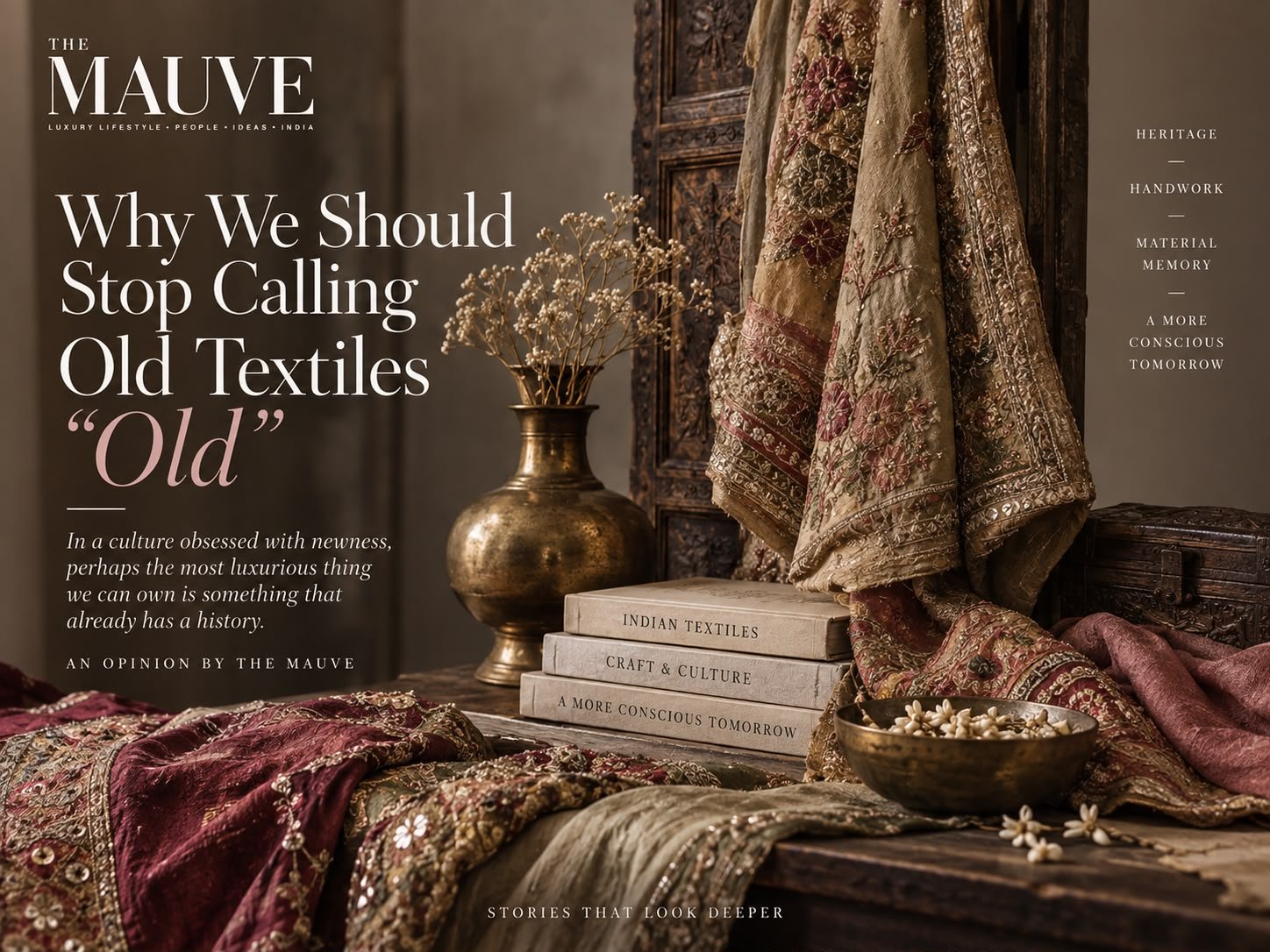
In a culture obsessed with newness, perhaps the most luxurious thing we can own is something that already has a history.
An Opinion by The Mauve
There is a particular kind of beauty that cannot be manufactured.
It exists in a faded piece of silk that has survived decades. In zari that has lost some of its original shine but gained character. In embroidery where no two stitches are quite identical. In a textile that has been worn, stored, inherited, forgotten and eventually discovered again.
We often call these things old.
Perhaps we should start calling them experienced.
The contemporary luxury world has spent years teaching us to associate value with what is new: the latest collection, the newest launch, the freshest drop, the object nobody else has yet seen. But quietly, another idea of luxury is emerging—one that values provenance, craftsmanship, material history and the evidence of human hands.
And textiles sit at the centre of that conversation.
A Textile Is More Than a Surface
Clothing and textiles have always carried information about the people and communities that made and used them.
UNESCO considers traditional craftsmanship part of intangible cultural heritage, emphasising that what needs safeguarding is not simply the finished object but the knowledge and skills through which it is made and passed on.
That distinction matters.
When we look at a piece of hand embroidery, we are not merely looking at decoration. We are looking at technique, time and accumulated knowledge.
A textile can tell us about a region, a community, an occasion, a material and sometimes even the social context in which it was made or worn. Museum collections around the world treat historical textiles as objects requiring research, documentation and conservation precisely because their material and cultural histories matter.
The value is therefore not only visual.
It is embedded.
The Imperfection Is the Point
There is an irony in contemporary design.
Technology has made perfect reproduction easier than ever, while consumers are simultaneously becoming fascinated by things that cannot be perfectly reproduced.
A machine can repeat a pattern thousands of times.
A hand cannot.
A hand leaves behind minute variations: an uneven stitch, a change in tension, an individual placement of a bead, a slight difference in embroidery.
For a long time, these irregularities were treated as shortcomings.
Today, they can be understood differently.
They are evidence.
Evidence that someone sat down and made the object. Evidence that the process involved time. Evidence that the final result was not simply generated from a file and reproduced indefinitely.
The hand is, in many ways, the signature.
What Happens When We Throw the Past Away?
There is also a larger question beneath our fascination with vintage textiles: what happens when the materials and knowledge of the past are no longer valued enough to survive?
UNESCO’s work on Indian heritage textile crafts has highlighted concerns around the sustainability of hand skills and the transmission of craft knowledge, particularly where artisan communities and traditional practices face economic and social pressures.
Traditional craftsmanship survives when there is a reason to practise it.
That reason can be cultural.
It can be familial.
It can be economic.
And increasingly, it can also be design.
When an old textile is transformed into something that belongs naturally in a contemporary home, it isn’t necessarily being preserved behind glass. It is being given another context in which its material and craft language can continue to be appreciated.
That does not mean every old textile needs to be transformed.
Some should simply be preserved.
But it does mean we should question the instinct to discard something merely because it no longer fits the definition of new.
The Luxury of Slowness
Luxury has traditionally been associated with scarcity.
But perhaps scarcity is only one part of the story.
There is another form of luxury in time.
A handworked textile can take hours, days or considerably longer to create. Its value cannot be understood entirely through the amount of material used. The labour, knowledge and technique embedded within it are part of the object.
UNESCO’s approach to traditional craftsmanship similarly focuses on keeping the knowledge and skills alive, rather than treating craft objects as static museum pieces.
This is why the conversation around handmade design should not simply be reduced to artisan versus machine.
The more interesting question is:
What kind of relationship do we want to have with the objects we own?
Do we want objects that are easily replaced?
Or do we want things that become more meaningful because we have lived with them?
From Heirloom to Contemporary Collectible
Perhaps the next chapter of Indian design will not be about choosing between heritage and modernity.
It will be about understanding that the two can exist together.
An old embroidered textile does not necessarily belong only in a traditional home.
A fragment of a ceremonial garment can become part of a contemporary composition. A piece of zari can move from clothing into an object. A handworked surface can become art, design or something that exists somewhere between the two.
The important thing is not to erase its history in order to make it contemporary.
It is to let the history remain visible.
This is where the idea of collectible design becomes particularly interesting.
A collectible is not necessarily valuable because it is expensive or exclusive. Its significance can come from its identity, its provenance, its materiality and the story of how it came into existence.
The object becomes something we choose to keep.
And This Is Where Névah Enters the Conversation
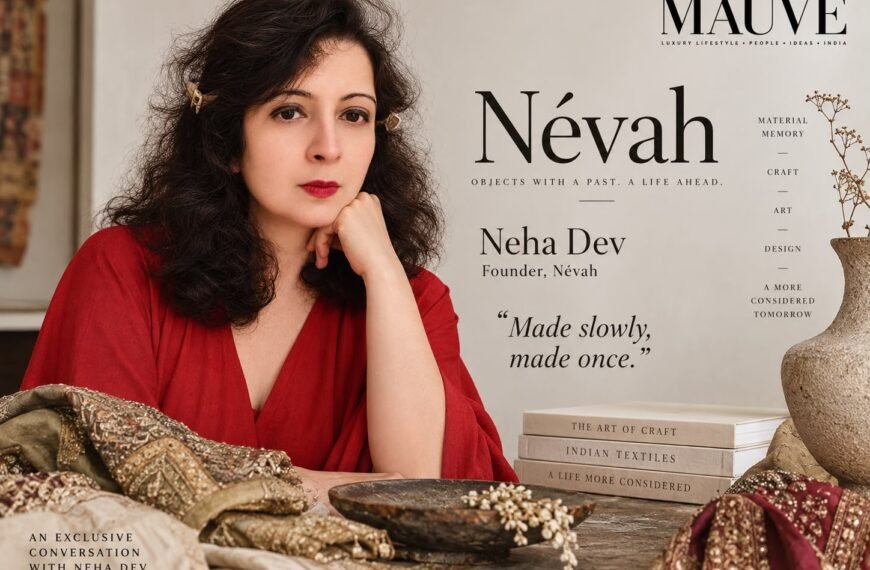
At The Mauve, we find this approach particularly compelling in the work of Névah, founded by Neha Dev. What interests us is not simply that Névah works with old textiles or handcrafted materials, but the decision to allow those materials to remain themselves. There is no obvious desire to disguise age, erase irregularity or force heritage into a fashionable vocabulary. Instead, Névah treats fragments, handwork and material history as creative starting points. In our view, that is where the work becomes relevant to the larger design conversation: it suggests that an object does not have to be untouched to be precious, and that contemporary luxury can sometimes be about recognising value in what already exists. The most interesting objects may not be the ones that look new, but the ones that make us look at the old differently.
Perhaps “Old” Is the Wrong Word
We are surrounded by things designed to become obsolete.
New seasons. New drops. New trends. New versions.
Against that culture, an old textile offers a different proposition.
It asks us to slow down.
To look closely.
To notice the hand.
To understand that wear is not always damage, that age is not always decline, and that history can be part of beauty.
Perhaps the future of luxury will not belong entirely to what is new.
Perhaps it will belong, at least in part, to what has survived.
And perhaps the most contemporary thing we can do with an old textile is simply to give it another reason to exist.