
- 31.3% of employees showed blood-sugar dysfunction, while 40.4% reported high stress and 81.4% of tested Vitamin D reports were below the sufficiency threshold.
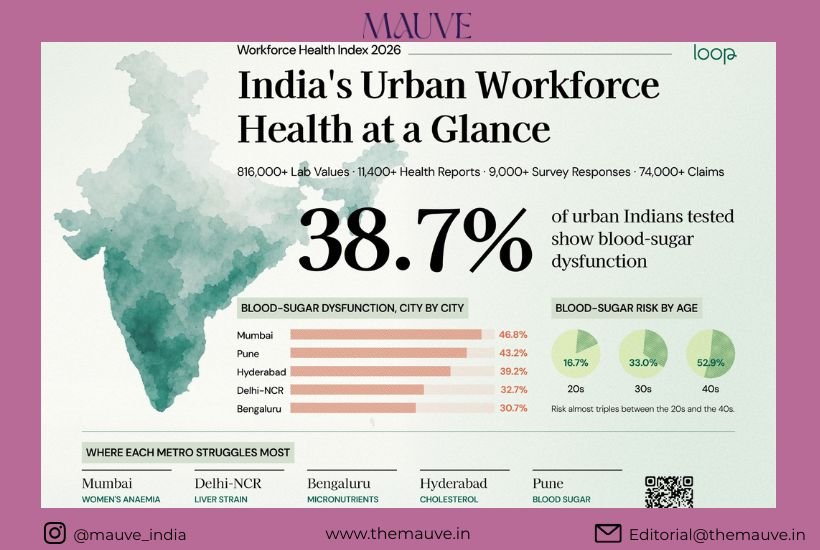
- Metro-level findings show distinct health patterns, with Mumbai recording the highest glucose dysfunction at 46.8%, Delhi-NCR the highest liver dysfunction at 34.4%, and Bengaluru the highest Vitamin D insufficiency at 83.9%.
- Among employees, 47.3% recorded low HDL levels, 23.7% showed liver dysfunction, 14.5% were identified with anaemia, and 73.9% recorded low Vitamin B12 levels.
- Hospital claims show parents and parents-in-law accounted for 36.9% of incurred healthcare costs, compared with 32.2% for employees.
National, 30th September 2026 | Loop Health, India’s leading group health insurance and health benefits provider, today announced the launch of the Workforce Health Index (WHI) 2026, its largest national assessment of urban workforce health to date.
Among employees across India’s urban workforce, health risks are emerging well before middle age. The warning lights are already blinking in blood sugar, sleep, stress, nutrition, and liver health, often before people realise anything is wrong.
Now in its second edition, WHI 2026 is Loop Health’s largest read yet on India’s workforce health, drawing on a dataset 4x larger than its 2025 debut. The report is built on 816,000+ lab values across 11,400+ health reports and 9,000+ survey responses from urban working Indians, with a biomarker sample more than 4x the size of WHI 2025’s 214,142 biomarker rows and 3,437 survey responses. This year’s edition also adds hospital-claims data for the first time, covering 74,000+ hospital claims.
Source Link: https://whi.loophealth.com/
The picture didn’t shift overnight: the larger 2026 sample shows several core health risks have stayed stubbornly high, while a few lifestyle indicators have moved in the wrong direction. Glucose dysfunction stood at 31.3% among employees tested in 2026. Nutritional deficiencies remain widespread, with 81.4% of Vitamin D reports below the sufficiency threshold and 73.9% of employee reports recording low Vitamin B12 levels.
“The most important finding from WHI 2026 is how early these health risks are showing up. One in three professionals in their 30s already shows blood-sugar dysfunction, and that is only one part of the picture. We are also seeing high stress, widespread Vitamin D and B12 deficiencies, and a clear gap between the health risks people have and the care they actually seek. Most of these signals are visible well before someone feels unwell. That is where prevention has to start—with knowing what is happening, getting the right medical guidance and acting before a health problem becomes a much bigger one.”
— Ryan Singh, Co-Founder and COO, Loop Health
India’s Blood-Sugar Warning Decade May Now Be the 30s
The findings show that blood sugar markers are being observed during prime working years. According to the report, among employees alone, 31.3% showed blood sugar dysfunction on HbA1c, based on 4,482 HbA1c reports. The share increased with age, from 16.7% among those tested in their 20s to 33% among those in their 30s and 52.9% among those in their 40s.
The findings also show a difference between measured markers and self-reported diagnoses. Across the full tested group of employees and dependents, 38.7% flagged blood sugar dysfunction, while only 5.8% of respondents said they had ever been diagnosed with diabetes. Among people in their 30s, 10.3% of men and 4.3% of women fell into the diabetic-range category.
The Sunshine Vitamin Is Still Missing In Urban India
Micronutrient levels emerged as an important health indicator in urban India. 81.4% of Vitamin D reports had insufficient levels, including 60.1% who were deficient or severely deficient, while 73.9% recorded low Vitamin B12 levels.
The preventive picture also showed a change in Vitamin D supplementation. Vitamin D supplementation stood at 20.4% in WHI 2026, compared with 26.2% in WHI 2025, while 81.4% of employees tested remained below the Vitamin D sufficiency threshold.
34.6% Of Women Tested Had Haemoglobin Below 12 g/dL
Anaemia emerged as another significant health finding. 34.6% of 4,375 female reports had haemoglobin below 12 g/dL, while 8.9% of 5,210 male reports were below 13 g/dL. Among employees, 14.5% were identified with anaemia.
The biomarker sample includes both employees and covered dependents, so the broader biomarker figures should not be described as employee-only prevalence. Among women, the share was 30.6% in the 20–29 age group, 36.4% in the 30–39 age group, and 37.5% in the 40–49 age group. Metro-level findings also showed variation: in Mumbai, 52.3% of female reports were below the report threshold, compared with 23.2% in Bengaluru.
30.7% Of Respondents Reported Sleeping Less Than Six Hours Per Night
Sleep and stress findings emerged as important aspects of workforce health. 30.7% of respondents reported sleeping less than six hours per night, while 40.4% reported high stress in the past week. Among women, 47.4% reported high stress and 36.3% reported sleeping less than six hours per night.
The findings also showed changes compared with WHI 2025. The share of professionals getting less than six hours of sleep stood at 30.7%, compared with 27.3% in WHI 2025, while high stress stood at 40.4%, compared with 33.9%. The share of professionals who do not exercise regularly stood at 30.9%, compared with 28.0% in WHI 2025.
Heart Health Risks Are Building Earlier Than Expected
The report also examined key cardiovascular health indicators among urban professionals. 62.6% of the 8,054 LDL reports recorded levels at or above 100 mg/dL, while 47.3% of employees recorded HDL levels below 40 mg/dL. Among the employee reports, the HDL finding was based on 4,824 reports.
The findings also showed variation across major urban centres. Hyderabad recorded the highest share of low HDL at 50.6%, followed by Pune at 47.8%, Mumbai at 46.3%, Bengaluru at 41.8% and Delhi NCR at 39.1%. The findings provide a city-level view of lipid health indicators across India’s major urban centres. The report also found that 23.7% of employees tested showed liver dysfunction, while Delhi-NCR recorded the highest metro-level figure at 34.4%.
19.8% Turn to AI Tools Like ChatGPT for Health Information
The report also captures changing patterns in how urban professionals access health information. 19.8% of respondents reported using AI tools such as ChatGPT for health-related information, while 19.7% cited Google and 54.0% said they referred to doctors or healthcare professionals. Respondents could select multiple sources. The findings reflect the growing presence of digital tools alongside traditional healthcare sources in everyday health information-seeking.
Metro-Level Biomarker Mapping
WHI 2026 also maps health indicators across Mumbai, Delhi-NCR, Bengaluru, Hyderabad and Pune, showing meaningful differences between major urban workforces.
- Mumbai: Recorded the highest blood-sugar dysfunction among the five major metros at 46.8%. Nearly half of the HbA1c reports in the Mumbai sample fell at or above 5.7%. Mumbai also recorded the highest female haemoglobin-below-threshold rate among the five metros, at 52.3%.
- Delhi-NCR: Showed the highest liver-health signal, with 34.4% of tested reports showing elevated liver enzymes.
- Bengaluru: Recorded the lowest glucose dysfunction at 30.7%, but had the highest Vitamin D insufficiency rate at 83.9%.
- Hyderabad: Recorded the highest prevalence of low HDL at 50.6%, a lipid marker used in cardiovascular risk assessment.
- Pune: Recorded the lowest share of professionals reporting fewer than six hours of sleep among the five metros, at 26.2%, compared with 30.7% across the overall survey sample.
Workforce Healthcare Patterns Revealed Through Hospital Claims
For the first time, WHI 2026 analyses 74,000+ hospital claims, offering a broader view of healthcare needs and costs across India’s workforce.
The data reveals that non-employee relationship categories (dependents and extended family members) account for 66.5% of total corporate insurance claims, driving 67.8% of the overall recorded healthcare costs. Within this family portfolio, claims filed for parents and parents-in-law alone emerged as the single largest structural factor, accounting for 36.9% of total incurred costs, outpacing the corporate employees themselves who generated 32.2% of the overall volume