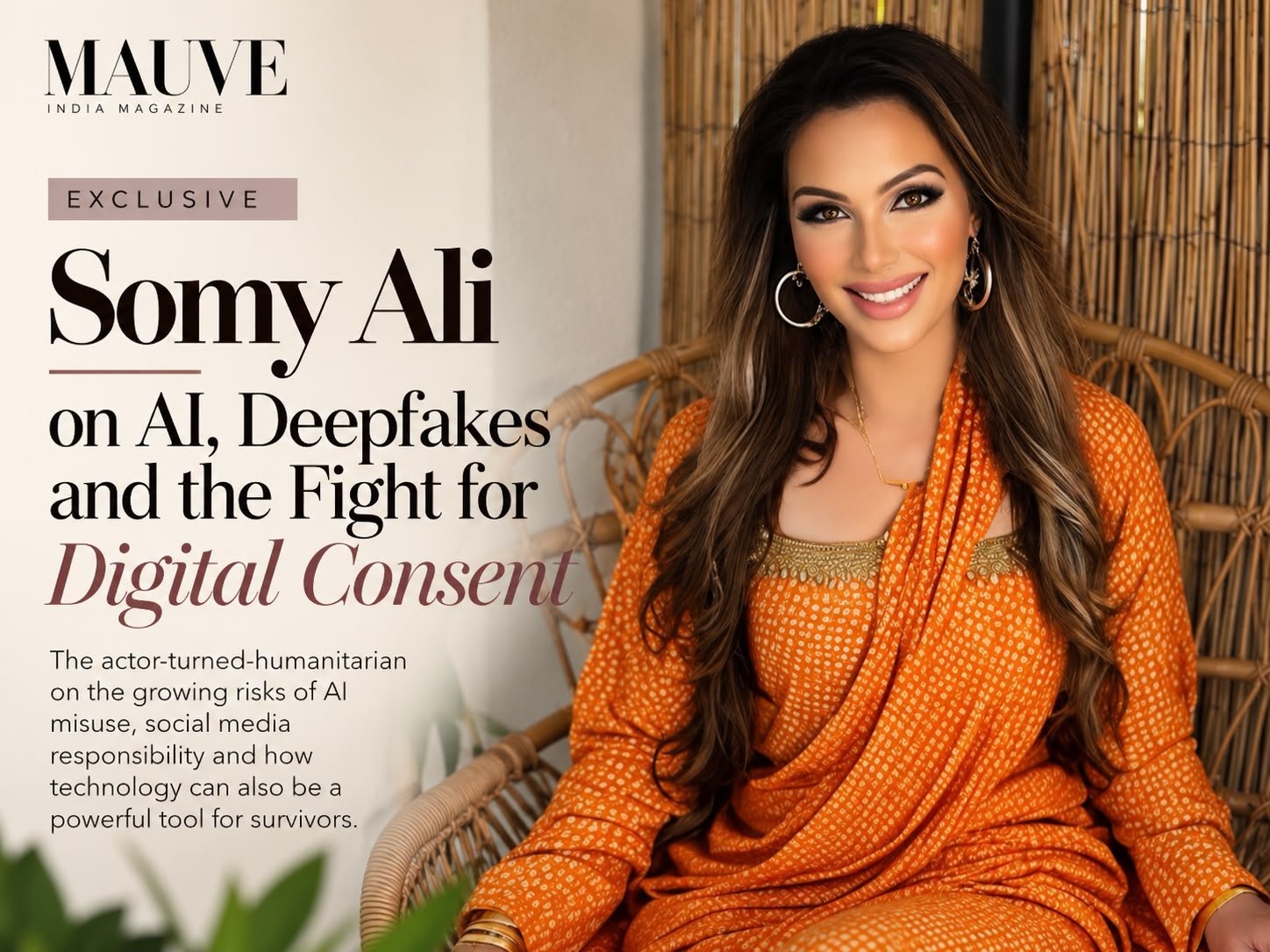
In an exclusive conversation with Mauve, the actor-turned-humanitarian opens up about the darker side of artificial intelligence, the growing threat of deepfake abuse and why technology could also become a powerful tool for survivors.
Artificial intelligence has made it possible to create almost anything. But as the technology becomes more sophisticated, one question is becoming increasingly difficult to avoid: what happens when someone’s identity can be recreated without their permission?
For Somy Ali, this isn’t simply a conversation about technology.
It is a conversation about consent, dignity and what happens when the digital world moves faster than the systems meant to protect the people inside it.
In an exclusive conversation with Mauve, Ali speaks about the growing threat of deepfakes, the responsibility of social media platforms, the dangers of casually forwarding manipulated content—and why she believes the same technology capable of causing harm could also help survivors find support.
“The Gap Between Possible and Everyday Has Closed”
For years, AI-generated content seemed like something belonging to the future.
Today, it is sitting inside our phones.
The technology required to manipulate an image or create a convincing video is no longer limited to Hollywood studios or specialised laboratories. Its accessibility has fundamentally changed the conversation.
And with that accessibility comes a new kind of vulnerability.
For Ali, the issue becomes particularly serious when someone’s face or identity is placed into content they never participated in or consented to.
“A still from a movie on a wall is not the same as a lie that can destroy a private person,” she says.
That distinction is at the heart of the deepfake debate.
When Technology Turns Personal
The internet has always made images difficult to control. AI has made that problem considerably more complicated.
A photograph can now be altered. A voice can be replicated. A face can be inserted into an entirely fabricated situation.
And once that content begins circulating, removing the original doesn’t necessarily mean removing its impact.
For someone already vulnerable, the consequences can extend far beyond the screen.
Ali’s work with No More Tears, her organisation supporting survivors of abuse and exploitation, has given her a perspective that goes beyond the usual conversation around celebrity deepfakes.
Because the most vulnerable person online may not have millions of followers.
They may not have a publicist.
They may not know where to report the content.
They may simply be someone whose life has suddenly been turned into something they never agreed to.
“The Tool Is Not Innocent. The Ease Is the Wound.”
Ali isn’t arguing that AI itself should be rejected.
Her concern is what happens when powerful technology becomes extraordinarily easy to access without equally accessible systems of protection.
“The tool is not innocent. The ease is the wound,” she says.
It is a distinction worth considering.
AI can help filmmakers restore archival footage, develop concepts and experiment creatively. It can make information more accessible and help organisations reach people in ways that weren’t previously possible.
But technology doesn’t exist in isolation.
It exists within human behaviour.
And that means responsibility cannot sit entirely with the person who created the tool.
Could AI Become Part of the Solution?
Interestingly, Ali sees enormous potential for AI in the very space where she has spent years working: survivor support.
For someone experiencing abuse, asking for help can be intimidating.
There may be fear. Shame. Language barriers. Financial dependence. Or simply uncertainty about where to begin.
Technology could potentially provide a private first point of contact—helping people understand their options, access information and find appropriate support without immediately having to make themselves vulnerable in person.
“At No More Tears, we are not anti-AI. We are anti-abandonment,” Ali says.
It is perhaps the most important distinction in her argument.
The goal isn’t to stop technology from evolving.
It is to make sure people aren’t left behind while it does.
The Responsibility Doesn’t End With the Creator
There is another player in the deepfake ecosystem that Ali wants us to think about: the person watching.
A manipulated image becomes more powerful when it is circulated.
A video gains credibility when thousands of people interact with it.
“The person who shares is not a spectator. Forwarding is participation,” she says.
In an internet culture built around instant reactions, that is a difficult message—but perhaps a necessary one.
The simplest form of digital responsibility may sometimes be to stop before pressing share.
“Verification Is Not Cold. It Is Protection.”
Ali believes audiences need to become more conscious consumers of digital content.
Not every image is evidence.
Not every video is authentic.
And not everything that looks convincing is real.
“Verification is not cold. It is protection,” she says.
The responsibility also extends to social platforms, which increasingly have to determine how quickly manipulated and non-consensual content can be identified, reported and removed.
Because when technology can create something in seconds, protection cannot take days.
The Question Isn’t Whether AI Will Stay It will.
The more relevant question is what kind of digital culture we build around it.
For Ali, AI can be part of filmmaking, creativity, communication and survivor support. But consent and dignity have to remain non-negotiable.
Her vision is ultimately less about restricting technology and more about making it accountable.
“Let the same country that can generate a face also generate a door — one that opens at night,” she says.
It is a powerful way to think about the future.
Because perhaps the real measure of artificial intelligence won’t be how convincingly it can create a person who doesn’t exist.
It will be whether it can help a real person who does.