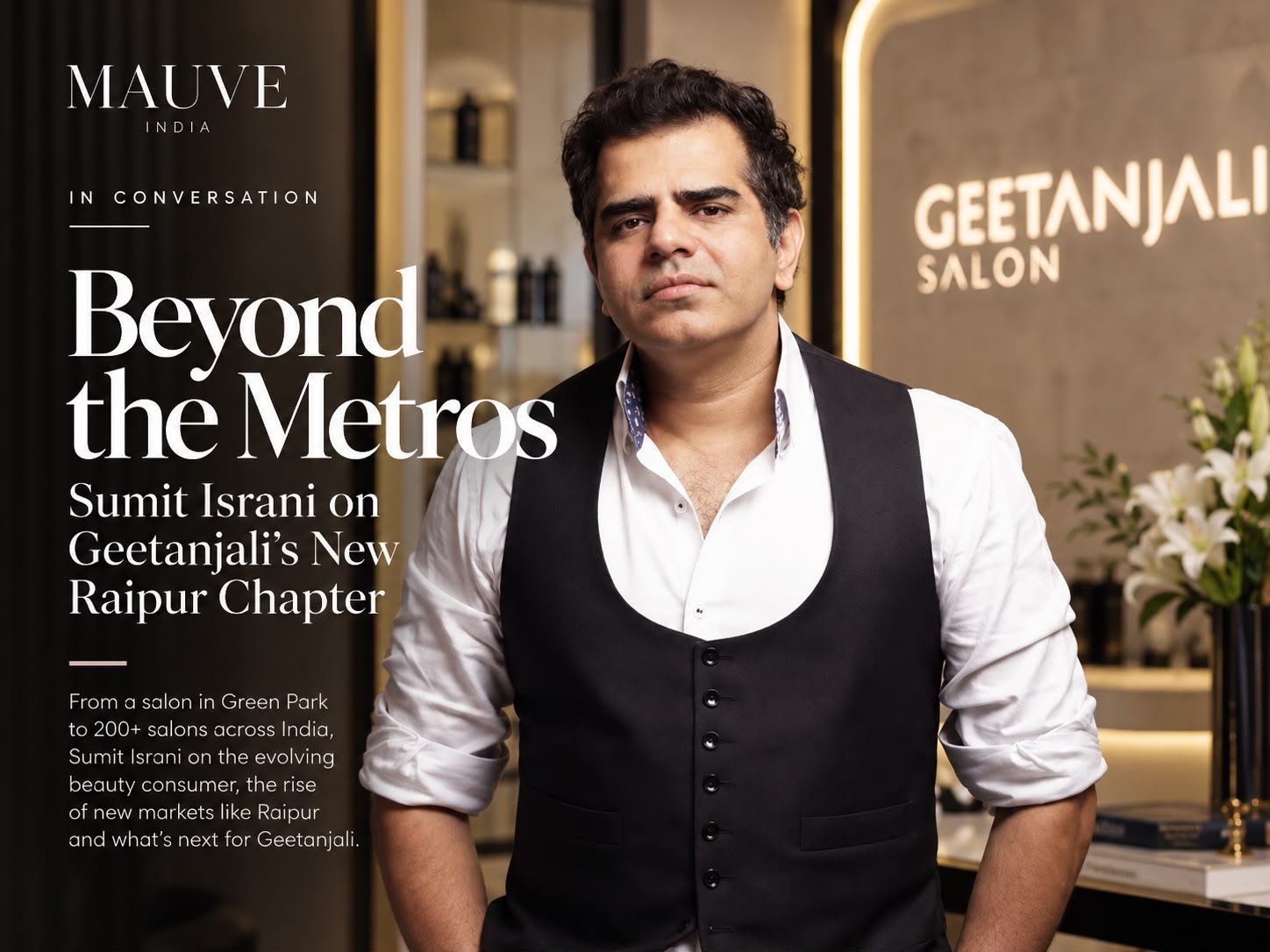
At the September opening of Geetanjali Salon’s first Chhattisgarh flagship, Chitrangada Singh joined Raipur’s cultural and business community. We caught up with founder and Managing Director Sumit Israni on beauty, changing consumers and why the future of India’s beauty industry may lie far beyond the metros.
There is a particular moment when a city tells you it has changed.
Sometimes, it arrives through a new restaurant. Sometimes, a luxury hotel. Sometimes, a fashion label that once seemed destined only for Mumbai or Delhi quietly chooses the city for its next address.
And sometimes, it arrives through the salon chair.
On September 19, Geetanjali Salon opened its first flagship in Chhattisgarh at Zora The Mall, Raipur, bringing one of India’s established beauty names into a city whose relationship with grooming, fashion and luxury has been steadily evolving.
Actor Chitrangada Singh was present for the launch, which brought together Raipur’s industrialists, entrepreneurs, socialites and creative community.
But weeks after the opening-night photographs have made their way through social feeds, there is a more interesting story beneath the glamour.
Why Raipur? And what does the city’s beauty consumer look like today?
To understand that, we spoke to Sumit Israni, the man who has spent more than three decades building Geetanjali from a family-run salon in Delhi into a nationwide beauty brand.
From the Salon Chair to a National Beauty Brand
Israni’s relationship with beauty began early.
Geetanjali’s story dates back to 1989, when his family started a salon in Green Park, New Delhi. Israni eventually trained in London and Paris with L’Oréal, developing an international understanding of hair, beauty and client experience before returning to India.
Today, under his leadership, Geetanjali has grown to more than 200 salons and studios across 50-plus cities, with a network of thousands of trained professionals.
Yet when Israni talks about the business, the conversation rarely begins with scale.
It begins with people.
Because for him, beauty has always been about more than changing how someone looks.
It is about changing how they feel.
Mauve: Geetanjali has been present in India for decades. What made Raipur the right city at this point in the brand’s journey?
Sumit Israni: Raipur has a distinct energy. It is a city that is evolving rapidly, with a new generation of consumers who are increasingly conscious of beauty, grooming and personal expression.
For us, being here is about recognising that evolution and becoming part of it.
I have always believed that the future of India’s beauty industry will be shaped not only by its largest cities, but by the aspirations emerging across the country.
Raipur is our first chapter in Chhattisgarh.
The Beauty Consumer Has Changed
The Indian beauty consumer of 2026 is considerably more informed than the consumer of a decade ago.
She arrives with references saved from Instagram. She knows her hair texture. She understands treatments. She follows international trends. She has opinions about colour, cuts, skincare and styling.
And increasingly, she expects personalisation.
For Israni, this shift is one of the most exciting developments in the industry.
Mauve: How has the Indian beauty consumer changed over the years?
Sumit Israni: The consumer today is far more aware, informed and experimental.
People are exposed to global trends instantly, but at the same time they are becoming more conscious of what actually works for them.
Beauty is becoming more individual.
It is not simply about following a trend. It is about understanding your personality, your lifestyle and what makes you feel confident.
That is where professional expertise becomes important.
What Happens When Global Beauty Meets a Regional Consumer?
This is perhaps where Geetanjali’s expansion becomes particularly interesting.
The brand has spent decades establishing itself in India’s major beauty markets. But moving beyond those traditional centres means adapting to consumers who may have a different cultural relationship with beauty.
And Israni sees that as an opportunity rather than a challenge.
Mauve: Does expanding beyond the metros require a different understanding of the consumer?
Sumit Israni: Absolutely.
Every city has its own personality, and every consumer has her own needs.
Our approach is never to assume that one beauty formula works everywhere.
What remains consistent is our focus on expertise, quality and personalised service. But understanding the local consumer is equally important.
When you enter a new city, you are not just bringing a brand there.
You are becoming part of that city’s ecosystem.
The Celebrity Moment
At Geetanjali’s Raipur launch, that ecosystem came together in style.
Chitrangada Singh joined the celebrations, adding a cinematic edge to an evening that already brought together some of the city’s most recognisable names from business, entrepreneurship and social circles.
But celebrity associations have long been part of the Geetanjali story.
Israni’s career has included work with celebrities, diplomats and fashion personalities, while his creative journey has also received international recognition.
For a brand built around hair and beauty, that connection between the salon and the world of fashion and entertainment feels natural.
Because today, beauty doesn’t exist in isolation.
It sits somewhere between fashion, identity, culture and self-expression.
From Haircuts to Confidence
Perhaps the most compelling part of Israni’s philosophy is how little he separates beauty from confidence.
His own journey began behind the chair, and that experience continues to influence how he thinks about the industry.
Mauve: What does a great salon experience mean to you today?
Sumit Israni: A great salon experience should leave you feeling better than when you walked in.
Of course, technical expertise and quality are essential. But there is also the experience of being understood.
When someone trusts you with their hair, skin or appearance, there is a personal relationship involved.
That trust is something we never take lightly.
The Next Chapter of Beauty
Geetanjali’s expansion also comes at a moment when the Indian beauty industry itself is becoming increasingly sophisticated.
The salon is no longer simply a functional stop between work and a social event.
It is becoming part of the lifestyle ecosystem.
Hair, skincare, makeup, grooming, wellness and self-care increasingly overlap. Geetanjali’s own expansion reflects that wider ecosystem, with the brand operating across hair, skin, barbering and makeup, alongside its professional training initiatives.
And for Israni, education remains central to the future.
Through the Geetanjali Academy, the brand continues to invest in training beauty professionals—a recognition that the future of the industry depends not just on opening more doors, but on building better talent behind them.
Mauve: Where do you see the Indian beauty industry heading next?
Sumit Israni: I think the industry is going to become more professional, more personalised and more technology-driven.
But despite all the changes, the fundamentals will remain the same—skill, creativity, trust and the ability to understand people.
India has enormous potential.
The opportunity is not just to build more salons, but to build an Indian beauty ecosystem that can have relevance globally.
Raipur, Now in the Beauty Conversation
Perhaps that is why Geetanjali’s Raipur opening feels larger than a new salon address.
It is a marker of where India’s luxury and lifestyle economy is heading.
The country’s next generation of consumers is emerging in cities that were once considered secondary markets. Their aspirations are global, but their identities are distinctly local.
And brands are beginning to follow.
For Raipur, Geetanjali’s arrival adds another name to an increasingly sophisticated lifestyle landscape.
For Geetanjali, it is a new market.
And for Sumit Israni, it is another step towards a larger ambition: taking Indian beauty expertise beyond the metros—and eventually beyond India itself. The brand currently says its long-term vision is to grow to more than 500 salons and studios while building an Indian lifestyle brand with global presence.
The launch may have happened on September 19.
But the conversation it represents is very much current.
Because India’s beauty map is changing.
And Raipur is now on it.