Exclusive for Mauve | Mauve Style
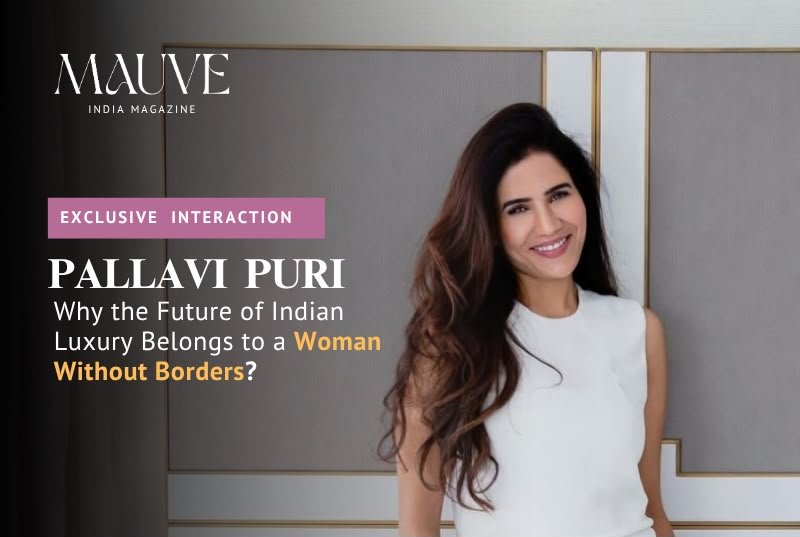
From Delhi’s rich couture heritage to Dubai’s global fashion landscape, designer Pallavi Puri is reimagining Indian luxury through fluid silhouettes, intricate craftsmanship and a contemporary design language. In an exclusive conversation with Mauve, she discusses modern Indian dressing, the artisans behind the craft and why the future of Indian fashion belongs to a woman without borders.
What does it mean to dress the modern Indian woman when her world extends beyond geography, tradition and conventional ideas of luxury? For designer Pallavi Puri, the answer lies in creating clothes that honour India’s rich design heritage while reflecting the fluidity of contemporary life.
Her design language brings together intricate Indian craftsmanship, expressive colour palettes and silhouettes that move effortlessly between grandeur and ease. Shaped by her journey between Delhi and Dubai, Puri’s perspective reflects a growing shift in Indian luxury fashion: heritage is no longer confined to ceremonial dressing but is finding its place in a more versatile, globally minded wardrobe.
In her latest collection, architectural influences, traditional textiles and elaborate detailing meet softer silhouettes and a contemporary approach to occasion wear. The result is fashion that feels distinctly Indian without being restricted by traditional categories.
As Puri puts it, “Heritage is not something that needs to be showcased in a glass case. It should be lived in, worn and continuously reinterpreted.”
It is a philosophy that runs through her work—and one that offers a compelling perspective on where contemporary Indian couture is headed.
Pallavi Puri’s Design Philosophy: Indian Heritage Meets Modern Luxury
For Puri, India remains the starting point of her creative process. Its architecture, craftsmanship, textiles and cultural diversity provide an enduring source of inspiration, but the intention is never simply to reproduce familiar references.
Instead, she approaches heritage as something that can evolve alongside the woman wearing it.
“I wanted to revisit the visual language that has always inspired me, but present it through a more contemporary lens,” she explains.
This approach allows her collections to move between richly embellished occasion pieces and relaxed separates. The craftsmanship brings depth and opulence, while the silhouettes are designed to feel relevant to a woman whose life may involve celebrations, professional commitments, international travel and everyday moments.
For Puri, modern Indian dressing is not about making traditional fashion look Western. It is about retaining the soul of Indian design while allowing women to interpret it on their own terms.
“I don’t want women to fit themselves into a prescribed mould. I would rather create pieces that allow them to create their own mould,” she says.
That distinction is central to her understanding of modern luxury. Rather than designing for one archetype, she creates space for different expressions of femininity, individuality and personal style.
Colour, Craft and the Art of Contemporary Indian Couture
Rich fuchsias, antique golds, soft blushes and jewel tones shape the emotional language of Puri’s collection. The palette moves between celebration and restraint, creating a visual dialogue that reflects the designer’s own experience of navigating different cultures and contrasting influences.
“The richer tones bring drama, celebration and a certain Indian exuberance, while the softer blushes and pastels introduce femininity and restraint,” she says.
Rather than committing to a single colour story, Puri prefers a palette that accommodates different personalities. Some women may gravitate towards dramatic, embellished pieces; others may find their expression in quieter silhouettes and understated luxury.
That same balance informs her approach to embroidery and surface detailing. Techniques such as Jamawar and sheesha, or mirror work, connect her designs to India’s textile and artisanal heritage, while their contemporary interpretation prevents the pieces from feeling purely nostalgic.
“I don’t believe embellishment needs to be excessive to feel luxurious,” Puri explains.
For her, the real skill lies in understanding the character of a traditional technique and finding a fresh context for it. The result is craftsmanship that remains recognisable while becoming relevant to a new generation of luxury consumers.
Why Comfort Is Becoming Essential to Luxury Fashion
The contemporary luxury wardrobe is expected to do more than make a visual statement. Women increasingly want garments that accommodate movement, travel and changing occasions without sacrificing the richness associated with Indian couture.
Puri approaches this expectation through silhouette, fabric, movement and the relationship between embellishment and construction.
“My approach has always been to let the craftsmanship create the richness, rather than making the silhouette unnecessarily complicated,” she says.
A beautifully embroidered garment should allow its wearer to sit comfortably, travel between cities, attend an event and move into the rest of her day without constantly adjusting what she is wearing.
“Luxury and comfort should not have to be opposites,” she says.
This philosophy also explains her interest in understated grandeur. A garment need not be covered in embellishment to feel special; the quality of a textile, the precision of embroidery or the way a silhouette falls can create an equally powerful impression.
For Puri, contemporary occasion wear exists on a spectrum—from extravagant wedding dressing to elegant eveningwear and more relaxed pieces for intimate celebrations. The woman wearing the garment determines how much of its luxury she wants to express.
Pallavi Puri’s Delhi–Dubai Journey and Its Influence on Indian Fashion
Delhi and Dubai have shaped Puri’s design vocabulary in distinct but complementary ways. Delhi has strengthened her connection to Indian textiles, embroidery, couture and traditional craftsmanship, while Dubai has exposed her to an international audience and a more culturally fluid understanding of luxury.
“Delhi gave me a deep connection with Indian craftsmanship, textiles, embroidery and the cultural richness that surrounds fashion here. Dubai introduced me to a highly global, culturally diverse audience and made me look at Indian design through a different lens,” she explains.
Living and working between the two cities has reinforced her belief that luxury is ultimately personal. Women may have different cultural references, but many share an appreciation for quality, individuality, beauty and clothing that inspires confidence.
The contrast between Delhi’s craft-led couture traditions and Dubai’s international approach to glamour is visible in Puri’s ability to move between sarees, abayas, kaftans and kurta sets while maintaining a recognisable creative identity.
“I don’t see Delhi and Dubai as opposing influences. They are two parts of a larger design conversation that continues to shape my vocabulary,” she says.
This cross-cultural perspective is increasingly relevant to Indian luxury fashion, particularly as designers engage with consumers whose lives, wardrobes and aspirations extend across borders.
The Global Indian Woman Is Redefining Luxury
The Indian woman today may live in one country, work in another and travel internationally while remaining deeply connected to her cultural roots. Her wardrobe reflects that complexity, creating opportunities for Indian craftsmanship to move beyond conventional occasion wear and into a broader luxury vocabulary.
Puri sees this as an exciting moment for Indian design. Traditional techniques and textiles can remain central to a collection while being expressed through contemporary proportions, styling and silhouettes.
“The stronger our connection with our craft, textiles and design heritage, the more confidently we can take them into contemporary contexts,” she says.
For the designer, global relevance does not mean diluting Indian identity. It means understanding how to present that identity in ways that resonate with different audiences.
“I believe Indian luxury has the opportunity to be global without becoming generic,” she explains. “The strongest proposition, for me, is one where you can recognise the roots even when the expression feels completely contemporary.”
It is a perspective shaped by experience. Working across markets has allowed Puri to see how the same garment can carry different meanings: a saree may represent heritage to one woman and contemporary glamour to another.
Rather than creating separate design identities for separate markets, she aims to maintain a consistent design language that leaves room for individual interpretation.
Preserving Indian Craftsmanship While Giving It a New Life
Behind the visual language of Indian luxury lies a network of artisans whose skills and knowledge have often been passed down through generations. For Puri, their contribution is inseparable from the value of the finished garment.
“Craftsmanship cannot exist without the people who practise it. For me, the artisan is not simply part of the production process; their skill is fundamental to the value of the garment,” she says.
Her involvement in the design process extends from selecting textiles and developing embroidery to understanding how a fabric falls and how different techniques work together. This hands-on approach allows her to bring a contemporary perspective to traditional expertise without overlooking the knowledge behind it.
She believes designers have a responsibility to help keep these techniques relevant by creating opportunities for them within contemporary fashion.
“My role is to bring my own design perspective to that expertise—to understand what the craft can do and then find a contemporary way of allowing it to shine,” she explains.
The distinction is important: preserving heritage does not mean leaving it unchanged. It means protecting the integrity of the craft while allowing its expression to evolve.
What Makes Indian Luxury Fashion Timeless?
In an industry increasingly shaped by seasonal trends and fast-moving aesthetics, Puri sees timelessness as a question of authenticity, thoughtful construction and emotional connection.
“I have never been particularly interested in creating something simply because it is fashionable for one season,” she says.
For her, a garment becomes enduring when it has a strong identity, is beautifully made and allows the woman wearing it to feel like herself. Craftsmanship plays a vital role, but so does the personal history that develops around a piece over time.
“I think the best luxury pieces become part of a woman’s personal history. She remembers where she wore them, how she felt in them and perhaps passes them on,” she reflects.
This perspective gives her approach to Indian couture a longer horizon. Rather than designing only for a particular occasion or season, she is interested in creating pieces that remain meaningful as personal style evolves.
From Delhi to Dubai Fashion Week: The Next Chapter for Pallavi Puri
With showcases planned in Delhi and Mumbai and a presentation at Dubai Fashion Week, Puri continues to explore how Indian craftsmanship can engage with different cultural audiences without losing its identity.
Delhi brings an instinctive understanding of Indian craft and couture, Mumbai offers its own relationship with entertainment and contemporary luxury, while Dubai brings together women from a wide range of cultural backgrounds.
For Puri, the collection does not need to become something different for each destination. What changes is the way audiences experience and interpret it.
“I don’t want to create separate identities for different geographies. I want the Pallavi Puri language to remain consistent while allowing women in different places to interpret it through their own experiences,” she says.
Looking ahead, she hopes to explore further possibilities at the intersection of heritage textiles, traditional techniques and contemporary design. Rather than predicting a fixed direction, she prefers to let the process evolve through new markets, encounters and creative discoveries.
The constant, however, will remain the woman at the centre of her work.
“She Is a Woman Without Borders”
Asked to capture the central idea behind her collection, Puri offers a description that also summarises her wider design philosophy.
“She is a woman without borders.”
It is an idea that moves beyond geography. The contemporary Indian woman does not have to choose between tradition and modernity, comfort and glamour, or cultural heritage and global influences. She can embrace all of them, deciding what each means to her.
“She decides what each of those things means to her,” Puri says.
Her clothes are intended to become an extension of that individuality rather than a costume that demands conformity. Rooted in Indian craftsmanship but shaped by a fluid, international outlook, the collection reflects a woman who carries her heritage confidently without allowing it to limit her possibilities.
For Pallavi Puri, the future of Indian luxury fashion is not about choosing between the local and the global. It is about creating a design language in which the two can coexist naturally.
And perhaps that is what makes the idea of a woman without borders so compelling: she knows where she comes from, but she remains entirely free to decide where she is going.