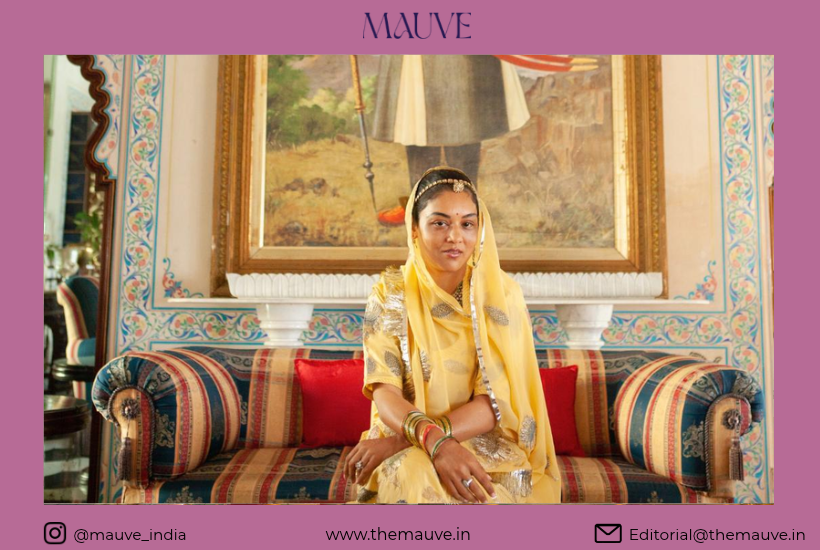
Padmaja Kumari Parmar on Mewar, the meaning of legacy, and the quiet courage of choosing values over convenience
Born into a legacy that has shaped India’s history, Padmaja Kumari Parmar is finding her own place within it. From the palaces of Udaipur to her home in Boston, from the world of heritage hospitality to philanthropy, her story is less about the privileges of an illustrious lineage and more about the responsibility of carrying it forward.
There are some places that never quite leave you. They stay in the details of your home, in the objects you choose to surround yourself with, in the memories that return unannounced and, sometimes, in the unmistakable feeling of coming home.
For Padmaja Kumari Parmar, that feeling begins with the air of Udaipur.
Now based in Boston, she has consciously created a home that carries fragments of the place she calls her own. Pichwai paintings from Nathdwara, traditional elephant motifs and intricate three-dimensional craftsmanship from Jaipur offer familiar reminders of Rajasthan. They are not merely decorative choices; they are expressions of an enduring connection to a place, its people and its cultural vocabulary.
Yet, when asked what she misses most about Udaipur, her answer is beautifully uncomplicated.
“It’s just the air,” she says. “When you land and take the first step out, there’s a feeling that you’re in a safe place.”
Perhaps that is where one begins to understand Padmaja. Her relationship with heritage is not confined to grand palaces, historical narratives or inherited possessions. It is personal, emotional and deeply connected to the idea of belonging.
A childhood beyond the palace walls
Being born into the family of Maharana Pratap comes with a historical inheritance that few can comprehend. But for Padmaja, childhood was deliberately kept away from the weight of that distinction.
Her parents, she recalls, were conscious of the world around them and particularly mindful of ensuring that their children experienced a normal, healthy upbringing. School meant being among local children, building friendships and navigating relationships without the expectation of a historical surname opening doors.
And that, she believes, became one of the most valuable gifts of her childhood.
Her father was equally supportive when it came to education. After completing her schooling in Udaipur, she was encouraged to leave home for college, an opportunity that allowed her to engage with a larger world and understand realities beyond familiar surroundings.
She eventually returned to Udaipur, where she worked alongside her father for five years before getting married.
The friendships formed during those formative years continue to hold a special place in her life. Even today, she remains connected with schoolmates, carrying relationships that were established long before the convenience of mobile phones and social media.
For someone whose family history is frequently discussed in the context of royalty and heritage, these seemingly ordinary memories are perhaps among her most treasured inheritances.
The weight of a name, the strength of a value
Some legacies are written in history books. Others are carried through stories repeated across generations.
For Padmaja, the story of Maharana Pratap is one such constant.
His bravery, his dedication to Mewar and the sacrifices he made to remain committed to his principles have remained recurring themes throughout her life. Whether in school, social settings or conversations around history, his legacy has always found its way back into her world.
But what makes these stories meaningful to her is not simply their historical significance. It is the philosophy behind them.
When asked which quality of Maharana Pratap she would most like to embody, her response is immediate in its conviction: the ability to stand by one’s values, irrespective of the circumstances.
She recalls how he chose to live in the forest rather than compromise on what he believed was right for Mewar and its people.
“I remind myself of that often: pick a value over convenience.”
It is perhaps the most revealing statement in our conversation. In a world that increasingly celebrates visibility, achievement and personal advancement, Padmaja’s idea of strength is rooted in the ability to remain steadfast.
She also acknowledges that her family might describe her as stubborn. She prefers to understand it through the lens of responsibility and reliability. Staying committed to something, she explains, can sometimes be mistaken for stubbornness.
There is a distinction she is conscious of: the intention behind the decision matters as much as the decision itself.
The woman behind the legacy
When conversations turn to identity, particularly for women born into historically significant families, the question often becomes one of balancing inheritance with individuality.
For Padmaja, the answer has evolved with time.
Her twenties and thirties were marked by ambition, hard work and the process of understanding where she wanted to belong. Today, in her forties, she speaks with a different kind of clarity. She is comfortable with who she is, proud of her background and equally conscious of the importance of establishing an identity of her own.
Motherhood, too, has contributed to this evolution. As a mother of two daughters, she views identity as something that continues to develop through experiences, relationships and the choices one makes.
She is particularly emphatic about this when speaking to young women.
“Make sure that you are aware of your own identity,” she says, encouraging women to leave room for personal growth and self-discovery.
For her, identity is not a declaration made one morning. It is an experience, a gradual understanding of oneself and one’s place in the larger picture.
There is also a certain humility in the way she speaks about her family. She does not see personal identity and inherited legacy as opposing ideas. Both can coexist, provided one understands the difference between carrying a history and allowing it to define every aspect of one’s life.
Learning hospitality, beyond the grandeur
Her professional journey began with an education in hospitality that extended beyond the familiar landscapes of Rajasthan.
After college, Padmaja moved to New York, where she worked at the Four Seasons Hotel. The experience offered her an opportunity to understand the workings of one of the world’s leading hospitality brands.
Eventually, the pull of home brought her back to Udaipur.
Between 2006 and 2011, she became involved in her father’s hospitality business, initially taking charge of one hotel before expanding her responsibilities across the hotels and the wider HRH Group.
It was an experience she describes as demanding but deeply rewarding.
Her father’s vision for the group was particularly interesting: preserve the authenticity of heritage properties while ensuring that contemporary travellers never felt they were compromising on comfort.
The challenge was to make history liveable.
Palaces built centuries ago were never designed with modern technology in mind. Their extraordinarily thick walls, traditional architecture and historical character presented practical challenges, particularly when guests expected uninterrupted Wi-Fi and contemporary services.
But the thoughtfulness of hospitality, she explains, often lies in the things guests never see.
Behind the scenes, considerable effort went into ensuring that the experience remained seamless.
The architecture could tell a story of another century, but the service needed to understand the expectations of the present.
When I ask what she notices first when visiting a hotel, her answer returns to something more fundamental than design, luxury or amenities.
“Hospitality is about feeling invited, feeling welcomed. It’s like going to a home.”
For her, true hospitality is the ability to make every guest feel individually recognised, even in a property with hundreds of rooms and an equally large number of visitors.
It could be something as simple as having a returning guest’s favourite preferences already taken care of.
Luxury, in this sense, is not necessarily about what is displayed. It is about what is remembered.
Friends of Mewar: Turning belonging into purpose
Marriage in 2011 brought another geographical transition, this time to the United States. Continuing to manage hotel operations from America was not a practical possibility, but the desire to remain connected to India and Rajasthan never diminished.
That desire eventually took shape as Friends of Mewar, a foundation established by Padmaja in the United States.
The organisation supports work in rural communities, with much of its current focus in Rajasthan. More importantly, it creates a bridge between people who wish to contribute to meaningful initiatives and communities where that support can make a difference.
Her motivation was personal, but the vision extended beyond herself.
She wanted to transform the emotional connection she felt towards India into something tangible, something that could encourage others, irrespective of whether they were Indian or American, to participate in supporting rural development.
Today, social media has become an important medium for sharing this work and inviting people to engage with the foundation.
She encourages interested individuals to explore Friends of Mewar’s work and reach out if something resonates with them.
There is a sense of fulfilment in knowing that the work is being noticed, but perhaps more importantly, that it is inspiring others to participate.
The idea, as she puts it, is to feel inspired and inspire others.
An heirloom is never just an object
For someone whose family history is so closely intertwined with the history of Mewar, the idea of inheritance naturally extends to personal possessions.
When asked about jewellery and family heirlooms, Padmaja speaks about the pieces gifted by her parents and those that have belonged to the family over generations.
But she is quick to distinguish their emotional significance from their monetary value.
It is never about how expensive a piece is or what it represents in material terms. It is about whose it was, where it came from and the memories attached to it.
She hopes to pass these possessions on to her daughters, who may eventually pass them on to their own children.
An heirloom, in her understanding, is not something to be enjoyed solely for personal satisfaction. It belongs to a larger family story.
And perhaps that is also how she views heritage itself: not as something to possess, but as something to preserve, respect and eventually share.
Mewar, experienced as a home
Towards the end of our conversation, we return to the subject that seems to bring together so many aspects of Padmaja’s life: the experience of Mewar.
Speaking about the HRH Group of Hotels, she describes properties that carry the stories of her grandparents and generations before them. For her, these are not simply heritage hotels. They are spaces in which family memories, architecture and the cultural history of Rajasthan continue to exist.
The aspiration is for guests to experience something beyond a beautiful stay: a connection with their own roots and with India’s extraordinary civilisational heritage.
She believes that heritage hospitality offers a different kind of experience from contemporary hotels. It allows visitors to engage with history not through a textbook or a photograph, but through the atmosphere of a place.
And for someone visiting Rajasthan for the first time, her recommendation is refreshingly thoughtful.
Rather than following a predetermined itinerary, she encourages travellers to understand what they genuinely seek. Do they want the experience of staying within a palace complex? Or would they prefer a quaint setting that offers the charm of Rajasthan with the comforts of contemporary living?
The state, she believes, has something for every kind of traveller.
But Udaipur will always be her recommendation.
She recalls seeing a social media post that described Udaipur as a person one would fall in love with. It is a sentiment she wholeheartedly understands.
She misses it. She loves it. And she hopes that everyone who visits discovers a connection of their own.
Perhaps that is the most beautiful way to understand Padmaja Kumari Parmar’s relationship with her inheritance. It is not about preserving a world in isolation or holding on to a past that cannot be recreated. It is about allowing that past to remain relevant in the present.
From a childhood shaped by ordinary friendships to a professional journey across continents, from the hospitality business to philanthropy, she has found ways to remain connected to where she comes from while continuing to discover who she is.
And in a conversation that began with the familiar comforts of home, one thought lingers long after it ends:
A legacy may tell you where you come from. Your values, however, determine what you leave behind.