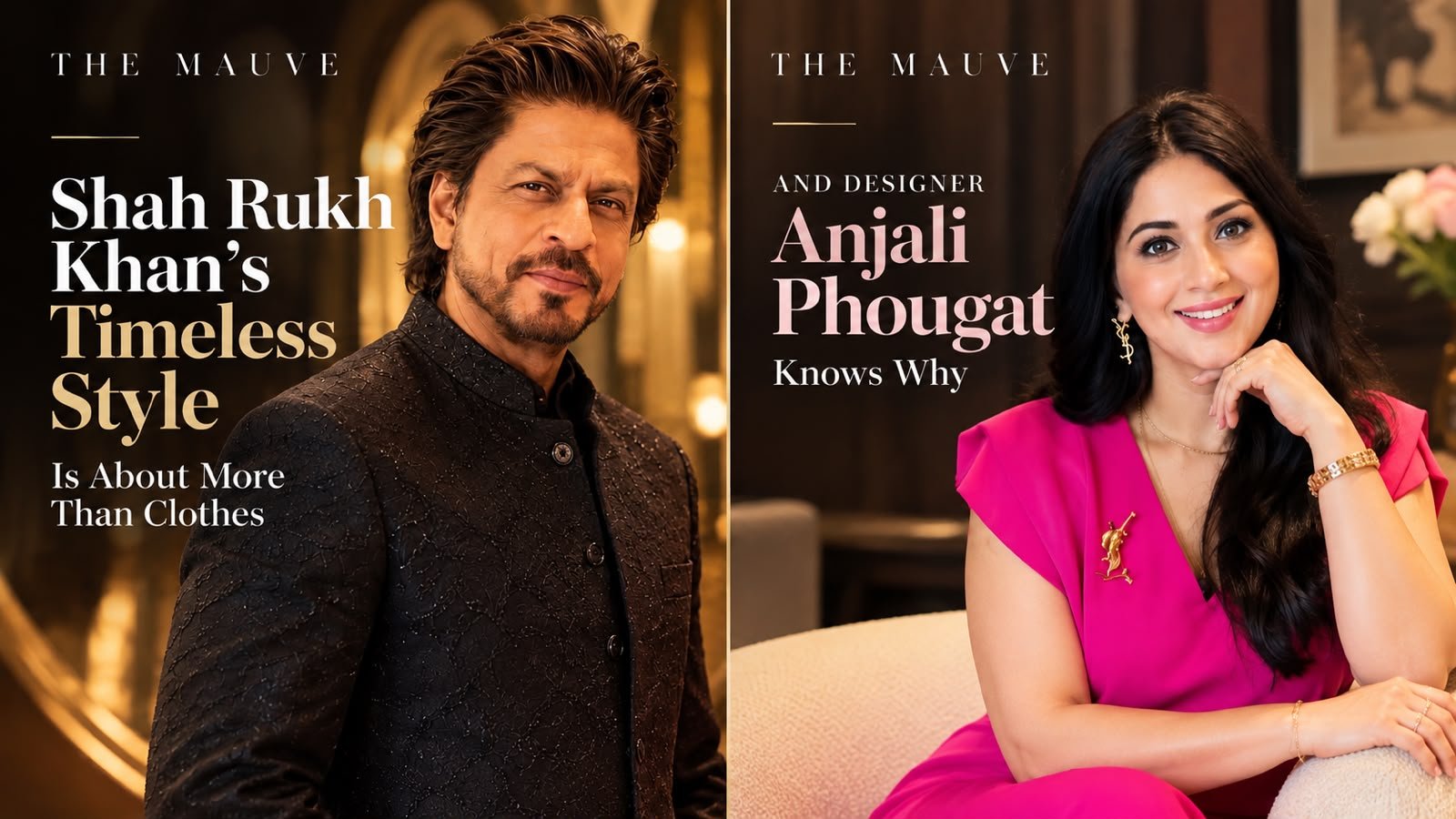
From the enduring elegance of the bandhgala to the emotional grandeur of Devdas, designer Anjali Phougat reflects on the superstar’s unmistakable style, the power of personal presence and the outfit she would create for the King of Bollywood.
Some people wear clothes. Others make them part of their mythology. Shah Rukh Khan belongs to the latter category.
Across decades of cinema, changing fashion trends and an ever-evolving public image, the superstar has retained something that cannot be bought off a designer rack: an unmistakable sense of presence. His style is not simply about tailoring, statement pieces or the occasional red-carpet appearance. It is about the personality that gives every silhouette its meaning, the nostalgia attached to his most memorable characters and the affection of a nation that has grown up watching him.
For fashion designer Anjali Phougat, this is precisely what makes Shah Rukh Khan a style icon. “Style is not what you wear. Style is what the room feels when you enter it,” she says.
It is a distinction that separates personal style from fashion itself. An expensive suit can be replicated. A memorable silhouette can inspire a thousand imitations. But the charisma, familiarity and emotional connection that Shah Rukh brings to his appearance are considerably harder to reproduce.
“Shah Rukh Khan does not wear clothes. He wears an era, a memory, a nation’s affection,” Phougat says. “The garment is only the frame; his energy is the portrait.”
It is a compelling way to understand his enduring appeal. In an industry where image is constantly constructed and reconstructed, Shah Rukh’s style feels deeply personal because it is inseparable from the man himself. As Phougat puts it, “You can copy the suit, but you cannot copy the soul inside it.”
Why the Bandhgala Remains His Most Compelling Silhouette
If Phougat were to choose one silhouette that captures Shah Rukh Khan at his most distinctive, the answer would be the bandhgala.
With its structured shoulders, clean lines and unmistakably Indian heritage, the traditional jacket occupies an interesting space between formal dressing and cultural identity. It can feel ceremonial without becoming excessive, contemporary without abandoning its roots, and powerful without relying on overt embellishment.
On Shah Rukh, Phougat believes, it achieves a particularly compelling balance.
“I look at the line of the shoulder and the honesty of the fabric. And on him, nothing beats the bandhgala,” she says.
Her preference is not simply about the garment’s visual appeal. It is about what the silhouette represents: an Indian design language that can hold its own in a global setting. The bandhgala does not need to imitate Western formalwear to feel international. Its strength lies in its own identity.
“It is heritage standing tall in the modern world,” she says.
The idea also speaks to a larger conversation about contemporary menswear, where cultural references, considered tailoring and individual expression increasingly matter as much as labels. For Phougat, the most successful clothing does not compete with the person wearing it. It reveals something about them.
“When a man knows who he is, even simplicity looks like coronation,” she says.
Devdas: When Costume Becomes Emotion
Ask Phougat to identify the Shah Rukh Khan film whose costumes left the strongest impression on her, and she arrives at Devdas.
Sanjay Leela Bhansali’s 2002 period drama remains memorable for its visual extravagance, intricate detailing and emotionally charged world. Its costumes were never merely decorative additions to the frame. They helped establish character, communicate status and heighten the film’s operatic atmosphere.
For Phougat, this is what makes the film such a significant example of costume-led storytelling.
“Devdas,” she says. “In one film he wore grief in unstitched white and celebration in hand-embroidered gold.”
The contrast is telling. White becomes an expression of vulnerability and loss, while gold carries the weight of spectacle, tradition and celebration. The clothing does not simply tell the audience what a character looks like; it contributes to how that character feels.
“The costume understood what I have built my entire house upon. Clothes are emotions made visible,” she says.
It is a philosophy that extends beyond cinema. In fashion, the most memorable pieces often succeed because they communicate something before the wearer says a word. A particular fabric can suggest restraint; a dramatic silhouette can convey confidence; embroidery can preserve the memory of a craft, a culture or an occasion.
In Devdas, Phougat sees an actor who understood how to allow clothing to become part of the performance rather than treating it as an accessory to fame.
“Most actors wear costumes. In Devdas, the clothes wore the story, and he let them,” she says.
For her, that willingness to disappear into a character is what elevates performance into art. “That surrender is the mark of a true artist,” she adds.
The Quiet Details Behind Shah Rukh Khan’s Star Power
Phougat’s admiration is not based solely on Shah Rukh’s cinematic wardrobe. A personal encounter at an airport, where she recalls seeing him alongside Katrina Kaif, offered her another perspective on the superstar’s appeal.
“‘Mesmerizing’ is exactly the word,” she says.
What stayed with her was not an elaborate gesture or a carefully staged moment. Instead, she remembers the ease with which he carried himself.
“You can feel when a person carries their success lightly. There was no performance in him, only presence,” she says.
For a designer, the smallest details can be revealing. The way a person stands, the ease of their movements and the warmth they extend to others can tell a story that no garment can manufacture.
“As a designer I notice everything. The ease of his posture, the warmth he gave a stranger’s moment,” Phougat recalls.
It is an observation that brings her perspective on style full circle. Clothes may shape the first impression, but the person wearing them determines what remains in the memory.
“Some people wear stardom like a costume. He wears it like skin,” she says.
The Outfit She Would Design for the King of Bollywood
Given the opportunity to create a bespoke look for Shah Rukh Khan, Phougat would return to the silhouette she believes suits him best: the bandhgala. Her imagined creation would be a midnight-black bandhgala in silk-wool, designed to feel grounded, powerful and unmistakably his.
The real statement, however, would emerge through the embroidery.
She envisions gold zardozi stars scattered across one shoulder, each representing a year of Shah Rukh’s career. The concept, which she would call The King Constellation, turns a garment into a tribute to the journey of an actor whose work has become part of India’s collective cultural memory.
“Each star marking a year, he taught India to dream,” she says.
It is a fitting idea for a designer who sees clothing as a language of emotion rather than simply an exercise in aesthetics. The black bandhgala would provide the restraint; the gold embroidery would tell the story. Together, they would honour a career without overwhelming the person at its centre.
“He never needed a crown. So I would stitch his dreams back onto his shoulders instead,” Phougat concludes.
Perhaps that is the most interesting thing about Shah Rukh Khan’s enduring style. It does not depend on a single outfit, a particular designer or a fleeting trend. It lives in the relationship between the clothes, the character and the cultural memory attached to him.
And sometimes, as Phougat’s imagined King Constellation suggests, the most meaningful fashion statement is not about wearing something extraordinary. It is about finding a way to tell an extraordinary story.