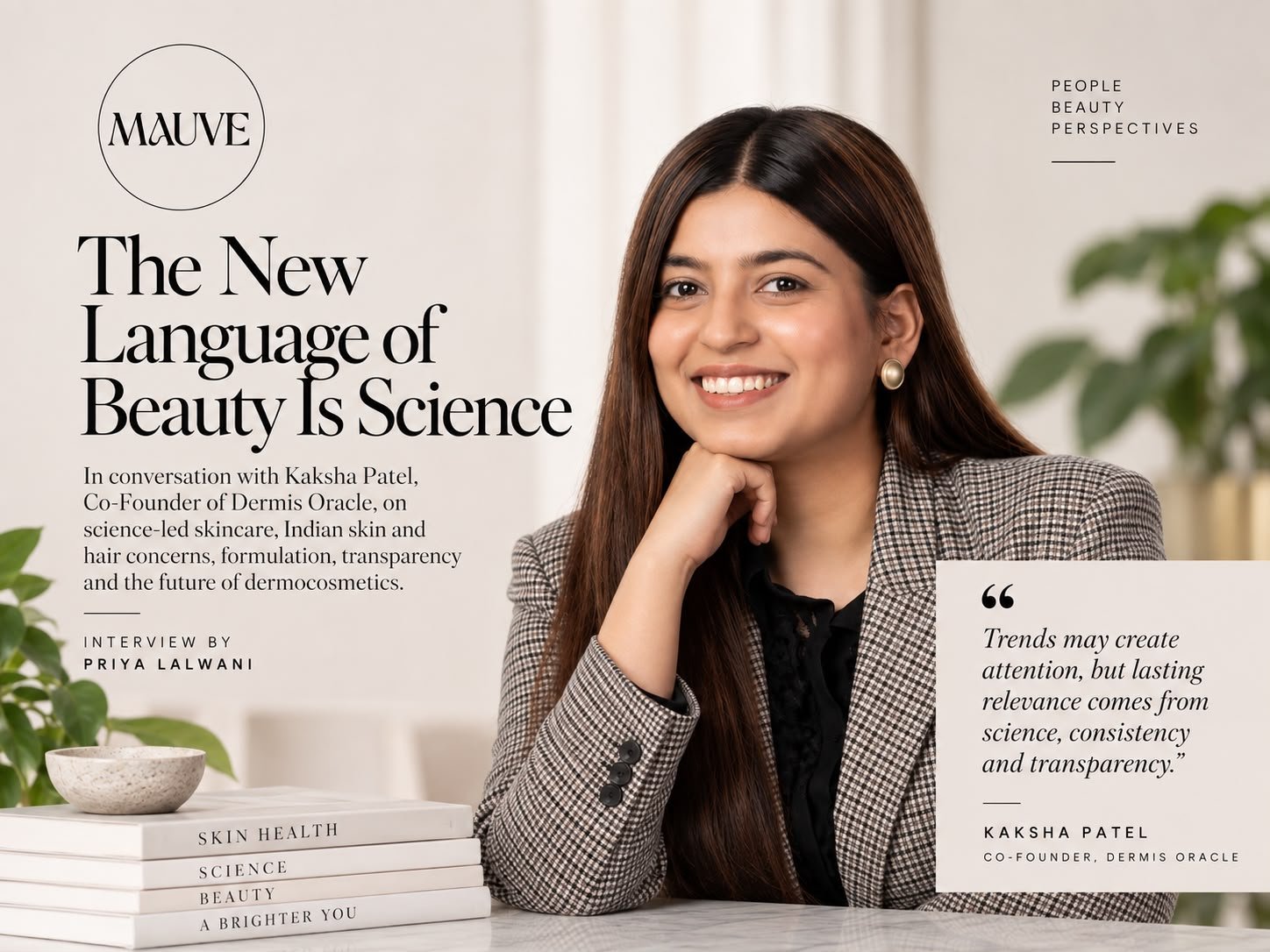
In conversation with Kaksha Patel, Co-Founder, Dermis Oracle
Interview by Priya Lalwani
Beauty is becoming increasingly intelligent.
For the modern Indian consumer, skincare is no longer simply about beautiful packaging, aspirational imagery or promises of transformation. Ingredients are being scrutinised, claims are being questioned and efficacy is becoming central to the purchase decision. As consumers become more aware of acne, pigmentation, sensitivity, hair fall and scalp health, the language of beauty is steadily shifting towards evidence, formulation and results.
At the intersection of this evolution is Dermis Oracle, a science-led skincare and haircare brand co-founded by Kaksha Patel and Ankit. Built around targeted concerns and focused formulations, the brand approaches beauty through the lens of dermatological understanding rather than fleeting trends.
In this conversation with Mauve, Kaksha Patel discusses the changing Indian beauty consumer, the difference between genuine science and scientific marketing, the importance of scalp health, formulation for Indian conditions and why the future of beauty may belong to brands that can substantiate what they promise.
Q1. Skincare has moved from being largely beauty-driven to increasingly science-driven. What has caused this shift in the Indian consumer?
The shift is driven by a more informed and evidence-conscious consumer. People are looking beyond packaging and beauty claims to understand ingredients, efficacy and the science behind products. Growing awareness of concerns such as acne, pigmentation and sensitivity is also driving interest in science-backed skincare.
Q2. What gap did you and Ankit identify in the Indian skincare and haircare market that made you believe Dermis Oracle needed to exist?
We identified a gap between brand recognition and actual product efficacy. Consumers increasingly need multifunctional products that address specific concerns without complex routines.
In haircare, the focus is often on hair length rather than the scalp, which is fundamental to healthy hair growth. These gaps shaped our focused approach at Dermis Oracle.
Q3. What did “science-led” mean to you beyond being a claim on a product label?
For us, science-led means understanding skin and scalp concerns and addressing them through targeted active percentages. Our formulations are built around clinical data rather than fleeting trends.
The real measure is whether consumers experience tangible, lasting results.
Q4. How can consumers distinguish genuine scientific formulation from science used simply as marketing language?
Consumers should look beyond scientific jargon or familiar actives. A genuine science-led formulation uses appropriate ingredients and concentrations for a specific concern, supported by credible evidence.
Science should be evident in the product, not just its marketing.
Q5. How do dermatological expertise and research influence a Dermis Oracle product?
It begins with identifying a genuine skin, hair or scalp concern and understanding it from a dermatological perspective.
Research helps evaluate suitable ingredients and formulation requirements, ensuring the product is built around a defined need rather than a trend.
Q6. What are consumers getting wrong about building an effective skincare or haircare routine?
The biggest challenge is the amount of online information. Consumers can easily end up chasing trends or following advice without adequate scientific basis.
Understanding the actual concern and seeking dermatologist guidance can help build a routine that is appropriate and effective.
Q7. How much does the Indian context influence the way you formulate?
The Indian context is crucial. Heat, humidity, pollution and changing conditions, combined with diverse skin and hair characteristics, influence both product performance and user experience.
Effective formulation therefore needs to account for the environment and genuine consumer needs.
Q8. How do you decide what is genuinely worth pursuing and what is simply hype?
The starting point is whether something solves a meaningful problem.
We assess the evidence, relevance to a defined concern, and formulation compatibility. Innovation matters only when it translates into a well-formulated solution.
Q9. How do you navigate consumers’ expectations of quick results?
We believe in setting realistic expectations rather than promising instant transformation.
Skin and scalp concerns can be complex, and recovery is a biological process. Our focus is on effective solutions that address underlying concerns and support lasting results.
Q10. What has building Dermis Oracle taught you about entrepreneurship?
It has taught me to look beyond marketing claims and understand the actual mechanisms and effectiveness of products.
Truly effective solutions can sometimes be overshadowed by heavily promoted alternatives, making critical evaluation and prioritising efficacy essential.
Q11. Was there a moment when you had to rethink an assumption about the consumer or market?
We realised that being informed does not always make a buying decision straightforward.
This reinforced the importance of making a product’s purpose immediately clear rather than expecting consumers to navigate complex information.
Q12. What will separate enduring dermocosmetic brands from short-lived trends?
It will come down to the depth of thinking behind the brand.
Trends may create attention, but lasting relevance requires an understanding of skin and scalp concerns, strong formulation principles, consistency and transparency.
Q13. Where do you see the biggest opportunity for innovation in Indian dermatological skincare and haircare?
The opportunity lies in creating solutions for the unique needs of Indian skin and hair.
Dermis Oracle aims to contribute through streamlined formulations that address complex concerns, encourage compliance and deliver visible results.
Q14. What would you like Indian consumers to demand from skincare brands five years from now?
I would like consumers to demand greater transparency, stronger evidence and accountability.
They should ask what a product addresses, why its ingredients have been chosen and what evidence supports its claims. The industry should compete less on promises and more on science, formulation and results.
The Future of Beauty Is More Informed
The evolution of Indian beauty is not necessarily about making routines more complicated. It is about making them more intentional.
As consumers become more discerning, the conversation is moving beyond what a product looks like or how compellingly it is marketed. The questions are becoming more fundamental: What problem does it solve? Why these ingredients? At what concentration? And what evidence supports the claim?
For brands operating in the dermocosmetic space, that shift creates both an opportunity and a responsibility.
And if Dermis Oracle’s philosophy is any indication, the next chapter of Indian beauty may be defined not by louder promises, but by better questions—and formulations that can answer them.