For many people, the hardest part of a legal problem isn’t necessarily the law itself.
It is knowing where to begin.
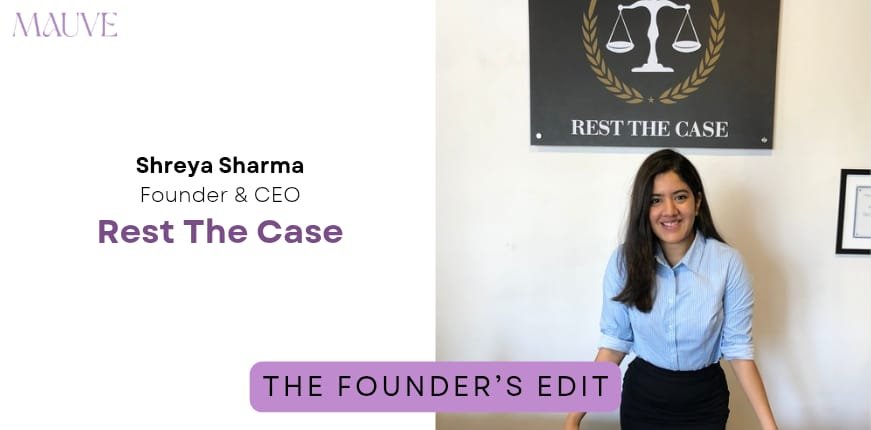
For Shreya Sharma, Founder & CEO of Rest The Case, that realisation came through a conversation with a woman in her fifties who was struggling with a property dispute. She had a legal problem, but what seemed to trouble her more was the uncertainty surrounding it. She didn’t know which lawyer to trust, what her rights were, or even how to navigate the system.
That interaction stayed with Sharma.
It made her recognise a larger problem within the legal ecosystem: solutions often exist, but accessing them can feel intimidating, complicated and opaque.
“Legal problems often become overwhelming not because solutions don’t exist, but because people don’t know how to access them.”
Rest The Case was born from the desire to change that experience.
The ambition, however, has grown far beyond simply helping individuals find lawyers.
As Sharma began looking more closely at the legal industry, she discovered that the friction extended across the ecosystem. Businesses were struggling with contracts, compliance, employment matters, intellectual property and regulatory requirements without necessarily having the resources to maintain large in-house legal teams.
Lawyers, meanwhile, were spending significant amounts of their time on repetitive tasks—drafting, research, citation checks and document reviews—rather than the strategic work that actually required their expertise.
The problem, therefore, wasn’t simply access.
It was inefficiency.
And that changed the trajectory of Rest The Case.
Today, the company is building what Sharma describes as a legal ecosystem—one that serves individuals, businesses and legal professionals through different but interconnected solutions.
For businesses, VCLO (Virtual Chief Legal Officer) provides ongoing legal support across contracts, compliance, governance, intellectual property, employment matters, fundraising documentation and everyday legal requirements.
For lawyers, LiA, an AI-powered legal assistant designed for Indian legal practice, aims to reduce the burden of repetitive research, drafting, citation and document-related work.
The technology may have evolved considerably from the company’s original proposition, but the underlying question remains exactly the same:
How do you remove friction from legal services?
That question has also shaped Sharma’s view of technology itself.
She doesn’t believe the future of legal services is about replacing human expertise with machines.
Law is inherently contextual. Every client, dispute and business decision carries its own circumstances. Technology can improve efficiency, but judgment remains human.
The objective is therefore not to automate the lawyer away.
It is to give the lawyer more time to be a lawyer.
That philosophy challenges another misconception Sharma frequently encounters: that legal services are only relevant once something has gone wrong.
In reality, she believes the best legal advice is preventive.
A founder should think about legal structures before signing a contract. A growing business should address compliance before it becomes a problem. Intellectual property should be protected before it is challenged. Employment decisions should be made with legal clarity rather than repaired after a dispute.
In that sense, the future of law may become less reactive and considerably more embedded in everyday decision-making.
And that shift is already influencing Rest The Case.
Some of the company’s most important developments have come directly from listening to its users.
Businesses repeatedly expressed the need for continuous legal guidance rather than occasional intervention. They didn’t necessarily need a lawyer only when a dispute arose—they needed someone who could help them navigate the legal questions that emerged as the business grew.
That insight led to VCLO.
Lawyers offered a different perspective. Their frustration centred on the amount of time consumed by repetitive work.
That became the foundation for LiA.
For Sharma, this is a crucial part of how the company innovates.
The roadmap doesn’t begin with the question of what technology can do.
It begins with what people actually need.
That people-first approach extends to the company’s definition of its customer.
There is no single demographic that defines the Rest The Case community.
There are founders building their first companies, individuals navigating deeply personal legal decisions, SMEs looking for dependable legal support and lawyers seeking better ways to practise.
What connects them isn’t age or profession.
It is a desire for clarity.
They want to understand their position, know their options and move forward with greater confidence.
That desire for clarity also explains how Sharma thinks about loyalty.
Rest The Case doesn’t want to be remembered only when someone has a legal emergency.
It wants legal support to become part of how people make decisions before an emergency exists.
Education therefore becomes as important as service.
The company invests in simplifying complex legal concepts, supporting businesses throughout their growth journeys and creating tools that help professionals work more effectively.
In a category often associated with complexity, making something understandable becomes its own form of value.
For Sharma, the strongest measure of the company’s health isn’t necessarily revenue.
It is continued trust.
A business that continues using VCLO as it grows.
A lawyer who makes LiA part of their everyday practice.
A consumer who returns to Rest The Case whenever a new legal question arises.
These repeated relationships signal something more important than a single transaction: the company has become part of someone’s decision-making infrastructure.
That trust has been particularly hard-earned.
Being a young founder in a traditionally established industry meant Sharma encountered questions about credibility early in her journey.
Could someone young build something sustainable in an industry where experience and reputation carry enormous weight?
The answer, she learned, could not be argued into existence.
It had to be demonstrated.
“Credibility isn’t built through titles or age. It’s built through consistency.”
Every promise kept, every client served, every product improved and every problem solved becomes another small deposit into that account of trust.
It is perhaps the most consequential lesson her journey has given her.
And it has also changed her role as a founder.
In the early days, Sharma was involved in almost everything—onboarding lawyers, speaking with clients, shaping products and managing operations.
Today, her responsibility is increasingly about direction.
Building teams.
Protecting the company’s purpose.
Understanding where the legal industry is moving.
And asking the questions that will matter next.
She no longer sees leadership as having every answer.
Instead, she sees it as creating the conditions in which the right people can find better answers.
Curiosity, resilience, empathy and adaptability have therefore become more important to her than control.
The legal industry is entering a period of significant change. AI will increasingly handle repetitive tasks. Businesses will become more proactive about legal risk. Consumers will expect professional services to be as accessible and seamless as the other services they use every day.
But for Sharma, technology is only meaningful if it makes the experience more human—not less.
The ambition behind Rest The Case began with one woman who didn’t know where to turn.
Today, it has expanded into something considerably larger: an attempt to make legal support less intimidating, more proactive and more accessible across the entire ecosystem.
Because perhaps the future of law isn’t simply about making legal services digital.
It’s about making people feel capable of navigating them.
And that may be the most important case Rest The Case is trying to build.