When the copycat culture starts moving upwards, who really owns luxury?
There was a time when the hierarchy of fashion was almost unquestionable.
The big designers created. The small designers followed.
A celebrated designer would introduce a silhouette, embroidery technique, colour palette or aesthetic, and soon enough, versions of it would appear everywhere — from smaller boutiques to local markets and, eventually, Sarojini Nagar.
The direction of influence was obvious:
Big designer → small designer → mass market.
But what happens when that arrow starts moving in the opposite direction?
Small designer → viral culture → big brand.
That, to me, is one of the most interesting shifts happening in fashion today.
And it makes me wonder:
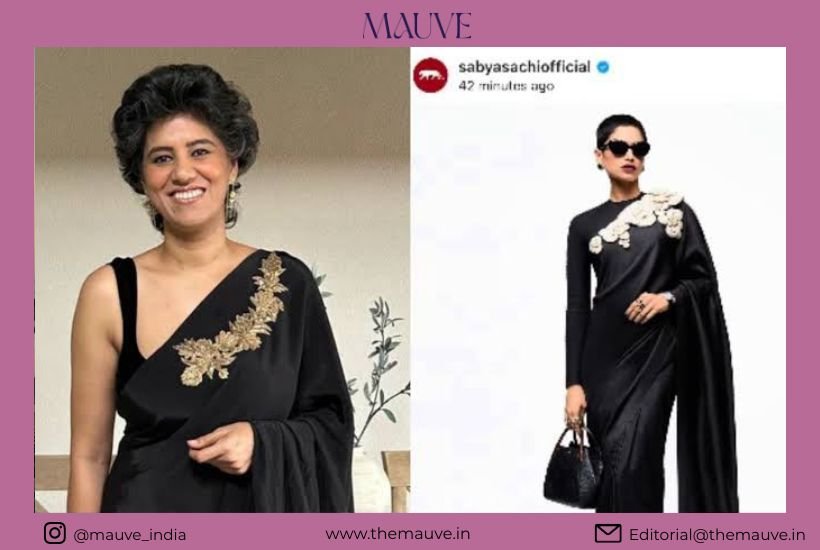
Are we going to find Sabyasachi at Sarojini now?
Of course, not literally.
The question is about the hierarchy.
Because the internet has fundamentally changed who gets to create a trend.
A young, independent designer can create a collection today, photograph it on a phone, put it on Instagram, and potentially reach millions of people without a fashion week, a global retail network or a multimillion-rupee campaign.
The traditional fashion calendar has been replaced, in many ways, by the algorithm.
And Gen Z understands this ecosystem exceptionally well.
They don’t necessarily wait for fashion houses to tell them what is fashionable.
They create, remix, reinterpret and circulate aesthetics at an extraordinary speed.
A homegrown designer can take something deeply Indian — a textile, an embroidery technique, an old silhouette, a craft tradition — and give it a contemporary context.
If the audience responds, the idea travels.
And suddenly, the small designer isn’t following culture.
They are creating it.
The Great Reversal
For decades, independent designers wanted to become big brands.
Today, something fascinating is happening: big brands increasingly have to remain culturally relevant to audiences who are discovering trends from independent creators first.
This doesn’t necessarily mean that every major luxury house is copying smaller designers.
It means the traditional monopoly over trend creation has weakened.
And that is a very important distinction.
Because luxury used to have an almost editorial authority.
A fashion house could decide what was desirable.
Today, desirability can emerge from anywhere.
A designer in Mumbai.
A jewellery maker in Jaipur.
A textile artist in Kolkata.
A young creator working out of their bedroom.
A small Instagram label with 5,000 followers.
A craft community that has existed for generations.
The audience decides what travels.
And once something travels, even the biggest brands have to pay attention.
So, Is Gen Z Actually Better?
We love comparing generations.
Millennials versus Gen Z.
Who has better taste?
Who understands fashion better?
Who is more creative?
I don’t think Gen Z is necessarily better.
But Gen Z operates differently.
And that difference matters.
Gen Z has grown up in a world where the consumer is also a creator.
They don’t simply consume fashion.
They participate in it.
They don’t necessarily need a luxury house to validate an aesthetic before embracing it.
And that creates a problem for traditional luxury:
speed.
A massive brand can have enormous resources, but it also has enormous machinery.
There are teams.
Approvals.
Campaigns.
Brand guidelines.
Global positioning.
Retail strategies.
Celebrity associations.
And millions spent on creating and protecting the perception of exclusivity.
The independent designer has something very different.
Freedom.
They can experiment.
They can fail.
They can change direction.
They can respond to culture almost immediately.
And sometimes, that freedom produces the most exciting design.
But Then What Are We Paying For?
This is where I think the conversation becomes uncomfortable.
If a smaller designer can create something equally compelling — with beautiful craftsmanship, interesting design and a strong point of view — why does the consumer automatically assume that the bigger name is worth ten times more?
What exactly is the premium paying for?
Craftsmanship?
Materials?
Originality?
The designer’s vision?
Or the brand ecosystem surrounding the product?
Because there is a difference between paying for luxury and paying for the perception of luxury.
And this is where I have always believed in homegrown brands.
Not because every homegrown brand is superior.
Not because every established luxury brand is overrated.
But because there is something incredibly valuable about knowing where your product came from.
Who designed it.
Who made it.
What craft went into it.
And why it exists.
The growing Indian homegrown-design ecosystem is already built around ideas like individuality, craftsmanship, discovery and a distinctly Indian point of view. (Ekke)
That, to me, is luxury.
The Sabyasachi Question
Sabyasachi is actually an interesting case study here — precisely because his own brand story is built around taking Indian heritage crafts and placing them into a contemporary luxury language.
The brand describes itself as rooted in heritage, quality and craftsmanship, and its own history explicitly talks about combining Indian heritage crafts with contemporary silhouettes. (Aditya Birla Group)
And there is no denying what that has achieved.
Sabyasachi has helped put Indian craft and Indian luxury into a global conversation. His collaborations, international expansion and cultural positioning have made the brand one of India’s most recognisable luxury houses. (Vogue)
But that success creates another question for the consumer:
If Indian craftsmanship is the foundation of the luxury story, why should the consumer only look upwards at the most famous label?
Why not look sideways?
Why not discover the smaller designer?
Why not find the artisan?
Why not buy from the person whose work made you stop scrolling in the first place?
Because perhaps the next Sabyasachi isn’t necessarily another giant luxury house.
Perhaps it is the designer with 3,000 Instagram followers today.
The New Luxury Consumer
This is where I think the definition of luxury is changing.
The old luxury consumer asked:
“What brand is this?”
The new luxury consumer increasingly asks:
“Who made this?”
“What is the story?”
“Is it original?”
“Where did it come from?”
“Why is it worth this much?”
And those are much more interesting questions.
Because if the only answer to “Why is this so expensive?” is “Because of the brand name”, then perhaps we’re not talking about product value anymore.
We’re talking about brand value.
And there is nothing inherently wrong with paying for brand value.
That’s what luxury businesses are built on.
But consumers should understand the distinction.
Maybe the Future Isn’t Bigger
Maybe the future of luxury isn’t about finding the biggest brand.
Maybe it is about finding the most interesting one.
A brand that hasn’t spent years teaching you that it is luxurious.
A designer whose work makes you understand it.
A craftsperson whose skill doesn’t need a celebrity campaign to validate it.
A homegrown label that doesn’t need to look international because being Indian is already its point of difference.
And perhaps that is the real reversal happening in fashion.
The question is no longer:
“When will this small designer become a big designer?”
It is:
“How many big designers are watching the small designer?”
So no, we probably aren’t going to find Sabyasachi at Sarojini.
But perhaps we should stop looking at Sarojini as merely the place where people copy luxury.
Because the next great luxury idea might already be coming from somewhere much smaller.
And by the time the biggest brands discover it—
the consumer may have already moved on.
Because real luxury was never supposed to be about the tag.
It was supposed to be about the art.