
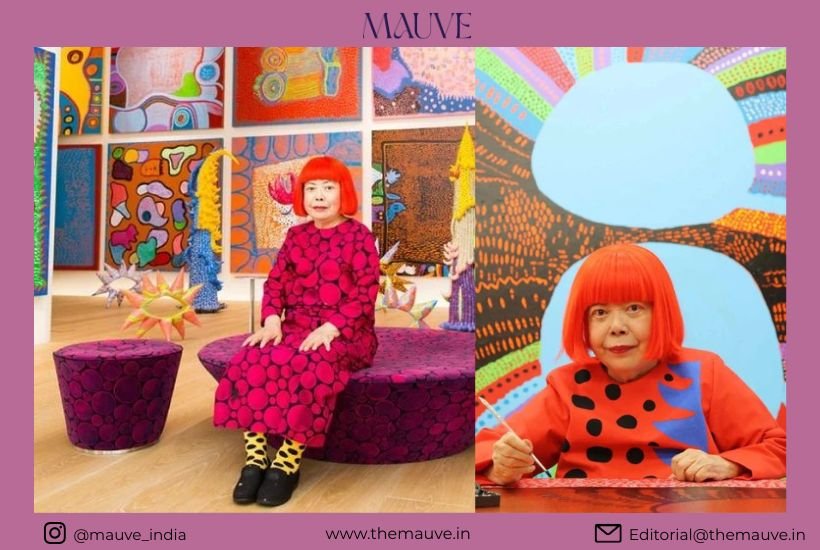
The Japanese artist who transformed polka dots, pumpkins and mirrors into a language of infinity has died at 97. But Yayoi Kusama leaves behind something far greater than a recognisable visual signature: a world that taught us to see beyond the edges of the self.
There are artists whose work you recognise.
And then there are artists whose worlds you recognise.
Yayoi Kusama belonged to the latter.
The red bob. The polka dots. The pumpkins. The kaleidoscopic rooms of mirrors and light. Her work became so instantly recognisable that it eventually travelled far beyond museums and galleries, finding a second life on social media, in fashion, popular culture and the millions of photographs taken inside her Infinity Mirror Rooms.
But before Kusama became a global cultural phenomenon, she was an outsider.
And perhaps that is the most extraordinary part of her story.
Yayoi Kusama died in a Tokyo hospital on 14 August 2026, aged 97, her company, Yayoi Kusama Inc, announced. She continued painting until her final days.
“Throughout an extraordinary lifetime devoted entirely to artistic creation,” her company said, Kusama pursued a career spanning visual art, performance, fiction and poetry.
It is difficult to imagine a more fitting description of an artist who spent her life trying to make the infinite visible.
Before the Dots Came the Flowers
Born in Matsumoto, Japan, in 1929, Kusama grew up in a wealthy family that ran plant nurseries.
Flowers became an early obsession.
As a child, she experienced hallucinations in which flowers appeared to swarm around her and speak to her. Rather than simply being frightened by what she saw, Kusama began drawing it.
Art became her language for confronting a world that often appeared larger, stranger and more overwhelming than herself.
That impulse would remain at the centre of her practice for decades.
The idea of self-obliteration—of dissolving the boundaries between the individual, the surrounding world and infinity—became one of the defining concepts of her work.
She once described seeing a pattern spread from a tablecloth across the room, eventually covering her body and the universe.
The dots were no longer merely dots.
They were infinity.
Leaving Japan, Finding New York
Kusama studied traditional Japanese painting in Kyoto but became increasingly frustrated by its limitations.
In 1958, she left Japan for New York.
She arrived with little money and an enormous ambition.
New York in the 1960s was becoming the centre of an artistic revolution, and Kusama inserted herself into its most experimental circles.
She developed her Infinity Net paintings—vast canvases covered in seemingly endless repetitions of painted marks.
The works were obsessive, labour-intensive and hypnotic.
They also became the foundation for the visual language that would eventually make her famous.
In 1962, one of her Infinity Net paintings was sold to artists Donald Judd and Frank Stella for $75.
More than five decades later, Kusama’s White No. 28 sold for $7.1 million at auction, at the time a record for a work by a living female artist.
The numbers tell one story.
The journey tells another.
An Outsider in an Art World That Wasn’t Ready
Kusama worked alongside—and sometimes ahead of—artists associated with pop art and minimalism.
But she never felt fully embraced by the art establishment.
She maintained that ideas she had pioneered were subsequently appropriated by better-connected white male artists while her contribution was overlooked.
It is one of the recurring tensions of her career:
Kusama was often ahead of the moment, only to be recognised once the world had caught up.
Her work challenged conventions around gender, sexuality, consumerism and the idea of the artwork itself.
She covered objects in soft, stuffed forms.
She painted bodies with polka dots.
She staged performances.
She disrupted institutions.
And she refused to behave like the artist the establishment expected her to be.
The Artist Who Made Controversy Part of the Canvas
In 1966, without being officially invited, Kusama took Narcissus Garden to the Venice Biennale.
The installation consisted of 1,500 mirrored balls, creating a landscape of reflections.
She began selling the balls for $2 each under the provocative slogan “Your narcissism for sale.”
The Biennale eventually intervened.
It was part performance, part provocation and entirely Kusama.
Throughout the 1960s, she staged happenings involving nudity, polka dots and political protest.
Her work was not interested in staying politely inside the frame.
She challenged America’s conservative social climate, protested war and staged performances that confronted sexuality and identity.
Some dismissed the work as shock value.
Today, much of it feels remarkably prescient.
From New York Back to Japan
Behind the public spectacle, Kusama was struggling.
She experienced hallucinations, panic attacks and periods of severe mental distress and was frequently hospitalised during her years in New York.
The death of Joseph Cornell, the artist with whom she shared an intense and platonic relationship, in 1972 profoundly affected her.
In 1977, Kusama voluntarily entered a psychiatric hospital in Tokyo.
She would remain there for the rest of her life.
But this was not the end of her artistic career.
If anything, it became the environment from which one of the most extraordinary late-career reinventions in modern art emerged.
She established a studio nearby and continued working every day.
Morning to night.
Painting, writing, creating.
The world outside may have considered her career finished.
Kusama did not.
The World Finally Catches Up
By the 1980s and early 1990s, Kusama’s name had faded from the centre of the international art conversation.
Then came Venice.
In 1993, she represented Japan at the Venice Biennale with a mirrored room filled with pumpkin sculptures.
The pumpkin had personal meaning for Kusama. She had encountered one as a child and remembered it as almost alive.
It became one of her most recognisable motifs.
Yellow.
Black.
Polka-dotted.
Playful at first glance, but deeply connected to her lifelong fascination with repetition, infinity and the transformation of the familiar into something otherworldly.
Then came the Infinity Mirror Rooms.
And everything changed.
The Selfie Meets Infinity
Kusama had been exploring mirrored environments since the 1960s.
But decades later, the world was ready for them in a completely different way.
Her rooms of lights, reflections, pumpkins and endless repetitions became global sensations.
They were immersive before “immersive” became one of the most overused words in contemporary culture.
They were photogenic before museums had to think about Instagram.
And they transformed the relationship between the artwork and the audience.
You did not simply look at a Kusama installation.
You entered it.
For a few moments, the individual disappeared into repetition and reflection.
The artwork became the photograph.
The photograph became the memory.
And the memory travelled around the world.
Her exhibitions began selling out, with visitors waiting hours for a fleeting encounter inside the rooms.
A 2017 exhibition at Washington DC’s Hirshhorn Museum even had to temporarily close after a visitor damaged an artwork while attempting to take a selfie.
By then, Kusama had become more than an artist.
She had become a cultural phenomenon.
From Outsider to Superstar
Major retrospectives followed at the Museum of Modern Art in New York, Tate Modern in London and the Hirshhorn Museum.
Her exhibitions travelled internationally.
Her pumpkins became objects of desire.
Her dots became instantly identifiable.
Her Infinity Mirror Rooms became some of the most photographed art experiences in the world.
In Australia, her 2024 exhibition became the country’s most popular exhibition in history, according to the report.
The irony was almost perfect.
An artist who had once struggled to be seen by the establishment had become impossible for the world to ignore.
A Legacy Bigger Than the Polka Dot
It is tempting to reduce Kusama to her visual trademarks.
The dots.
The pumpkins.
The mirrors.
The red hair.
But to do so would miss the radicalism underneath.
Kusama spent her life questioning the boundaries between self and universe, repetition and infinity, beauty and obsession, art and life.
Her work took deeply personal experiences and transformed them into something millions of people could enter.
And perhaps that is why her work resonated so powerfully.
You did not need to understand every theoretical layer of Kusama to feel something inside an Infinity Mirror Room.
For a few seconds, you could simply stand there.
Surrounded by light.
Surrounded by reflections.
Unable to tell where you ended and the artwork began.
“It Feels Good to Be an Outsider”
Kusama once said:
“I cannot imagine how I will be classified after my death. It feels good to be an outsider.”
There is something beautifully defiant about that sentence.
Because the world eventually tried to classify her anyway.
Avant-garde artist.
Pop artist.
Feminist icon.
Outsider artist.
Japanese contemporary artist.
Global superstar.
None of the labels quite contain her.
Perhaps they never could.
Yayoi Kusama spent her life painting infinity.
And in doing so, she created something remarkably human: a reminder that sometimes the person standing outside the room is the one who sees the room differently.
She leaves behind an artistic universe that will continue to reflect, repeat, multiply and expand.
**The dots will remain.
The mirrors will remain.
And somewhere inside all that infinity, Kusama will remain too.**