There are textiles we wear, and then there are textiles we inherit.
Ajrak belongs to the second category.
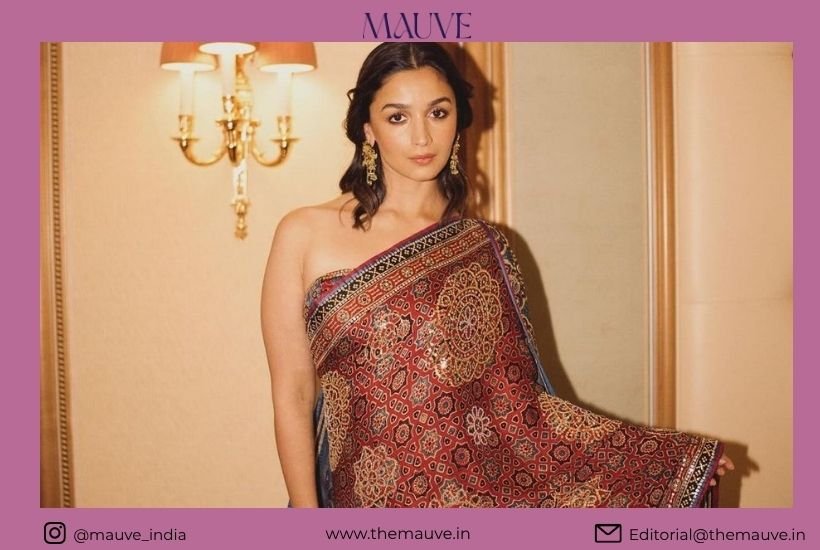
Recognisable for its deep indigo, rich red, black and white palette, its geometric symmetry and its intricate repetition of motifs, Ajrak is far more than a beautiful piece of printed cotton. For generations, it has been woven into the cultural life of Sindh — worn, gifted, reused and passed through some of the most important moments of everyday life.
Its story is also one of movement. From Sindh to Kutch and parts of Rajasthan, Ajrak travelled with artisan communities, techniques crossed borders, and a textile tradition found new homes without losing its distinctive visual language.
Today, the word “Ajrak” is often used loosely for a print. But the real Ajrak story lies beneath the pattern: in natural dyes, hand-carved wooden blocks, resist printing, repeated washing, drying and dyeing, and the extraordinary patience required to make the design appear on both sides of the cloth.
Because Ajrak is not simply something that looks a certain way.
It is a way of making.
What Exactly Is Ajrak?
Ajrak, also spelled Ajrakh, refers to a traditional resist-dyed and block-printed textile associated most strongly with Sindh and, in India, with the craft traditions of Kutch and Barmer.
The textile is traditionally made from cotton and uses a complex combination of printing, mordanting, resist-dyeing and washing. Its characteristic palette is built around deep indigo, madder red, black and white, while its designs rely heavily on geometric symmetry and repeated borders.
The Government of India’s handicrafts documentation describes Kutch Ajrakh as an ancient craft that originated in Sindh and later flourished in Kachchh after Khatri artisan communities migrated there. (Handicrafts)
But defining Ajrak only by its technique misses something essential.
In Sindh, Ajrak has historically been much more than fabric. It has been a shawl, turban, wrap and everyday textile; something worn by men, women and children and used across social occasions. Research documented by Sahapedia describes its presence across the life cycle, from birth and marriage to mourning, and notes that its cultural significance has traditionally extended across class. (Sahapedia)
That is what makes Ajrak fascinating.
It is simultaneously craft, clothing and cultural language.
A Textile Shaped by the Indus
The history of Ajrak sits within the much larger history of textile-making around the Indus.
The Indus Valley region developed sophisticated traditions of weaving, dyeing and decorating cloth. Indigo, which became one of the defining colours of Ajrak, was historically cultivated along the Indus. Sahapedia’s documentation also points to visual parallels between motifs associated with ancient Indus civilisation imagery and designs that continue to appear in Ajrak traditions today — although such connections should be understood as part of the ongoing scholarly conversation around the craft rather than as proof that a specific modern Ajrak piece descends directly from a particular ancient textile. (Sahapedia)
Even the name carries a story of cultural exchange.
One widely cited explanation connects Ajrak to the Arabic word “azrak”, meaning blue, reflecting the importance of indigo in the textile. Other interpretations have been proposed, and the etymology remains debated. (Handicrafts)
Perhaps that uncertainty is fitting.
Ajrak itself has never belonged to just one moment in history.
It has evolved through trade, migration, religion, geography and changing communities while retaining its unmistakable visual identity.
Why Does Ajrak Look the Way It Does?
Look closely at an Ajrak and the first thing that becomes apparent is its sense of order.
There are borders within borders. Repeated geometric forms. Stars, flowers, circular patterns and other motifs arranged with remarkable symmetry.
The effect can feel almost architectural.
Ajrak designs have been shaped by several cultural influences, including Iranian and Islamic geometric traditions, while some researchers have also explored connections with Sufi philosophy and the symbolism embedded in the craft’s vocabulary and patterns. (Sahapedia)
But Ajrak is not simply geometry for geometry’s sake.
The repeated pattern gives the textile its rhythm.
The borders frame the cloth. The central composition creates movement. The repetition means that even when the eye settles on a single motif, it is always aware of the larger structure around it.
This is part of why authentic Ajrak has such a distinctive presence.
It does not rely on one dramatic motif.
Its beauty comes from accumulation.
The Colours of Ajrak
If there is one colour that immediately brings Ajrak to mind, it is indigo.
Deep, almost midnight blue forms one of the foundations of the traditional palette. It is paired with rich reds, earthy blacks and areas of white created through resist techniques.
Traditional Kutch Ajrakh uses natural dye materials including indigo and madder, along with mordants and resist materials that help produce its characteristic contrasts. (Handicrafts)
The palette is striking precisely because it is restrained.
There is no need for a dozen competing colours.
Blue meets red. Black defines the geometry. White gives the pattern space to breathe.
The result feels both bold and remarkably calm.
The Craft Behind the Pattern
This is where Ajrak separates itself from the idea of a simple “print”.
Traditional Ajrak printing is an extraordinarily labour-intensive process.
The cloth goes through multiple stages of preparation, printing, dyeing, washing and drying. In traditional Sindhi practice, research documented by Sahapedia describes a process of around 21 stages for a particular form of Ajrak, with the cloth repeatedly washed and treated throughout production. Government documentation on Kutch Ajrakh describes 14 stages in its process. The exact sequence varies according to the tradition and type of Ajrak being produced. (Handicrafts)
First comes the cloth.
Then comes preparation.
Then the blocks.
The wooden blocks are carved by hand, and their precise placement determines whether the intricate pattern will align correctly. Resist pastes are used to protect selected areas from particular dyes. Mordants help colour bind to the fabric. Indigo and madder create the characteristic blues and reds.
The cloth is repeatedly printed and dyed, with washing and drying helping to reveal and stabilise the design.
And then comes one of Ajrak’s most remarkable characteristics:
the pattern can be printed on both sides.
Creating symmetry across a textile is difficult enough on one surface. Doing it on both sides demands extraordinary precision. Government handicrafts documentation identifies this double-sided quality as one of the defining achievements of the craft. (Handicrafts)
The finished textile may look effortless.
The process is anything but.
From Sindh to Kutch
Ajrak’s Indian story is inseparable from migration.
The Khatri community of textile printers carried the tradition from Sindh into Kutch, where the craft established itself and developed its own living centres.
Government handicrafts documentation places this migration roughly 500 years ago, while Sahapedia’s historical account records the settlement of Khatri printers in Kutch under the rule of Rao Bharmalji I in the late 16th and early 17th centuries. (Handicrafts)
Dhamadka, Khavda and later Ajrakhpur became important centres of the craft in Kutch. Barmer in Rajasthan also developed a significant Ajrakh tradition.
What makes this history particularly compelling is that the craft did not simply travel as a finished product.
It travelled through people.
Through families.
Through knowledge passed from one generation to another.
The blocks, recipes, dyeing techniques and ways of working became part of the cultural inheritance of artisan communities.
In this sense, Ajrak is as much a story about migration as it is about textiles.
A Cloth of Everyday Life
Perhaps the most important thing to understand about Ajrak is that it was never created simply to sit inside a museum.
In Sindh, it has traditionally been part of everyday life.
It has been worn as a shawl, turban, wrap, sarong and other forms of clothing. It has been used at ceremonies and significant life events, while also being part of ordinary daily dress. Sahapedia describes Ajrak as a textile whose significance historically crossed class and whose use extended across the life cycle. (Sahapedia)
That relationship between craft and daily life is increasingly rare.
Many traditional textiles survive because museums preserve them.
Ajrak survived because people used it.
They wore it.
They gifted it.
They reused it.
And when a piece eventually became too worn to wear, it could continue another life as part of household textiles and quilts.
That relationship gives Ajrak a different kind of value.
Its worth is not simply in how it looks when it is new.
It is in how much life it can contain.
When Craft Becomes Identity
There are very few textiles that can function almost like a cultural emblem.
Ajrak is one of them.
In Sindh, it has become deeply associated with Sindhi identity and pride. Its presence at ceremonies and public occasions can communicate respect, belonging and cultural connection. (Sahapedia)
This is why reducing Ajrak to “the blue-and-red print” does the textile a disservice.
The colours are recognisable.
The patterns are recognisable.
But the meaning comes from everything surrounding them.
The artisan.
The community.
The land.
The history.
The occasions on which the textile is worn.
And the memories attached to it.
The Difference Between Ajrak and an Ajrak Print
There is an important distinction in today’s fashion vocabulary.
You can reproduce an Ajrak-like pattern digitally or through screen printing in a matter of minutes.
You cannot reproduce the entire Ajrak tradition that quickly.
The difference is not simply whether a pattern resembles the original.
It is the process behind it.
Traditional Ajrak involves hand-carved blocks, resist techniques, dyeing, repeated washing and painstaking alignment. Cheap screen-printed imitations can reproduce the appearance without reproducing the labour or knowledge embedded in the craft. Researchers have documented this tension between traditional hand-blocked Ajrak and inexpensive imitations. (Sahapedia)
That distinction matters increasingly as Indian and South Asian crafts enter contemporary fashion.
When a designer borrows a motif, what exactly is being preserved?
The pattern?
The technique?
The material?
The artisan community?
Or simply the aesthetic?
These questions become more important as heritage crafts become fashionable.
Ajrak in Contemporary Fashion
The survival of a traditional craft does not necessarily mean freezing it in time.
Ajrak is already being interpreted through contemporary clothing and home textiles. Government handicrafts documentation notes its use today in products ranging from saris, dupattas and kurtas to shirts, jackets, turbans and home décor. (Handicrafts)
In Kutch and Barmer, traditional techniques continue to inform contemporary fashion.
This is where heritage can become interesting rather than nostalgic.
A traditional textile does not need to remain trapped in the wardrobe of its past.
It can become a contemporary jacket.
A sari.
A scarf.
A modern shirt.
A piece of home décor.
The challenge is ensuring that adaptation does not erase the knowledge that made the original possible.
Because the future of craft cannot simply be about making heritage fashionable.
It has to be about making the craft sustainable for the people who practise it.
What We Stand to Lose
Ajrak has survived extraordinary changes, but survival should not be confused with security.
Research on traditional Sindhi Ajrak has documented a decline in the number of workshops and artisans practising the most labour-intensive forms of the craft. At the same time, contemporary Ajrak traditions in Kutch and Barmer continue to adapt to changing markets and fashion. (Sahapedia)
The paradox is familiar across traditional crafts.
The more popular the aesthetic becomes, the easier it is to separate the aesthetic from the artisan.
A consumer may recognise an Ajrak pattern without knowing how it was made.
They may appreciate indigo without knowing what natural dyeing involves.
They may buy “Ajrak print” without knowing the difference between hand-block printing and a mass-produced imitation.
And that is why education matters.
The future of heritage does not depend only on preserving old objects.
It depends on preserving knowledge.
The Luxury of Taking Time
Luxury today is often described through scarcity, price or exclusivity.
Ajrak offers another definition.
Time.
A textile that requires repeated preparation, printing, dyeing, washing and drying cannot be rushed into existence without changing what it is.
Its value lies partly in the fact that someone had to spend time making it.
Someone had to carve the block.
Someone had to place it.
Someone had to prepare the dye.
Someone had to wash the cloth.
Someone had to wait.
And then do it again.
In a world increasingly designed around speed, Ajrak represents the opposite philosophy.
Make carefully.
Repeat patiently.
Let the material develop.
Allow the hand to remain visible.
That may be one of the most contemporary lessons hidden inside this very old textile.
A Living Heritage, Not a Relic
Ajrak’s story is ultimately not about looking backwards.
It is about understanding what deserves to move forward.
A textile can cross borders without losing its identity. A centuries-old technique can enter contemporary fashion without becoming meaningless. A traditional pattern can evolve while its craft continues to matter.
But that future depends on remembering that Ajrak is not simply a print.
It is a relationship between material, maker and community.
It is Sindhi identity expressed through cloth.
It is the story of migration from Sindh to Kutch and Rajasthan.
It is indigo, madder, carved wood and resist paste.
It is geometry and repetition.
It is ceremony and everyday life.
And perhaps most importantly, it is proof that heritage does not have to remain behind glass to survive.
Sometimes, it survives because someone is still willing to make it by hand.
And someone else is still willing to wear it.