There are filmmakers who speak about stories as narratives, some who speak about them as craft, and then there are those who reduce the entire exercise to something much more instinctive: a feeling.
For Ram Madhvani, storytelling is, quite simply, the business of manufacturing emotion.
“Some people manufacture ball bearings, some make tyres, some make cars,” he says, laughing. “We make emotions.”
It is an unexpectedly simple description of a complex creative life—one that moves between cinema and advertising, between the intimacy of a full-length film and the precision of a 30-second commercial.
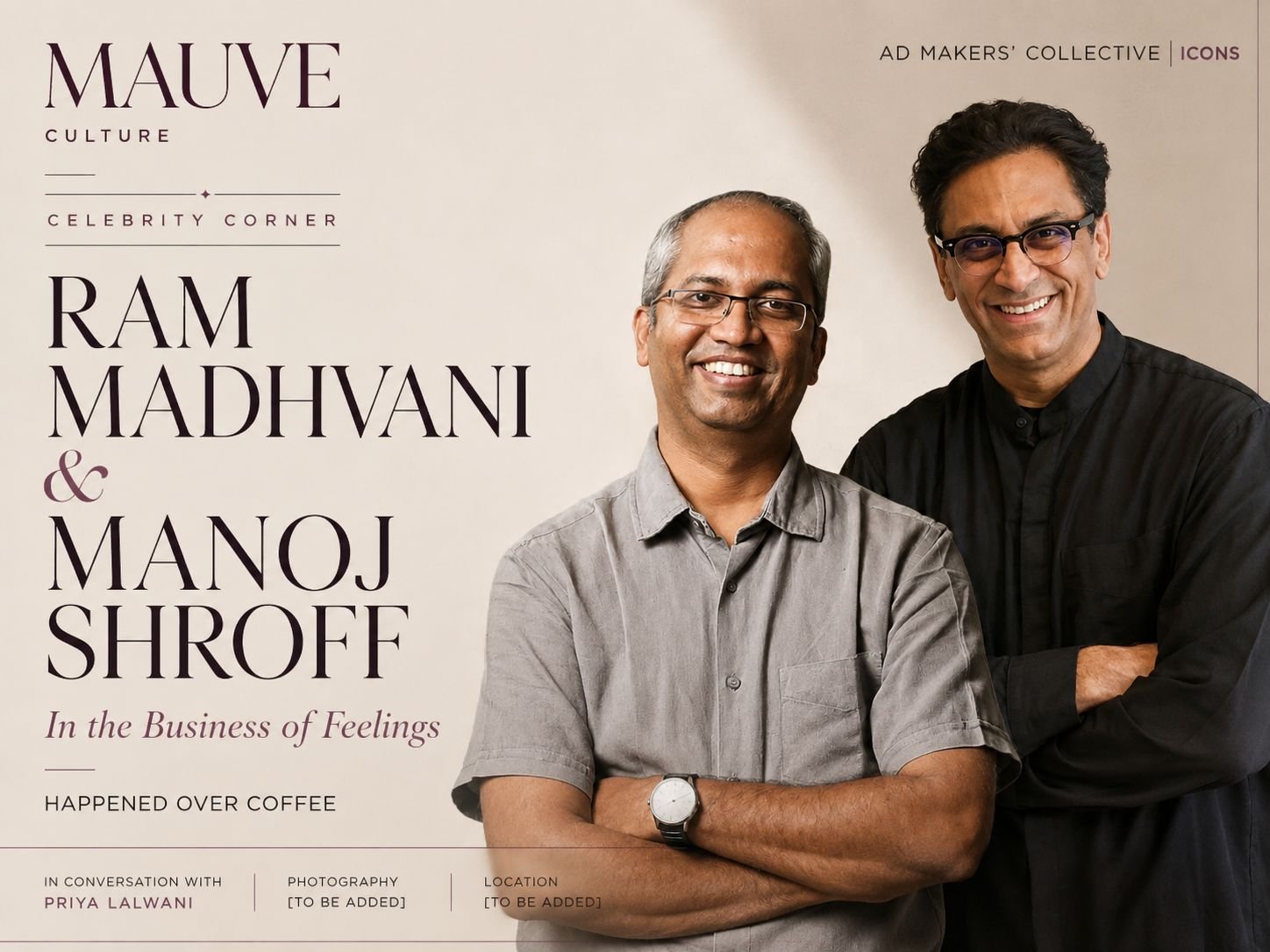
Over coffee, Madhvani and Manoj Shroff spoke to Mauve about what changes when a story moves from cinema to advertising, why silence can sometimes say more than dialogue, whether a celebrity is really necessary to make an advertisement memorable, and what happens when artificial intelligence enters a world built on human emotion.
At the centre of it all was one recurring question:
What makes a story worth telling?
Where Transformation Begins
For Madhvani, the difference between cinema and advertising begins with the nature of transformation.
“In cinema, the transformation is of the character.”
A film, he explains, must take its character somewhere. There is a beginning, an arc and, ultimately, a change. The transformation is internal.
Advertising operates differently.
Here, the brand can become the catalyst for change.
A person may begin with a problem, a stain, a limitation or an unmet need. The brand enters the narrative and changes their circumstances. In cinema, however, the device cannot do the emotional work for the character.
“In a movie, that transformation does not happen with a device. It happens internally.”
It is a distinction that reveals something fundamental about the two forms.
Advertising asks us to imagine how something can change our lives.
Cinema asks us to watch how life changes us.
Nothing Comes Without a Constraint
Ask a filmmaker whether cinema is harder than advertising, and the obvious assumption might be that a two-hour film carries greater complexity than a 30-second commercial.
Madhvani refuses the comparison.
“Everything is hard. Everything is messy. Everything is difficult.”
And then comes the reality that unites both worlds: budgets.
Interestingly, the creative process between Madhvani and Shroff has increasingly begun with the number rather than the idea.
“How much do you have?” they ask a client.
Then they work backwards.
“I don’t think budgets are now done forwards; they’re done backwards,” Madhvani says.
It is not necessarily a compromise. In some ways, it is another form of creativity.
There is a push and pull between what the idea demands and what the budget allows. Conversations happen. Ideas are adjusted. They negotiate, settle and find the version that can exist.
Perhaps this is where creativity becomes less romantic and more practical: not in having everything, but in knowing how to create something meaningful with what you have.
The Quiet Power of Silence
There is a certain kind of silence in Madhvani’s work that does not feel empty.
It feels charged.
When I point this out during our conversation, he admits that he had not consciously thought of silence as a recurring part of his creative language.
But once the observation is made, he begins to recognise it.
In advertising, he explains, silence can be just as important as music.
There is often a moment in an Airtel commercial when the music suddenly stops. The interruption creates attention.
Because we are accustomed to noise, removing it makes us listen.
In dramatic sequences too, he sometimes deliberately strips away the surrounding sound—no traffic, no unnecessary ambience, nothing competing with the moment.
The silence becomes a device.
Manoj Shroff brings up the familiar rhythm of Happy Dent: the music builds, pauses, and then returns at the emotional high point.
Without that pause, the climax would not land in quite the same way.
For Madhvani, there is an elegant explanation.
“It’s basically punctuation.”
A comma.
A full stop.
A question mark.
An ellipsis.
Silence, he suggests, works in much the same way.
It tells the audience how to read the moment.
And perhaps that is why it can be so powerful. We rarely notice punctuation while reading, yet without it, language loses rhythm, meaning and emotion.
The same is true of silence.
Sometimes, what is removed becomes what we remember.
Do We Really Need the Celebrity?
The advertising landscape has long been fascinated by familiar faces.
Celebrity endorsements can provide instant recognition, attention and association. But can a truly good advertisement survive without one?
Madhvani thinks so.
He points to recent work for Jindal Steel and British Airways as examples of campaigns that, in his view, demonstrated that an advertisement does not necessarily need a celebrity to hold an audience.
Shroff adds an important qualification: celebrity-led advertising is not inherently wrong.
The question is whether the celebrity is being used meaningfully.
Sometimes a familiar face belongs naturally within the story. Sometimes it becomes the story.
And there is a difference.
The strongest advertising, like the strongest cinema, ultimately asks the audience to care about something beyond recognition.
A famous face can get attention.
It cannot manufacture emotion on its own.
The AI Question
No conversation about contemporary storytelling can escape artificial intelligence.
The debate has already become polarised: raw versus generated, human versus machine, authentic versus artificial.
Madhvani approaches it with considerably less certainty.
“We need to be actually looking at where the world is going,” he says.
AI is happening.
And therefore, creators have to engage with it rather than simply stand outside it and judge it.
For now, he describes it as another device.
Something to be explored.
Something to be understood.
Something whose eventual impact is still impossible to predict.
He draws a parallel with previous technological shifts.
When television arrived, there were predictions that theatre would die.
When digital books and Kindle became popular, there were predictions that physical books would disappear.
Neither quite happened.
The old forms adapted. Audiences continued to find value in experiences that technology was expected to replace.
So perhaps the question is not whether AI will replace human storytelling.
Perhaps it is what human storytellers will choose to do with it.
“We’ll know maybe two years, five years, ten years from now.”
For now, they are experimenting.
And when asked whether we will see AI-generated work from them, Madhvani answers with a laugh:
“Right now. We’ll show it to you.”
Good Stories. Necessary Stories.
Towards the end of our conversation, I ask a deceptively difficult question:
What makes a story good—and what makes it necessary?
Madhvani pauses.
His answer moves away from the idea of quality altogether.
A story may be loved.
It may be disliked.
A filmmaker cannot always know how an audience will respond once the work leaves their hands.
But there is something that can be decided before the story is told.
Whether it needs to exist.
“If you’re going to be putting out a story, it needs to be necessary.”
Necessary does not mean commercially successful.
It does not necessarily mean universally appreciated.
It means that the story exists for a reason.
That there is something to say.
And perhaps this is where his philosophy of storytelling comes full circle.
If the filmmaker is in the business of feelings, then the story is the vessel.
The emotion is the product.
But the reason to tell it is what gives it meaning.
The Feeling Remains
Technology will continue to evolve.
Budgets will tighten and expand.
Advertising will discover new formats. Celebrities will remain part of the cultural landscape. AI will become another tool in the filmmaker’s vocabulary.
But the fundamental human instinct behind storytelling remains unchanged.
We want to feel.
We want to recognise ourselves in someone else’s journey.
We want to be surprised, moved, challenged or simply made to pause.
Perhaps that is why silence matters so much in Madhvani’s work.
Perhaps that is why character transformation matters.
And perhaps that is why, in an age of endless content, the most important question is not whether a story is good.
It is whether it is necessary.
Because when everything can be made, the real act of creativity may lie in knowing what deserves to exist.
THE MAUVE CONVERSATION
Ram Madhvani
Filmmaker & Director
Manoj Shroff
Creative Collaborator
Conversation with: Priya Lalwani, Mauve