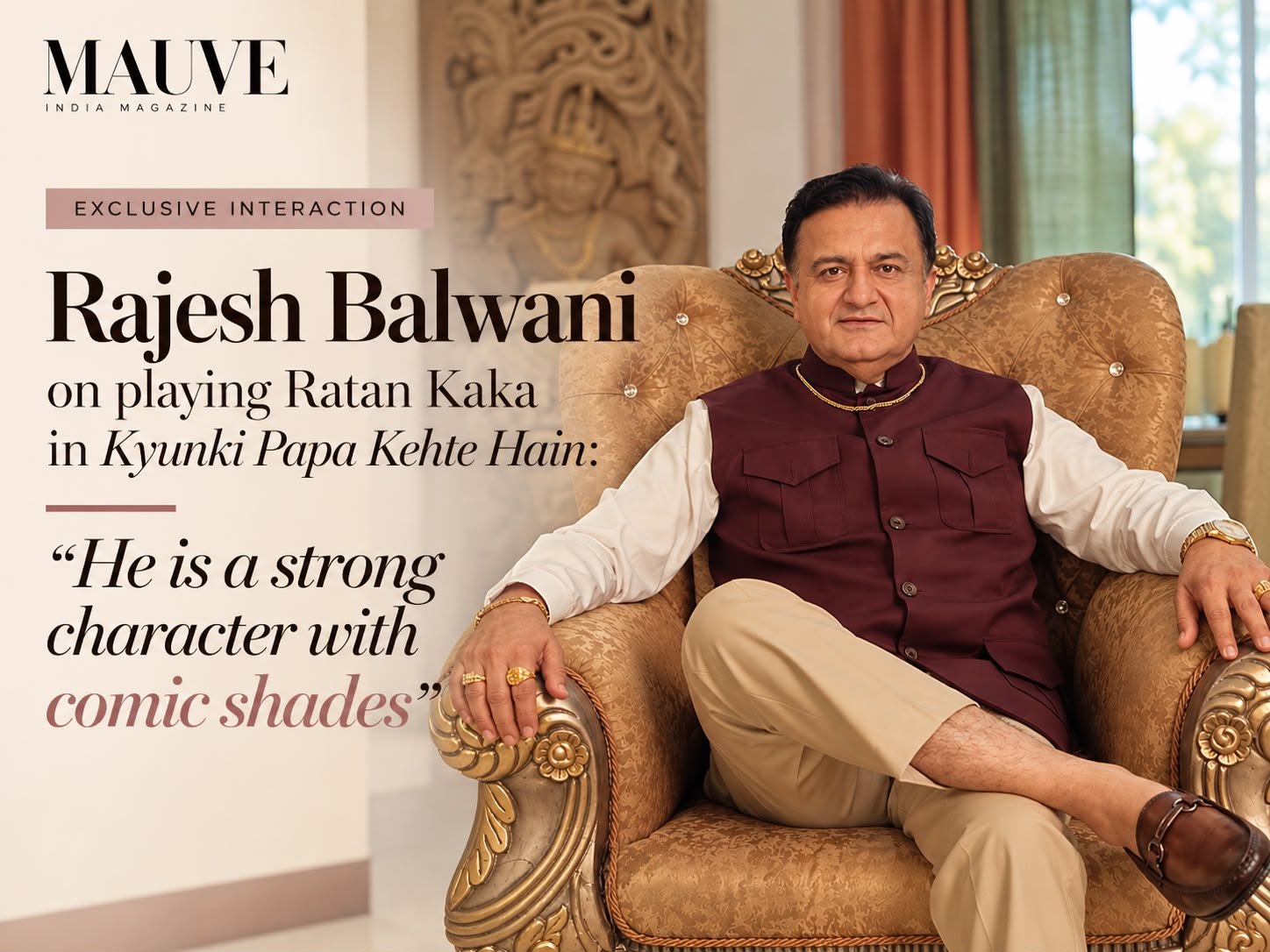
In Kyunki Papa Kehte Hain, Rajesh Balwani plays a man who believes success can be measured in money, status and the size of the car in your driveway. But behind Ratan Kaka’s strong opinions is a character who loves his family deeply—making him far more complicated than a conventional comic antagonist.
What happens when someone genuinely loves you but fundamentally disagrees with the way you choose to live?
That tension sits at the heart of Ratan Kaka, the character played by actor Rajesh Balwani in Kyunki Papa Kehte Hain, the new family drama produced by Yash Patnaik and Mamta Patnaik of Inspire Films.
Set against the emotional dynamics of a large family, the show explores different ideas of ambition, relationships and success. And somewhere in the middle of those conversations is Ratan Kaka—a man with very strong opinions about money, achievement and what constitutes a “good life.”
But calling him simply negative would be missing the point.
And calling him comic wouldn’t quite capture him either.
For Balwani, that contradiction is exactly what makes Ratan Kaka worth playing.
A Character That Refuses to Be Categorised
“My role in Kyunki Papa Kehte Hain is completely different from what I’ve ever played,” Balwani tells Mauve.
For the actor, the challenge wasn’t simply finding the humour in the character. It was understanding where the humour ends and the person begins.
“It’s such a clearly defined role in terms of what the character is all about. Second, it’s comic. Third, you have to be very careful that it’s an opinionated character and not a negative character,” he explains.
That distinction becomes important.
Ratan Kaka has strong views, and he isn’t afraid to voice them. His worldview can create friction within the family, but the character isn’t driven by malice.
Balwani prefers to describe him as “a strong character which has comic traits”—a distinction that perhaps reveals more about Ratan Kaka than the label of a typical television antagonist ever could.
When Success Has a Price Tag
Ratan Kaka belongs to an older school of thinking where material achievement is closely tied to personal success.
For him, the equation is straightforward: a bigger house, a better car, more money—and you’ve made it.
“Ratan Kaka is basically a result-oriented person. He is from the old school where money is everything for him,” Balwani says.
And then there is the Mercedes.
“I have a Mercedes Benz,” Ratan Kaka proudly declares, according to Balwani, who adds that his character values the car almost like a member of the family.
It is a detail that makes the character amusing, but it also reveals something deeper about his worldview.
For Ratan Kaka, possessions aren’t simply possessions. They are evidence.
Evidence that he has succeeded. Evidence that his choices were right. Evidence that life is moving in the direction it should.
The Complication: He Actually Cares
And then comes the part that makes Ratan Kaka more interesting.
For all his emphasis on money and material success, Balwani doesn’t see his character as someone without emotion.
“I honestly believe that this character Ratan Kaka that I’m playing is someone who truly loves his brother’s kids also,” he says.
“He loves them to the core, but it’s just that his way of thinking in life is different.”
That difference becomes the emotional engine of the character.
Ratan Kaka may believe he knows what is best for his family. His intentions may come from affection. But his definition of success doesn’t necessarily align with theirs.
And isn’t that where many family conflicts begin?
Not always with a lack of love, but with different ideas of what love should look like.
Finding the Humour in the Conflict
For Balwani, the humour comes organically from that clash.
Ratan Kaka isn’t necessarily trying to be funny. His seriousness about money, status and success becomes funny because of how strongly—and sometimes unapologetically—he believes in his worldview.
That gives the character a certain unpredictability.
He can create tension in one scene and become the source of laughter in another, without either feeling completely out of character.
It is also why Balwani was drawn to the role.
“It’s a very interesting character and that’s why I said yes to the role,” he says.
And perhaps that is the most intriguing thing about Ratan Kaka.
He isn’t the family member you can simply love or dislike.
He is the one who makes you ask whether good intentions are enough when your idea of a good life is completely different from everyone else’s.
Kyunki Papa Kehte Hain promises a family story built around precisely these differences—and with Rajesh Balwani’s Ratan Kaka bringing his own particular combination of conviction, conflict and comic timing to the mix, the character may prove to be one of the show’s more unexpected talking points.