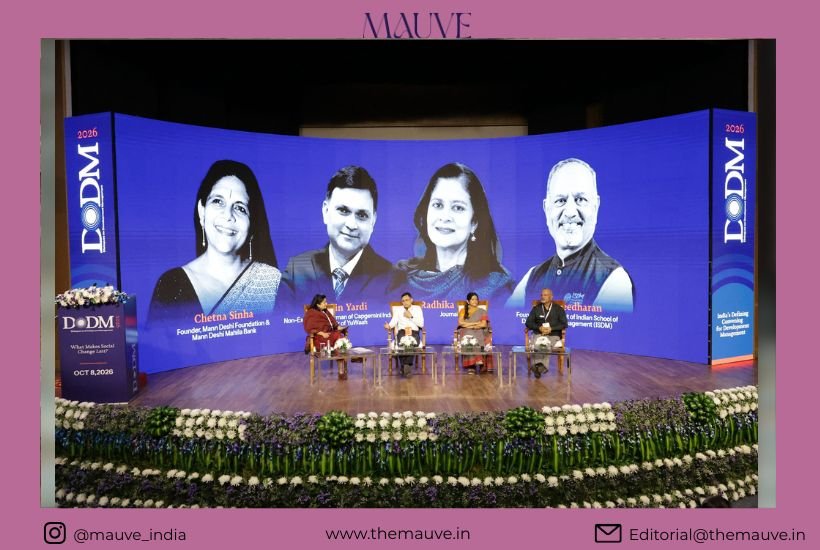
At DoDM 2026 in New Delhi, the Indian School of Development Management brought together business leaders, grassroots changemakers and development practitioners to explore what it takes to build institutions, systems and communities capable of sustaining social progress.
Social change rarely happens overnight. It takes years of patient work, the right institutional support and communities empowered to shape their own futures. Yet, even promising initiatives can lose momentum when funding runs out, leadership changes or the systems supporting them fail to evolve.
The question, then, is not simply how to create impact, but how to make it endure.
This was the central idea behind the fourth edition of the Dialogues on Development Management (DoDM) 2026, hosted by the Indian School of Development Management (ISDM) on October 9 at the Dr. Ambedkar International Centre in New Delhi. Centred on the theme ‘What Makes Social Change Last?’, the convening brought together voices from business, technology, grassroots development, financial inclusion, public policy and philanthropy to examine the conditions that allow social progress to survive beyond individual programmes and funding cycles.
Beyond Good Intentions: Building Institutions That Endure
Across the development sector, successful programmes often demonstrate what is possible. The more complex challenge is building organisations and institutions capable of sustaining those outcomes over time.
DoDM 2026 placed this question at the heart of its conversations, bringing together perspectives from different parts of India’s development ecosystem. Among the speakers were Ashwin Yardi, Non-Executive Chairman of Capgemini India; Chetna Sinha, Founder and Chairperson of Mann Deshi Bank and Mann Deshi Foundation; and Ravi Sreedharan, Founder and President of ISDM.
Their experiences highlighted different but interconnected dimensions of lasting change, from institutional leadership and financial inclusion to organisational resilience and the management capabilities needed to support long-term development.
The gathering examined a fundamental distinction: while organisations may deliver immediate results, lasting transformation requires systems that can adapt, respond to changing circumstances and continue creating value long after an individual intervention ends.
Four Conversations Shaping the Future of Development
The day’s discussions were organised around four interconnected tracks, each examining a different dimension of sustainable social change.
Building Institutions, Not Just Organisations explored the governance structures, leadership capabilities and institutional resilience required to ensure that progress does not depend on a single individual, initiative or funding cycle.
From Schemes to Systems examined how public institutions can become more responsive and adaptive, enabling successful interventions to translate into sustained change across communities and geographies.
Funding the Future We Say We Want turned attention to the financial relationships and forms of capital needed to support long-term development, challenging the limitations of funding models that prioritise short-term outcomes over enduring progress.
What Is Impact Beyond the Numbers? questioned how the sector measures success, exploring the need to look beyond immediate outputs and assess whether meaningful change is actually taking root in people’s lives.
Together, these conversations reflected a broader shift in development thinking: impact is not measured only by what a programme delivers today, but also by what continues to function, grow and evolve tomorrow.
When Communities Become Architects of Change
For Chetna Sinha, whose work through Mann Deshi Bank and Mann Deshi Foundation focuses on rural women and economic empowerment, sustainable change begins with the agency of the communities it seeks to serve.
“For social change to last, communities must have the agency, institutions and resources to shape their own futures,” she said, highlighting how financial inclusion, entrepreneurship and community institutions can help embed progress in people’s lives.
Her perspective places ownership at the centre of development. When communities have access to resources, opportunities and institutions that respond to their needs, they are better positioned to continue building on the progress they have made.
The implication extends beyond financial inclusion. Sustainable development requires moving away from approaches in which communities are merely recipients of support towards models that recognise them as active participants in shaping outcomes.
The Management Question Behind Social Impact
While vision and commitment are essential to social change, they are not always enough to sustain it. Organisations also need the leadership, operational capabilities and management structures required to navigate complexity and grow responsibly.
This is where Development Management, the discipline championed by ISDM, enters the conversation.
“Social change may happen because of good programmes or even good individuals. But for social change to last, it needs Social Purpose Organisations that are resilient and equipped to work over long periods in specific geographies or on specific issues,” said Ravi Sreedharan, Founder and President of ISDM.
He emphasised the importance of strengthening the leadership, management and organisational capabilities that allow social purpose organisations to remain effective as they grow and as their operating environments change.
The idea challenges the assumption that strong intentions alone can sustain development work. Organisations working on complex social issues need the ability to manage people, resources, partnerships and long-term strategy with the same rigour expected in other sectors, while remaining grounded in their social purpose.
Sharad Agarwal, Co-Founder of ISDM, reinforced the importance of systems that remain accountable and responsive to the communities they serve. Lasting outcomes, he noted, depend on investing in the structures that carry progress forward, rather than focusing exclusively on what an individual programme delivers.
From Conversations to Collective Capability
Since its inaugural edition in 2023, DoDM has grown into a platform for discussions on Development Management, recording more than 4,000 participants, 400 speakers and moderators, 270 research papers presented and 50 track partners across its editions.
The 2026 convening brought together multiple formats for engagement, including plenary discussions, Development Management Cases, masterclasses, research paper presentations, interactive sessions and Development Management Clinics.
These formats created opportunities to examine development challenges from both conceptual and practical perspectives, connecting research and experience with the organisational realities of implementing change.
The emphasis on collaboration is particularly relevant in a sector where challenges rarely sit within the boundaries of a single organisation. Public systems, social purpose organisations, funders and communities often need to work together to sustain progress. Their ability to align priorities, build institutional capacity and learn from evidence can determine whether successful interventions remain isolated achievements or become enduring solutions.
The Real Measure of Social Change
DoDM 2026 returned to a question that extends well beyond the development sector: what makes progress last?
The conversations in New Delhi pointed towards a combination of capable institutions, responsive public systems, long-term funding relationships, meaningful community participation and a more nuanced understanding of impact.
None of these elements operates in isolation. Funding needs institutions capable of using it effectively. Institutions need leadership that can adapt. Public systems need to respond to communities, while impact measurement must capture not only immediate results but also the durability of change.
For ISDM, the convening was an opportunity to bring these questions into sharper focus and strengthen the conversation around Development Management as a foundation for sustainable social transformation.
Ultimately, the most meaningful measure of progress may not be how quickly change can be demonstrated, but whether it continues when the programme ends, the funding cycle closes or the leadership moves on.
Because creating change begins with an intervention. Making it last requires building the people, institutions and systems that can carry it forward.
About the Indian School of Development Management (ISDM)
Established in 2016, the Indian School of Development Management prepares leaders to address complex social challenges through functional expertise, managerial judgement and ethical responsibility. Its work focuses on leadership development through its Post Graduate Program in Development Management, advancing Development Management as a distinct discipline, and strengthening organisational capabilities across NGOs, foundations, social enterprises and policy institutions.
ISDM’s 11-month Post Graduate Program in Development Management combines development perspectives with management practice to equip professionals with the capabilities required to lead social purpose organisations and contribute to India’s development ecosystem.