
Avaada Group Chairman Vineet Mittal highlights the role of transmission, battery storage, local grids and manufacturing in scaling renewable power
India’s renewable-energy transition is entering a phase where generating clean electricity is only one part of the challenge. Moving that power efficiently, storing it when required and ensuring it reaches consumers at the right time will increasingly determine how effectively renewable capacity can translate into dependable electricity.
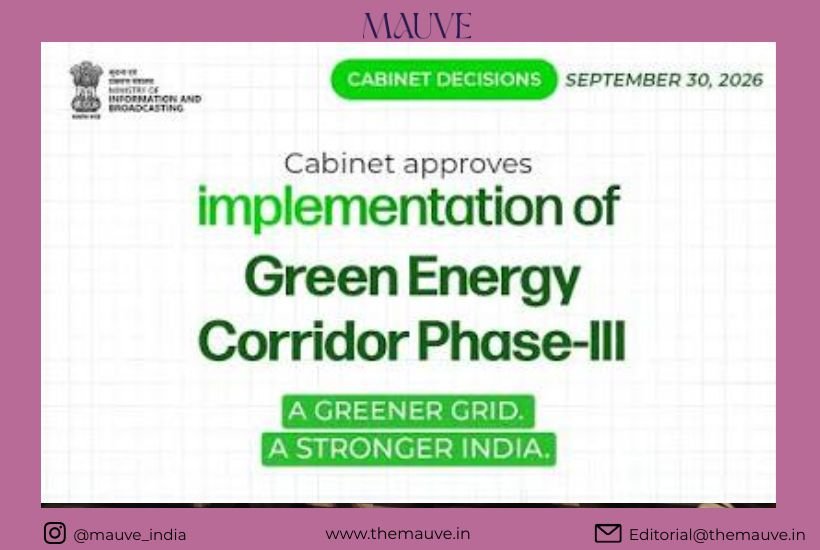
Against this backdrop, the Union Cabinet’s approval of Green Energy Corridor Phase III (GEC-III) marks a significant expansion of India’s intra-state renewable-energy infrastructure. The programme is designed to strengthen intra-state transmission systems to enable the evacuation of up to 135 GW of renewable energy, alongside the deployment of 50 GWh of Battery Energy Storage Systems (BESS). The scheme has a total outlay of ₹1,86,405 crore and is targeted for completion by FY2032-33.
Reacting to the announcement, Vineet Mittal, Chairman, Avaada Group, said the integration of transmission and storage under one programme recognises that renewable generation, delivery and availability need to develop together.
Beyond generating clean power
For Mittal, the significance of GEC-III lies in connecting different parts of the clean-energy system.
As battery storage deployment increases, batteries could initially absorb surplus electricity from existing renewable plants. Over time, higher storage utilisation and demand could also create additional requirements for renewable generation to charge those systems.
However, he points out that the relationship between storage and new renewable generation cannot be reduced to a simple capacity calculation.
The amount of additional solar generation required will depend on factors including charging sources, battery operating cycles, efficiency, local electricity demand and the availability of surplus renewable power.
That makes coordinated planning increasingly important as India scales up both renewable generation and storage.
The government says the BESS component of GEC-III is intended to address challenges including intermittency, congestion, peak-hour curtailment and demand during non-solar hours.
Why intra-state transmission matters
A key feature of the programme is its focus on strengthening transmission within states.
Electricity generated from renewable projects ultimately needs to move through state networks to reach industrial clusters, agricultural communities, towns and other demand centres.
Mittal argues that states and districts will need to assess how local renewable generation and storage can contribute to their individual electricity requirements.
The appropriate model, he suggests, will vary by geography.
Some districts could benefit from renewable generation and battery storage located closer to demand centres, while others may need stronger connections to larger renewable-energy projects.
Factors such as local renewable resources, land availability, existing network conditions and consumption patterns will therefore influence how infrastructure is planned.
The emphasis on intra-state networks also builds on earlier phases of the Green Energy Corridor programme, which have focused on strengthening transmission infrastructure for renewable-energy integration.
Storage changes the renewable-energy equation
Battery storage is becoming increasingly important as renewable generation expands because solar and wind production does not always coincide with when electricity is consumed.
GEC-III’s inclusion of 50 GWh of BESS places storage directly within a major transmission programme rather than treating it as a separate piece of the energy system.
Mittal’s comments underline why this integration matters.
The question is not simply how many batteries India can deploy, but where they are located, what electricity charges them, when they operate and how they interact with the existing grid.
Such planning becomes particularly relevant as renewable power moves from being an addition to the electricity mix towards becoming a larger part of the country’s power system.
A manufacturing opportunity alongside infrastructure
The Green Energy Corridor could also have implications beyond electricity transmission.
The infrastructure required for a more electrified economy spans solar modules and cells, batteries, transformers, cables, inverters and control systems, among other components.
For India, Mittal sees an opportunity to develop domestic capabilities across the broader value chain—from designing and manufacturing equipment to installation, operation and maintenance.
The Cabinet has also stated that GEC-III is expected to generate direct and indirect employment in power, manufacturing and construction, with BESS deployment contributing to employment in the domestic energy-storage industry.
For the industry, however, scaling manufacturing will require more than capacity expansion. Mittal points to quality, engineering capabilities, skilled talent and sustained innovation as important parts of building a competitive clean-energy ecosystem.
From policy direction to infrastructure
The approval of GEC-III provides another piece of the infrastructure required for India’s renewable-energy ambitions.
The programme is aligned with the government’s stated target of reaching 900 GW of installed non-fossil capacity by 2035, while its central financial support is intended in part to help offset intra-state transmission charges and contain costs for end users.
For the private sector, utilities and state transmission agencies, the next phase will be about implementation.
Mittal’s central argument is that generation, transmission and storage cannot be planned independently if India is to build a renewable-energy system that is not only large in capacity but also dependable in delivery.
The next chapter of India’s clean-energy transition may therefore be less about how much renewable power the country can generate—and increasingly about how intelligently it can move, store and use it.