Few garments carry the quiet authority of a crisp, perfectly engineered shirt. It is the ultimate sartorial chameleon: equal parts sharp uniform, effortless armor, and blank canvas. Yet, in an era of hyper-embellished occasionwear and fleeting trend cycles, the humble button-down is often relegated to baseline functionality. We accept off-the-rack proportions, synthetic blends, and collared templates that sacrifice movement for rigidity.
Enter Payal Khandwala, a designer whose name has long been synonymous with painterly color blocking, geometric precision, and structural intelligence. With her latest release, ‘The Perfect Shirt’, Khandwala turns her hyper-focused lens onto this singular wardrobe foundation.
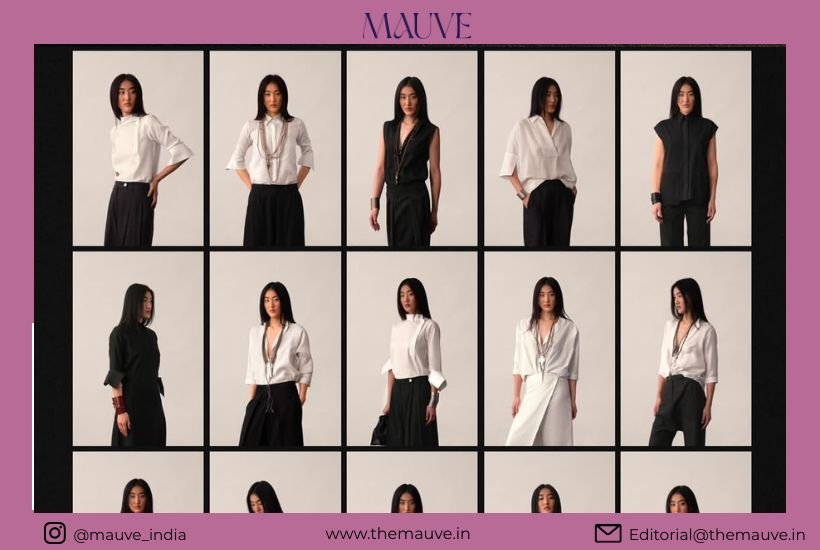
Unveiling her largest capsule to date—comprising 21 distinct interpretations—she strips away surface distraction entirely. Stripped of prints and embellishments, the collection relies on a strict monochrome palette of black and white. What remains is a pure study in form, proportion, and textile integrity. It is not an attempt to define the definitive shirt, but rather an invitation for the wearer to discover their own.
The White & Black: Payal Khandwala’s 21-Piece Masterclass in Form
To strip a garment of color and ornament is the ultimate flex for a designer. Without heavy embroidery or vivid dyes to hide behind, every line is exposed. A fraction-of-an-inch error in collar drop, armhole pitch, or hem weight becomes instantly visible. For Payal Khandwala—an artist-turned-designer trained in the precision of fine arts—this constraint is not a limitation; it is a playground.
In ‘The Perfect Shirt’, Khandwala discards the notion of a one-size-fits-all wardrobe standard. Instead, she approaches the capsule like a sculptor working across three foundational textiles: crisp cotton poplin, fluid silk, and textured linen. Each piece takes days to engineer, treating seams and folds as structural load-bearers rather than mere construction lines.
The 3 Material Pillars: Poplin, Silk, and Linen
- The Architectural Anchor: High-Density Cotton Poplin
Poplin provides the structural spine of the capsule. Engineered with a sharp, paper-touch hand feel, these iterations feature razor-sharp collars, drop shoulders, and exaggerated cuffs that hold their shape throughout the day.
The Mauve Style Note: Pair a volumetric white poplin shirt with fluid black wide-leg trousers and architectural silver cuffs for an effortless boardroom-to-gallery look. - The Fluid Operator: Heavyweight Silk
When draped in silk, the shirt loses its rigid workwear connotations and gains a seductive, evening-ready fluidity. Khandwala manipulates silk to cling and fall across asymmetric hems, plunging V-necks, and soft band collars.
The Mauve Style Note: Tuck a liquid-black silk interpretation into a high-waisted metallic skirt or layer it unbuttoned over a silk slip dress for understated evening glamour. - The Modern Tactile: Breathable Linen
Linen brings a relaxed, organic weight to the 21-piece edit. By applying sharp tailoring techniques to raw linen weaves, Khandwala elevates the breezy summer fabric into structured, high-fashion statement shirts.
The Mauve Style Note: Style an oversized white linen tunic shirt over tailored linen trousers with minimal leather slides for warm-weather luxury.
Key Takeaways
Monochrome Precision: The capsule relies strictly on black and white to emphasize drape, pattern making, and proportion over surface ornament.
Material Integrity: Crafted across silk, linen, and cotton poplin, each garment requires days of engineering to achieve structural permanence.
Scale of the Edit: With 21 distinct cuts, this marks Payal Khandwala’s largest focused capsule offering to date.
Versatility First: Designed as a permanent wardrobe foundation rather than seasonal occasionwear, built to be re-styled fluidly.
About the Brand
About Payal Khandwala
Payal Khandwala launched her eponymous label in 2011, bringing a fine artist’s eye to modern Indian luxury. Renowned for her signature geometric silhouettes, vibrant color blocking, and uncompromising focus on handwoven fabrics, the brand crafts thoughtful, non-conformist apparel for the modern, independent woman.
Editorial Conclusion
In a fashion ecosystem consumed by novelty, there is immense bravery in reducing design to its absolute core. Payal Khandwala’s ‘The Perfect Shirt’ reminds us that true luxury is not about loud decoration—it is about how a shoulder seam falls, how a cuff frames the wrist, and how a garment makes the wearer feel as they move through the world. By offering 21 paths to a single wardrobe staple, Khandwala gives modern women something far more valuable than a trend: an enduring personal uniform.