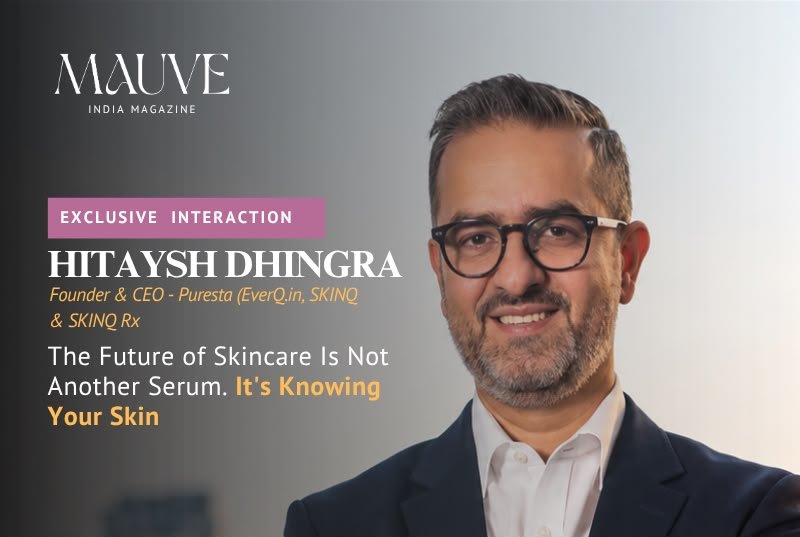
In an industry obsessed with miracle ingredients, immaculate packaging and ten-step routines, EVERQ founder Hitaysh Dhingraa is making a case for something far more fundamental: understanding your skin before treating it. In an exclusive conversation with Priya Lalwani for Mauve, Dhingraa discusses the science behind personalised skincare, the promise of AI-powered diagnosis, the role of dermatologists and why the future of beauty belongs to brands that can deliver results—not just make promises.
There was a time when skincare meant little more than a cleanser, a moisturiser and perhaps a sunscreen. Today, the beauty cabinet has become a carefully curated laboratory of active ingredients, trending serums and products promising to transform everything from acne to uneven skin tone. The modern consumer knows the vocabulary of skincare, but does knowing the difference between niacinamide and salicylic acid necessarily translate into knowing what one’s skin actually needs?
For Hitaysh Dhingraa, founder of EVERQ and the entrepreneur previously behind The Man Company, that distinction is where the next chapter of beauty begins.
Having built The Man Company into a business with revenues approaching ₹250 crore before its acquisition by Emami, Dhingraa is now turning his attention to a different challenge: bringing skincare and healthcare closer together. EVERQ is built around a simple premise—diagnose first, treat second—using AI-powered skin analysis, personalised product recommendations and dermatologist consultations to help consumers make more informed decisions.
In an exclusive interaction with Mauve, Dhingraa speaks to Priya Lalwani about India’s evolving skincare consumer, the limitations of ingredient-led marketing, the importance of testing finished formulations on real skin, and why the industry’s most significant shift may be away from collecting products and towards solving problems.
“Skincare becomes ingredient collecting for a 22-year-old rather than problem-solving.”
— Hitaysh Dhingraa, Founder, EVERQ
From Selling Grooming to Solving Skin Problems
Mauve: You previously built The Man Company, a brand that helped bring men’s grooming into the mainstream. What made you look at skincare differently, and what was the insight that eventually led to EVERQ?
Hitaysh Dhingraa: I started The Man Company in 2015 because we realised that most beauty and personal-care brands were speaking primarily to women. Nobody was really addressing men in a language they understood. We built the business over eight or nine years, scaled it to nearly ₹250 crore in revenue and were eventually acquired by Emami.
Throughout that journey, one of our biggest challenges was creating the category itself. Men weren’t necessarily participating in grooming, so much of our marketing involved educating them about why they should groom themselves and use products such as beard oils.
At the same time, we were closely observing the skincare market, which was largely driven by women. We saw brands growing rapidly, sunscreen becoming a significant category and consumers moving from generic products towards more science-led formulations.
We partnered with Smitten to understand the market better. We conducted primary and secondary research and spoke to approximately 1,400 women across seven or eight cities.
The biggest insight was that consumers had become much more aware of skincare ingredients. They knew about niacinamide, salicylic acid and retinol, and many had already tried products from multiple brands. Yet they were increasingly frustrated because they weren’t necessarily seeing the results they expected.
That led us to a fundamental question: what if consumers could understand their skin problem before buying another product?
That became the thesis behind EVERQ. We wanted to create a platform where people could begin with a skin assessment, understand what they might be dealing with and then move towards an appropriate treatment.
When Skincare Becomes Ingredient Collecting
Mauve: Today’s consumer is more informed than ever, yet the sheer volume of information can be overwhelming. Every few months, there is a new hero ingredient. Are we becoming better at skincare, or simply better at following trends?
Hitaysh Dhingraa: I think even dermatologists are frustrated with the way the industry promotes ingredients. Every few months, there is a new hero ingredient, and suddenly everyone is talking about it. We have seen trends around snail mucin, rice water and now PDRN, among others.
The danger is that skincare becomes ingredient collecting for a 22-year-old rather than problem-solving.
If you have acne or pigmentation, you might purchase whatever ingredient is trending. But that ingredient may not be relevant to your particular skin concern.
Niacinamide, retinol and peptides can all be useful. The question, however, should not simply be whether an ingredient is good. It should be whether it is the right ingredient, in the right formulation and at the right concentration for your skin.
That is why we do not position our products around individual ingredients alone. We take an evidence-led approach and focus on the outcomes our formulations are designed to deliver.
“The question should not simply be whether an ingredient is good. It should be whether it is the right ingredient, in the right formulation and at the right concentration for your skin.”
— Hitaysh Dhingraa
Mauve: So, in a way, the beauty industry’s next big trend might be moving away from trends altogether?
Hitaysh Dhingraa: I believe consumers will increasingly start asking brands the right questions. Instead of asking which ingredient a product contains, they will want to know what the product can actually do.
We anticipate a significant shift towards outcome-led skincare. Brands will need to be more transparent and invest in testing their finished formulations, rather than relying only on the presence of particular ingredients to support their claims.
Indian Skin Deserves Its Own Conversation
Mauve: Skincare products are often influenced by global beauty movements, from Korean beauty to Western dermatological trends. How important is it to develop products with Indian skin, climate and lifestyles in mind?
Hitaysh Dhingraa: It is extremely important. Last year, we acquired SkinQ and SkinQ RX, brands co-founded and formulated by Dr Chytra Anand, a senior dermatologist with approximately 25 years of experience working with Indian patients.
India has a wide range of skin tones, and our environmental conditions are different from those in many Western markets. Humidity, pollution, sun exposure and lifestyle patterns all influence the concerns people experience.
Pigmentation and hyperpigmentation are particularly important concerns for Indian consumers. On our platform, we have observed that around 70 per cent of patients consulting a dermatologist report pigmentation-related concerns, while approximately 30–35 per cent report acne-related concerns. These categories can overlap.
Acne can also leave post-inflammatory pigmentation, making the issue particularly relevant for Indian skin.
The point is not that a formulation developed elsewhere cannot work for an Indian consumer. It is that products should be evaluated for the skin concerns, conditions and needs they are intended to address.
When Artificial Intelligence Meets Dermatology
Mauve: That brings us to personalisation. How does EVERQ combine technology with dermatological expertise without allowing AI to become another marketing gimmick?
Hitaysh Dhingraa: We see AI as a way to reduce the information gap between consumers and skin experts.
We have developed an AI-powered assessment tool that has been tested on more than 10,000 Indian skin samples. Consumers can upload a selfie and receive an initial assessment of their skin concerns.
Based on the assessment, the platform can recommend relevant products and a personalised skincare plan. If the concern appears to require medical attention, the user can be directed towards a dermatologist for a video consultation.
AI is the first layer, not the entire solution. We are not suggesting that technology should replace a dermatologist. We want to make it easier for consumers to understand their skin and access the right expertise when needed.
When a dermatologist receives a patient who has already completed the AI assessment, the available information can also help make the consultation more efficient.
“We are building at the intersection of skincare and healthcare.”
— Hitaysh Dhingraa
Mauve: With AI increasingly capable of analysing information and making recommendations, where do you draw the line between automation and human judgement?
Hitaysh Dhingraa: Technology is powerful, but it has limitations. We cannot expect AI to manage every case independently, nor would that be the right approach.
The idea is to use technology for the initial assessment and to identify cases that may need further attention. More severe or complex concerns should be directed to a dermatologist.
We also believe the dermatologist should have access to the information already gathered through the assessment. This can help the doctor understand the patient’s concerns before the consultation begins.
Ultimately, we are building at the intersection of skincare and healthcare. The objective is to help people make informed decisions, not simply to sell them another product.
The Doctor in Your Pocket
Mauve: Access to dermatological care remains uneven across India. Can technology make expert skincare guidance more accessible beyond metropolitan cities?
Hitaysh Dhingraa: Absolutely. India has a limited number of dermatologists relative to its population, and a significant proportion are concentrated in the country’s largest cities. At the same time, skincare purchases are not restricted to metropolitan markets.
Consumers in smaller cities and towns are buying products, experimenting with active ingredients and following skincare trends. But when something goes wrong, they may not have easy access to a dermatologist.
Through EVERQ, someone living in a smaller town—or even a more remote part of Chhattisgarh—can access the platform, connect with a dermatologist and receive guidance in their preferred language, subject to availability.
We are trying to bridge the gap between the growing demand for skincare and access to qualified medical expertise.
We currently work with more than 500 dermatologists and have set a target of expanding that network to approximately 1,200 by the end of December 2026.
Mauve: Do you see the skincare industry becoming less dependent on physical access to dermatologists as technology improves?
Hitaysh Dhingraa: Technology can make access easier, but it does not eliminate the need for medical expertise. AI can perform the initial assessment and help identify cases that need further attention. Dermatologists remain important for evaluating concerns, providing consultations and recommending appropriate treatments.
If we can make that first step easier and give doctors better information before a consultation, we can make the overall process more efficient.
The Problem with Beautiful Promises
Mauve: Beauty is an exceptionally visual business. Packaging, branding and influencer campaigns can make a product irresistible. But how much should consumers trust what they see on the shelf or on their screens?
Hitaysh Dhingraa: Packaging is important, particularly when you are targeting younger consumers. It is often the first thing they notice, and it can encourage someone to try a product.
But packaging alone cannot build a successful skincare business. A consumer may purchase a product once because it looks attractive. Whether they return depends on the formulation, efficacy and overall experience.
I believe the industry has invested heavily in packaging and influencer marketing, sometimes at the expense of formulation development. It is time for brands to place greater emphasis on the product itself.
“Packaging alone cannot build a successful skincare business. Whether consumers return depends on the formulation, efficacy and overall experience.”
— Hitaysh Dhingraa
Mauve: What is the one thing you wish every skincare consumer would start demanding from beauty brands?
Hitaysh Dhingraa: A clear promise about outcomes, supported by evidence.
When you pay a brand to solve a skin concern, you should be able to understand what the product is designed to do and what evidence supports that claim.
A formulation is much more than two active ingredients listed on the packaging. The concentrations, the combination of ingredients and the way the finished product is developed all matter.
Brands should invest in appropriate testing of finished formulations and communicate their claims transparently. Consumers deserve more than ingredient-led marketing.
Mauve: Does that mean the industry needs to rethink the way it communicates efficacy?
Hitaysh Dhingraa: Yes. We are already seeing greater scrutiny of product claims, particularly in categories such as sunscreen. Consumers have started questioning whether the protection advertised on a label matches the protection delivered in practice.
I believe this demand for accountability will extend to other skincare categories. As consumers become more discerning, brands will need to demonstrate efficacy rather than depend solely on marketing narratives.
Who Should We Really Trust?
Mauve: Consumers today are navigating advice from influencers, dermatologists, Reddit communities, Instagram and AI tools. How do we separate useful information from the noise?
Hitaysh Dhingraa: It is a difficult question because there is so much information available. One positive development is that consumers are increasingly following dermatologists online for educational content.
I would encourage people to consult qualified experts rather than blindly experiment with highly concentrated serums. Products containing ingredients such as retinol may be useful in the right circumstances, but they are not automatically necessary for everyone.
We need to stop treating our skin as something we can continually experiment on without understanding the consequences. If you have a persistent or significant concern, speak to a dermatologist.
Mauve: Influencer marketing is another complicated territory. Should there be stricter restrictions on creators who share skincare advice without the necessary qualifications?
Hitaysh Dhingraa: Influencers need to be more responsible. Their followers trust them, and many of those followers are young people who may act on what they see online.
When creators endorse a skincare product, they should do their due diligence on the brand and the claims being made. Their responsibility should extend beyond whether a campaign is commercially attractive.
Regulation and scrutiny of advertising claims are important, but individual creators also need to recognise that their credibility is at stake.
If you are influencing people’s decisions, you have a responsibility to ensure that the information you share is reliable.
Beyond the Ten-Step Routine
Mauve: From elaborate ten-step routines to skin minimalism and Korean beauty, consumers are constantly being introduced to new approaches. What do you think the future of beauty will look like?
Hitaysh Dhingraa: I think consumers will increasingly demand outcomes and transparency.
The ingredient story may not remain the dominant way of selling skincare. People will want to know what a product can do for them, how that has been evaluated and whether the claims are supported by evidence.
At EVERQ, we focus on testing our finished products and communicating their intended outcomes. We believe this approach will become increasingly important for brands that want to remain relevant.
I also think personalisation will become more significant. Consumers will increasingly want to understand their individual skin concerns rather than follow the same routine as everyone else.
Mauve: What are the core concerns EVERQ is currently addressing, and who is the consumer you are building for?
Hitaysh Dhingraa: Our primary focus is on three areas: acne, pigmentation and hydration.
Our core audience is women between 18 and 35. They are generally more engaged with skincare and more aware of concerns such as uneven skin tone and hyperpigmentation.
However, we want to become gender-neutral over time. Interestingly, approximately 30 per cent of our users are already men, even though we have not specifically targeted them through our advertising.
If someone needs help understanding a skin concern, that need is not determined by gender.
Building a Beauty Business That Begins with Diagnosis
Mauve: Tell us about the role of distribution in your business. How do you balance a digital-first model with the need for expert guidance?
Hitaysh Dhingraa: EVERQ is an online platform, so consumers can access it irrespective of where they live, subject to service and delivery availability.
Our product portfolio includes different ranges serving different needs. SkinQ, our over-the-counter range, is available through marketplaces such as Nykaa, Myntra and Flipkart, as well as quick-commerce platforms.
SkinQ RX is our prescription-grade range and is available through dermatologists following consultation. Consumers can access a dermatologist through EVERQ online or through our network of doctors in different cities.
The distinction is important because the product and the pathway to obtaining it should reflect the nature of the concern being addressed.
Mauve: You also work with Smitten. How has sampling contributed to your understanding of younger consumers?
Hitaysh Dhingraa: We have used Smitten’s platform for research as well as product sampling. Our research suggested that younger consumers are interested in trying smaller formats before committing to full-size products.
Sampling offers a way to introduce a brand to new consumers without relying entirely on expensive brand-building or performance marketing campaigns. It also gives people an opportunity to experience the product.
For us, the partnership has been useful in understanding consumer behaviour and creating opportunities for discovery.
Mauve: Looking ahead, what is the larger ambition for EVERQ?
Hitaysh Dhingraa: We are at the beginning of our journey. We have not even made a formal announcement of the EVERQ platform’s launch yet.
Our ambition is to scale the business significantly, with a target of building a company with approximately ₹1,500 crore in revenue over the next seven to eight years. An IPO is also an aspiration.
We are building towards a future where consumers do not have to navigate skincare entirely on their own.
The Final Word: Diagnose Before You Buy
Mauve: If you could debunk one misconception about skincare for millions of consumers, what would it be?
Hitaysh Dhingraa: That one generic product can solve everyone’s acne or pigmentation.
You need to understand your skin and choose products that are appropriate for your particular concern. Stop buying generic serums, ointments or moisturisers simply because they are trending.
Mauve: And what do you believe the beauty industry is getting fundamentally wrong today?
Hitaysh Dhingraa: False promises. Too much emphasis is placed on packaging, influencer marketing and making claims, rather than investing sufficiently in formulations and demonstrating efficacy.
It is time for brands to prioritise the science behind their products.
“Too much emphasis is placed on packaging, influencer marketing and making claims, rather than investing sufficiently in formulations and demonstrating efficacy.”
— Hitaysh Dhingraa
Mauve’s Take
Perhaps the most interesting shift in beauty is not the arrival of another active ingredient, another viral routine or another shelf-worthy bottle. It is the possibility that consumers may begin to question the very premise on which much of the industry operates: that the next product is always the answer.
EVERQ’s diagnosis-first approach reflects a wider conversation about accountability in beauty. As consumers become increasingly familiar with skincare terminology, the next stage of awareness may involve asking more meaningful questions about individual needs, clinical expertise and evidence-backed outcomes.
Dhingraa’s vision places technology and dermatological care closer to the consumer. For the wider industry, the challenge is more fundamental: to ensure that the promise on the packaging is matched by the science inside it.
Because the future of skincare may not belong to the brand with the most talked-about ingredient. It may belong to the one that understands the skin beneath it.
Interview by Priya Lalwani for Mauve.
Editorial note: Business figures, platform capabilities, consumer research findings and growth ambitions cited in this article are based on statements made by Hitaysh Dhingraa during the interview. They have not been independently verified by Mauve. Selected pull quotes have been lightly edited for readability.