
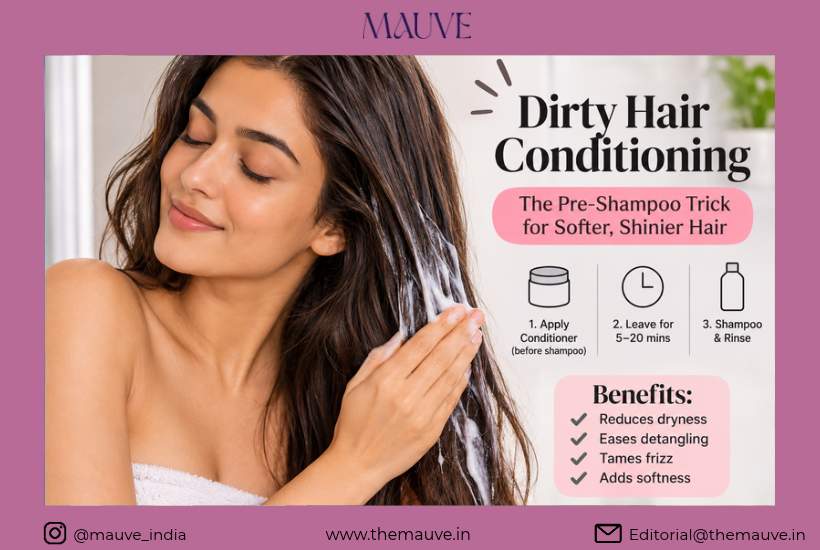
The pre-shampoo conditioning trick that promises softer, smoother hair without weighing it down.
Beauty · Haircare
Representative image: Instagram / @kritisanon
From reverse conditioning and double masking to the shampoo sandwich, haircare routines are constantly evolving with new techniques promising smoother, softer and more manageable hair. The latest trend making waves across social media and beauty circles is dirty hair conditioning, also known as pre-shampoo conditioning or pre-poo.
The technique is simple: apply conditioner to unwashed hair before shampooing. While it may sound counterintuitive, this extra step can help protect the hair lengths from the drying effects of cleansing, leaving them softer, smoother and easier to manage.
“It simply means applying conditioner to unwashed hair before shampooing. It sounds unusual, but the idea is very gentle and very logical,” explains Anna Maria Gaibova, a hairstylist at Behave Hair&Body Spa, Dubai.
Shampoo is designed to cleanse the scalp by removing excess oil, dirt and product residue. However, depending on your hair type and the shampoo you use, cleansing can also leave the lengths feeling dry, particularly if your hair is coloured, naturally porous, curly or already prone to dryness.
Applying conditioner before shampooing creates a protective layer around the hair fibre, helping minimise moisture loss and reducing the roughness that can sometimes follow a wash. “When conditioner is applied first, it creates a soft protective layer, so the hair stays more hydrated and comfortable after washing,” Gaibova explains.
The appeal of dirty hair conditioning lies in its simplicity. It may help achieve softer, shinier hair with less frizz and without the heaviness that traditional post-shampoo conditioning can sometimes leave behind, particularly for those with fine hair. It also requires no additional products, making it an easy step to incorporate into an existing haircare routine.
What Does Dirty Hair Conditioning Actually Do?
Dirty hair conditioning works by coating the hair lengths before they come into contact with shampoo. Conditioners contain ingredients designed to smooth the hair shaft, improve slip, reduce friction and make strands easier to detangle.
Dr Shireen Hussain, an aesthetic physician at Dubai-based Ceia Clinic, notes that although scientific research specifically on this trend remains limited, the underlying principle makes sense from a haircare perspective.
Since conditioners help smooth the hair surface and reduce tangling, applying them before cleansing may offer some protection to the lengths, especially when the hair is dry or prone to breakage.
However, it is important to distinguish cosmetic hair benefits from scalp or hair-growth claims. “From a medical perspective, it is important to remember that this is mainly a cosmetic technique to improve texture and manageability of hair,” says Dr Hussain. “There is no strong evidence that it promotes hair growth, prevents hair loss or improves scalp health.”
The Benefits of Dirty Hair Conditioning
1. Helps reduce dryness during washing
Pre-shampoo conditioning can help protect the lengths from feeling excessively dry after cleansing. By applying conditioner before shampooing, the hair fibre receives an additional layer of conditioning that may help retain softness and reduce the rough feeling that sometimes follows a wash.
2. Makes detangling easier
Conditioner improves slip between strands, helping reduce friction when combing or brushing. This can make detangling easier, particularly for curly, coily and textured hair, which is often more vulnerable to breakage when dry or tangled.
3. Helps tame frizz and improve softness
Dry, frizz-prone hair can benefit from the smoothing effect of conditioner before cleansing. The technique may help strands feel softer, look smoother and become easier to style after washing.
4. Works well for colour-treated and porous hair
Hair that has been chemically treated or coloured may be more prone to dryness and roughness. Pre-shampoo conditioning can be a useful addition to the wash routine for these hair types, helping improve softness and manageability.
5. May suit fine hair that struggles with regular conditioner
While fine hair can still benefit from moisture, traditional conditioning sometimes leaves it feeling flat. Applying conditioner before shampooing may help those who want softer lengths without the lingering weight of conditioner after washing.
“It’s also great for those with fine hair that loves moisture, but goes flat easily with a regular conditioner,” says Gaibova.
Who Should Try Dirty Hair Conditioning?
Dirty hair conditioning is particularly suited to:
- Dry hair: Helps improve softness and comfort during the cleansing process.
- Curly and coily hair: Can make detangling easier and reduce friction.
- Frizz-prone hair: Helps smooth the lengths and improve manageability.
- Colour-treated hair: Offers an additional conditioning step before shampooing.
- Fine hair: May help those who want conditioning without the heaviness of traditional conditioner application.
Those with fine hair or an oily scalp should be mindful of the formula and quantity they use. Heavy conditioners can leave residue or make hair feel weighed down, particularly if applied too close to the roots.
Dr Hussain recommends concentrating conditioner on the mid-lengths and ends instead of applying it directly to the scalp.
How Often Should You Dirty Hair Condition?
The ideal frequency depends on your hair texture, dryness and how often you wash your hair.
- Dry, curly or textured hair: You may try pre-shampoo conditioning with every wash if your hair responds well to it.
- Other hair types: Once or twice a week may be sufficient as a conditioning treatment.
- Very dry hair: If the lengths still feel dry after washing, a lightweight conditioner applied after shampooing may also be helpful.
The key is to pay attention to how your hair feels. If it becomes greasy, limp or difficult to cleanse, reduce the amount of conditioner or the frequency of the technique.
Dirty Hair Conditioning vs Regular Conditioning vs Hair Oiling
Unlike traditional conditioning, which is generally done after shampooing, dirty hair conditioning is applied before the cleansing step. This changes when the hair receives conditioning and may be particularly useful for those who find post-wash conditioner too heavy.
Hair oiling, on the other hand, involves applying oils to the scalp or lengths for lubrication, conditioning or other haircare purposes, depending on the product and routine. Pre-shampoo conditioning uses a conditioner formulated to smooth and soften hair, making it a relatively lightweight and convenient alternative for some people.
“Dirty hair conditioning sits gently in between,” explains Gaibova. “It gives the lengths protection and softness, but it rinses easily, takes only 5 to 20 minutes and leaves the hair light and clean.”
How to Do Dirty Hair Conditioning at Home
Step 1: Start with dry or slightly damp, unwashed hair.
Your hair should be free of the cleansing step. You can use the technique before your usual shampoo routine.
Step 2: Apply conditioner to the lengths.
Work the conditioner through the mid-lengths and ends. Avoid saturating your scalp, particularly if it tends to get oily.
Step 3: Leave it on for 5 to 20 minutes.
Allow the conditioner time to coat and soften the hair. Adjust the duration according to the product instructions and your hair’s needs.
Step 4: Shampoo your scalp.
Cleanse the scalp thoroughly with shampoo. Avoid aggressively scrubbing the lengths, as the shampoo foam running through them during rinsing is generally sufficient for routine cleansing.
Step 5: Rinse thoroughly and assess your hair.
Rinse out the shampoo and conditioner residue. If your hair still feels dry, you may apply a lightweight conditioner to the ends after shampooing.
Common Mistakes to Avoid
1. Applying conditioner directly to the scalp
Focus on the mid-lengths and ends instead. Applying too much conditioner to the roots may leave your scalp feeling greasy or contribute to residue.
2. Using too much product
A sufficient amount to coat the lengths is all you need. Excess conditioner can make it harder to rinse your hair thoroughly and may leave it feeling heavy.
3. Rinsing before the conditioner has had time to work
Give the product a few minutes to coat the strands. A short waiting period of around five minutes can be a practical starting point, unless the product instructions suggest otherwise.
4. Scrubbing the lengths aggressively with shampoo
Concentrate cleansing on the scalp. Roughly rubbing the lengths can increase friction and make hair more prone to tangling.
5. Choosing overly heavy formulas
Thick or rich conditioners may not suit every hair type, particularly fine hair. If your hair feels limp or coated, try a lighter formula.
6. Expecting it to repair severely damaged hair
Pre-shampoo conditioning is primarily a cosmetic conditioning technique. It may improve softness and manageability, but it does not replace a consistent haircare routine, trims when needed or professional care for significant hair damage.
Is Dirty Hair Conditioning Worth Trying?
Dirty hair conditioning is a simple haircare technique that may be worth experimenting with if your hair tends to feel dry, frizzy or difficult to detangle after shampooing. It does not require a complicated routine or a new collection of products, and it can be adapted to different hair textures.
While the trend is not a miracle treatment for hair growth or scalp health, its practical approach to protecting the lengths before cleansing makes it an interesting addition to a haircare routine.
Sometimes, healthier-looking hair isn’t about adding more steps to your routine, but changing the order in which you use the products you already have.