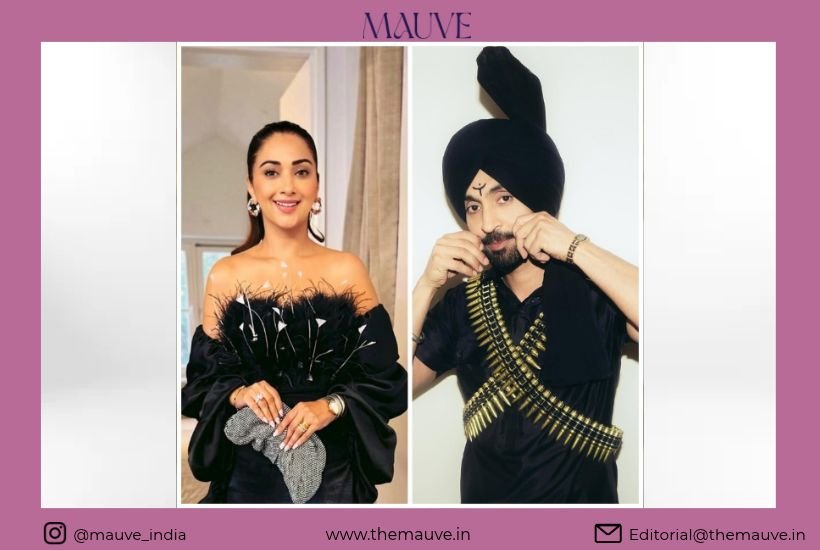
For designer Anjali Phougat, Diljit Dosanjh’s Met Gala appearance was more than a fashion moment. It was a statement on cultural pride, the power of representation and the enduring relevance of heritage on the world stage.
There are fashion moments that command attention, and then there are those that tell a story. When Diljit Dosanjh stepped onto the global fashion stage at the Met Gala, he brought more than a striking silhouette to the conversation. He brought Punjab with him.
For fashion designer Anjali Phougat, the significance of his appearance lay not merely in its visual impact, but in the intention woven into every detail. “I would choose his Met Gala look because of the thought behind the symbolism,” she says. At the heart of the ensemble was a message that needed little embellishment: Main Hoon Punjab.
“The words ‘Main Hoon Punjab’ at the back said something incredibly powerful without needing a speech. I have arrived on a global stage, but I have not left my identity behind. That is what makes the look significant to me,” she reflects.
It was a statement of presence, but also of belonging. In an industry where global recognition has often been associated with adapting to a dominant aesthetic, Diljit’s appearance offered a compelling alternative: the possibility of entering the international conversation without diluting the culture that shaped you.
The turban, the jewellery, the sword and the traditional references were, in Phougat’s view, integral to that narrative. “Together, they created a visual narrative about Punjab and its legacy,” she says. “Fashion should create a bridge between heritage and modernity.”
It is a philosophy that extends beyond a single red-carpet appearance. Through her own label, Designer Dream Collection, Phougat has explored the intersection of Indian heritage and international fashion, approaching tradition not as an archive to be preserved behind glass, but as a living language that can evolve with its wearer.
“I have never believed that representing your culture means looking backward,” she says. “You can honour your roots while standing firmly in the future.”
In Diljit, she sees that philosophy expressed with an ease that feels distinctly his own. His cultural identity is not a styling choice reserved for a particular occasion; it is an intrinsic part of his public persona, his music and his presence. The result is an image of Punjabi culture that travels without losing its point of origin.
Yet, for Phougat, the appeal of Diljit Dosanjh extends beyond the clothes, the performances or the scale of his international recognition. There is, she believes, a quality beneath the exuberance that makes his influence more enduring.
“Underneath that high energy, I see a remarkably positive and grounded human being,” she says. “What has always struck me is the calmness behind the public persona.”
She is particularly drawn to a philosophy of acceptance: the idea that people who hurt or disappoint us are, in their own way, playing the roles they have chosen in our journeys. For Phougat, this perspective speaks to emotional maturity and the ability to move through life without allowing every encounter to define one’s sense of self.
“That perspective reflects a level of acceptance and emotional maturity that I deeply value in my own life,” she says.
Perhaps this is where the distinction between visibility and influence becomes most apparent. An artist may be recognised for what they wear or celebrated for where they perform, but a deeper cultural impact emerges when their presence changes how an identity is perceived. Diljit’s journey, in Phougat’s eyes, belongs to the latter.
“So for me, Diljit is not just an artist. He is an artist with an aura. His aura is not manufactured,” she says.
It is an aura rooted in authenticity, in the consistency between who he is and what he represents. “He is not simply wearing Punjabi culture,” she adds. “He is walking it, speaking it, performing it, and taking it with him onto the world’s biggest stages.”
The reach of that representation, she suggests, can be measured in moments far removed from fashion’s most exclusive rooms. Phougat shares that her daughter, who aspires to become a singer, recognises very few Indian artists by name, yet immediately knows Diljit Dosanjh and Shah Rukh Khan.
For her, that recognition offers a telling glimpse into the power of contemporary cultural icons. Their influence travels across languages, borders and generations, creating points of connection that conventional measures of celebrity cannot fully capture.
“When an artist can cross generations, continents, and cultural boundaries and still make a young person connect with where they come from, that is much bigger than entertainment,” she says. “That is influence. That is representation. And that is legacy.”
In the evolving vocabulary of global fashion, Diljit Dosanjh represents a compelling proposition: that heritage need not be softened, simplified or set aside to be understood by the world. It can be worn with conviction, presented with pride and allowed to occupy space on its own terms.
And perhaps that is the most enduring statement of all. Not simply that Punjabi fashion has found a place on the global stage, but that the culture behind it has arrived unapologetically, carrying its history, its symbolism and its spirit into the future.
As Phougat puts it, “You do not have to leave your culture behind to become global. Sometimes, your culture is precisely what makes the world stop and look.”