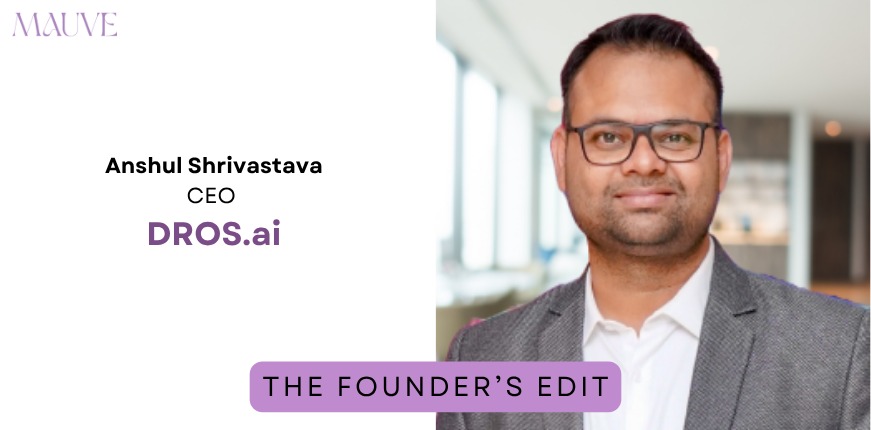
For the CEO of DROS.ai, the future of collections isn’t about making more calls—it’s about making every interaction more intelligent, compliant and human.
By Journalist Priya Lalwani
Debt collections have traditionally been associated with persistence, pressure and endless phone calls. But behind the scenes, the industry’s biggest challenge has rarely been a lack of effort—it has been a lack of intelligent systems. For Anshul Shrivastava, CEO of DROS.ai, that operational gap presented an opportunity to rethink the way collections function. Rather than replacing people, DROS.ai uses artificial intelligence to help collection teams identify intent, automate workflows and improve recovery outcomes while preserving consumer dignity. At The Founder’s Edit, Anshul Shrivastava shares insights on building AI for one of the world’s most complex industries, why compliance matters as much as innovation, and how operational intelligence is transforming collections.
The idea behind DROS.ai did not emerge from a breakthrough technology.
It emerged from conversations.
While working closely with collection agencies, Shrivastava repeatedly observed the same problem. Teams were working tirelessly—making calls, recording notes, managing callbacks, following payment commitments and responding to inbound queries—yet valuable opportunities were still slipping away.
The problem wasn’t effort.
It was the systems surrounding the people doing the work.
Critical follow-ups depended heavily on manual processes and human memory, allowing high-intent opportunities to disappear before action could be taken.
That was the moment DROS.ai began to take shape.
Shrivastava realised artificial intelligence could become much more than another chatbot or voice assistant. It could function as an operational co-worker—helping teams capture intent, automate follow-ups, reduce revenue leakage and allow human agents to focus where they create the greatest value.
Building that vision demanded significant personal trade-offs.
Like many founders, he left behind comfort, predictability and stability to navigate the uncertainty of entrepreneurship. Product pivots, hiring decisions, financial constraints and difficult strategic choices became part of everyday life.
Yet throughout that journey, several principles remained untouchable.
Trust.
Compliance.
And long-term thinking.
Within financial collections, he believes technology cannot simply prioritise speed. Every innovation must also respect consumer dignity, protect sensitive data and operate within increasingly stringent regulatory frameworks.
One misconception about the collections industry particularly stands out to him.
Many people still believe debt recovery is simply about contacting more consumers or applying greater pressure.
He argues the opposite.
Modern collections revolve around timing, empathy, behavioural understanding and operational discipline. Most consumers are willing to resolve outstanding balances—they simply need the right communication channel, appropriate timing and a less stressful experience.
The future of collections, he believes, isn’t louder.
It’s smarter.
The market itself reinforced that conclusion.
Collection agencies were managing enormous account volumes, yet their teams could effectively engage with only a fraction of them. Valuable signals—right-party contacts, callback requests and promises to pay—often failed to receive timely follow-up, creating avoidable operational losses.
Recognising that inefficiency, DROS.ai focused on building an AI-first operating system capable of responding to consumer intent in real time while helping human teams concentrate on higher-value interactions.
That original philosophy continues guiding every product decision.
Rather than building artificial intelligence for its own sake, DROS.ai begins with practical operational questions.
Does this reduce manual work?
Does it improve compliance?
Does it strengthen recovery performance?
Does it help managers gain better visibility?
Whether developing inbound call automation, payment-intent capture, recovery dashboards or broken promise-to-pay workflows, every feature originates from the realities experienced on collection floors each day.
In an increasingly crowded AI landscape, the company’s differentiation lies in its focus.
While many organisations develop general-purpose AI solutions, DROS.ai has built its platform specifically around collections.
Its objective extends beyond automation.
The platform helps agencies improve right-party contact rates, increase promise-to-pay conversions, automate after-hours engagement and support operational teams without continually increasing headcount.
Growth, however, has never meant sacrificing flexibility.
Collections vary significantly across clients, industries, regulatory environments and operating models.
Rather than forcing standardisation, DROS.ai combines a repeatable technology platform with configurable workflows tailored to each organisation’s compliance requirements, escalation rules, scripts and customer journeys.
Scalability, Shrivastava believes, should never eliminate context.
The company’s ideal customers also share a particular mindset.
Rather than being defined by company size or geography, they are leaders determined to modernise operations responsibly. They continually ask difficult operational questions—why payment commitments fail to convert, why valuable consumer interactions are missed and how artificial intelligence can strengthen workflows without compromising human judgement.
Listening carefully to those customers fundamentally shaped the company’s evolution.
One insight proved especially influential.
Most agencies celebrated promises to pay as successful outcomes.
Operationally, however, those promises represented only the beginning of the next process.
When payment commitments were broken, follow-ups often failed to occur quickly enough.
That realisation shifted DROS.ai’s attention from individual conversations towards intent-driven workflows—ensuring every callback, dispute, inbound enquiry and payment commitment automatically triggered the next appropriate action.
Beyond technology, Shrivastava believes education plays an equally important role.
Rather than limiting customer relationships to software implementation, DROS.ai actively shares practical playbooks, webinars, operational frameworks and industry insights designed to help collection leaders improve performance before they even become customers.
Trust, he believes, begins by creating value beyond the product itself.
Looking ahead, he expects collections to become increasingly digital, regulated and consumer-centric.
Artificial intelligence will evolve from automating repetitive tasks to understanding intent, timing and context more intelligently. Simultaneously, regulators will demand greater transparency, stronger consent management and higher standards of auditability across AI-powered communication.
The organisations that succeed will be those capable of balancing innovation with compliance and empathy.
Although commercial growth remains important, Shrivastava measures success differently.
The strongest indicator of DROS.ai’s health lies in customer outcomes.
Improved right-party contact rates.
Higher promise-to-pay conversions.
Reduced operational leakage.
Greater productivity.
More efficient teams.
Alongside measurable performance, trust remains equally significant. Collection agencies entrust DROS.ai with mission-critical workflows only because they believe the platform is secure, reliable and built responsibly.
As the organisation has matured, Shrivastava’s own leadership has evolved.
Where he once participated in nearly every customer conversation, product decision and operational challenge, his role now centres on building leadership, setting direction and ensuring the company remains focused on the market it understands best.
The leadership qualities he values today are clarity, resilience, patience and the ability to make difficult decisions without losing the human dimension of business.
Reflecting on his entrepreneurial journey, one lesson has become especially clear.
Focus is more valuable than ambition alone.
Startups constantly encounter new opportunities, markets and product ideas. The temptation to pursue everything can quickly dilute clarity.
DROS.ai became significantly stronger once the company chose to specialise.
By moving away from generic voice AI and concentrating entirely on purpose-built artificial intelligence for collections, the organisation sharpened its product, strengthened its messaging and created far greater customer value.
In an era where artificial intelligence is often discussed in terms of replacing people, DROS.ai offers a different perspective.
The most valuable AI doesn’t remove the human element.
It helps people make better decisions, at the right time, with greater confidence.