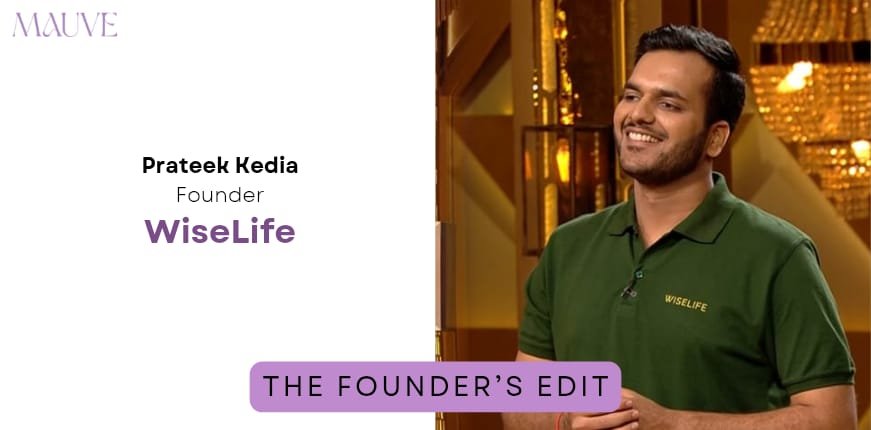
For the founder of Wiselife, wellness isn’t about chasing perfection—it’s about removing the small barriers that stop people from showing up for themselves every day.
By Priya Lalwani
Sometimes, the biggest businesses begin with the smallest frustrations.
For Prateek Kedia, Founder of Wiselife, it wasn’t a grand entrepreneurial vision that sparked the idea. It was a yoga mat.
Or rather, the inability to find one worth buying.
At The Founder’s Edit, Prateek Kedia shares how a personal wellness journey became the foundation of Wiselife, why quality should never be a luxury, and how thoughtful design can help people build healthier habits that last.
Before Wiselife existed, Kedia was living a life many professionals would recognise.
As a Chartered Accountant working at a leading consulting firm, he had what most would describe as a successful career. On paper, everything looked secure. In reality, years of corporate life had left him disconnected from his own wellbeing.
He had stopped exercising, was constantly stressed, and found himself trapped in routines that prioritised work over health.
Almost as a last attempt to change something, he signed up for a yoga class.
Halfway through the session, he admits, he almost gave up.
Physically exhausted, he struggled to keep pace.
Yet when the class ended, he walked away feeling lighter than he had in months.
That feeling stayed with him.
The next challenge came almost immediately.
Trying to continue the practice, he searched for a quality yoga mat.
He ordered three online.
Returned all of them.
Visited stores.
Still settled for something that felt mediocre.
Standing there, one question lingered.
If finding something as fundamental as a good yoga mat was this difficult, how many others were quietly giving up before their wellness journey had even begun?
That single frustration eventually became Wiselife.
Leaving behind a stable career to pursue the idea wasn’t easy.
Security gave way to uncertainty almost overnight.
But Kedia wasn’t interested in building another premium wellness brand reserved for a niche audience, nor did he want to create inexpensive products that compromised quality.
Instead, Wiselife was built around a balance rarely found in the category.
Products that combine thoughtful design, high-quality materials, honest pricing, and environmental responsibility.
For him, affordability should never require compromise.
Nor should quality become exclusive.
One misconception about the wellness industry is something he particularly enjoys challenging.
Many people believe yoga equipment doesn’t matter.
“A mat is just a mat.”
He once believed that too.
Until he experienced firsthand how poor equipment can interrupt practice, reduce motivation, and quietly discourage consistency.
Today, he sees wellness products not as accessories but as tools that make healthy habits easier to sustain.
The gap Wiselife set out to solve wasn’t purely personal.
In 2019, India’s yoga equipment market largely offered two extremes.
Imported products delivered quality but remained prohibitively expensive.
Domestic alternatives were affordable but often lacked thoughtful design, durability, or environmental consciousness.
There was little available between those two worlds.
That opportunity became the company’s foundation.
Interestingly, the original problem continues guiding nearly every product decision today.
Whenever Wiselife develops something new, the team returns to one simple question:
Will this genuinely make someone’s practice easier to continue?
Rather than designing products for retail shelves or online catalogues, the focus remains on improving everyday experience.
That same philosophy also explains why the company committed to Indian manufacturing and sustainable materials from the very beginning.
For Wiselife, these choices weren’t marketing strategies introduced later.
They were part of the original blueprint.
In an increasingly crowded marketplace, Kedia believes the brand’s differentiation comes from combining qualities that rarely coexist.
Premium materials.
Responsible manufacturing.
Accessible pricing.
Contemporary design.
Consumers usually have to compromise on at least one of those factors.
Wiselife was created to remove that compromise.
Even as the business has grown, scaling has never meant lowering standards.
Many of its products continue incorporating handcrafted processes alongside materials such as natural rubber, cork, and suede.
Growth, for the company, simply means making more products with the same level of care—not replacing quality with cheaper alternatives.
The brand also defines its customers differently.
Rather than focusing on demographics, Kedia thinks in terms of intention.
His customer is anyone trying to make one conscious change.
It may be someone beginning yoga for the first time.
Or someone who has practised for years and simply wants equipment that supports consistency.
Age matters less than mindset.
Customer feedback has played an equally important role in shaping the business.
Repeated complaints about slippery surfaces, uncomfortable textures, and products that wore out quickly echoed Kedia’s own early experiences.
Instead of treating those issues as isolated comments, Wiselife used them to refine grip, material selection, thickness, and overall product design.
For Kedia, the strongest validation arrives when personal experience aligns with customer behaviour.
Building loyalty, meanwhile, extends beyond selling products.
Wiselife positions itself as a wellness companion rather than an equipment brand.
Conversations with customers focus on movement, mindfulness, consistency, and creating sustainable habits—not simply encouraging another purchase.
The objective isn’t to sell one yoga mat.
It’s to help someone return to it every morning.
Looking ahead, Kedia believes the wellness industry is entering a significant transformation.
Sustainability will soon become an expectation rather than a differentiator.
Consumers will increasingly demand transparency around materials, manufacturing, and packaging.
At the same time, wellness itself is shifting from lifestyle aspiration to everyday necessity, particularly among younger generations navigating increasingly stressful lives.
Brands built on genuine purpose, he believes, will naturally be better positioned than those trying to retrofit authenticity later.
Although revenue remains important, Wiselife measures success through a different lens.
Repeat behaviour.
When customers return to expand their collection or upgrade their equipment, it signals something more meaningful than a single transaction.
It suggests the products have become part of a lasting wellness routine.
As the organisation has evolved, so has Kedia’s leadership.
The founder who once managed nearly every decision himself now focuses on enabling others to do the same.
Delegation, trust, and patience have gradually become as important as execution.
More importantly, he works to ensure every member of the growing team understands not only what Wiselife does, but why it exists.
Because culture, he believes, is easier to preserve when purpose is shared rather than documented.
Looking back, the biggest lesson of his entrepreneurial journey didn’t come from a failed product or unsuccessful campaign.
It came from choosing uncertainty over comfort.
Walking away from a secure career taught him that fulfilment rarely follows predictability.
Sometimes, the greatest risk isn’t leaving certainty behind.
It’s staying somewhere that no longer aligns with who you want to become.
For Prateek Kedia, Wiselife was never just about designing better yoga mats.
It was about making wellness feel more accessible—one thoughtful product, one conscious choice, and one better habit at a time.