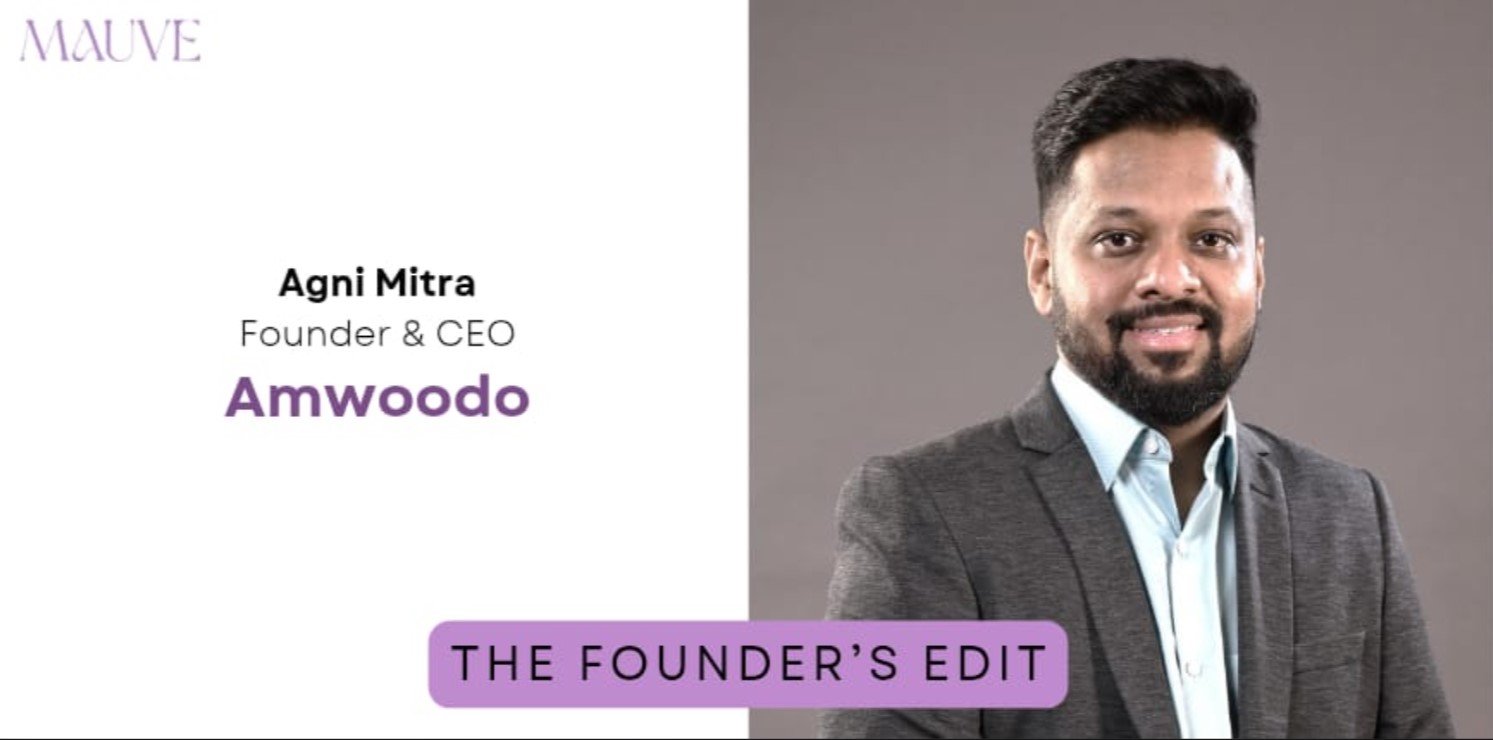
The Founder and CEO of Amwoodo believes sustainability will only succeed when businesses stop seeing it as a compromise—and start treating it as the smarter material choice.
By Priya Lalwani
Sometimes, an entrepreneurial idea begins not with invention, but with contradiction.
For Agni Mitra, Founder and CEO of Amwoodo Eco Products Pvt. Ltd., that contradiction became impossible to ignore.
In the bamboo-growing regions of Northeast India, he encountered an abundance of one of the world’s fastest-renewable natural resources. Communities possessed generations of craftsmanship and deep knowledge, yet very little economic value remained with them.
Back home, another image repeated itself just as often.
Mountains of discarded plastic.
The contrast was striking.
India possessed one of the world’s most sustainable natural materials, yet industries continued depending on products that carried a far greater environmental cost.
For Mitra, that disconnect wasn’t simply an environmental concern.
It was a business opportunity waiting to be solved.
For The Founder’s Edit, Agni Mitra reflects on building an engineered bamboo company from conviction, why sustainability must compete on performance rather than emotion, and why the future belongs to businesses that make responsible choices feel effortless.
Unlike many sustainability ventures built around awareness campaigns, Amwoodo began with a practical question.
Could bamboo become a modern industrial material rather than remain confined to traditional applications?
That question continues defining the company’s purpose today.
Mitra never wanted sustainability to feel like an alternative.
He wanted it to become the obvious choice.
Building that vision, however, demanded significant uncertainty.
Long before commercial outcomes became visible, Amwoodo invested in manufacturing capabilities, specialised machinery and skilled teams.
There were no guarantees.
Yet one principle remained non-negotiable.
Credibility would always matter more than speed.
“If we’re asking industries to adopt better materials,” Mitra believes, “we first have to earn their trust.”
That philosophy continues shaping every major decision.
One misconception he particularly enjoys challenging is the belief that sustainable materials inevitably require compromise.
For years, environmentally responsible products have often carried assumptions of higher costs, lower durability or limited scalability.
Engineered bamboo, he argues, challenges each of those assumptions.
When designed properly, bamboo delivers consistency, structural performance and commercial viability while significantly reducing environmental impact.
The conversation, therefore, shifts.
Sustainability stops becoming an ethical obligation.
It becomes a better business decision.
That distinction lies at the heart of Amwoodo’s strategy.
Rather than asking industries to prioritise environmental values over commercial realities, the company focuses on eliminating the trade-off entirely.
Whether serving hospitality, infrastructure, commercial interiors or workplaces, the objective remains remarkably simple.
Deliver products capable of matching traditional materials on quality, reliability, pricing and supply.
Only then does widespread adoption become realistic.
The company’s own origin story continues serving as its internal compass.
Whenever strategic decisions arise—whether entering new markets, investing in manufacturing or expanding production—the team returns to the original purpose.
Strengthen relationships with bamboo-growing communities.
Create greater value where the raw material originates.
Help industries transition confidently toward better alternatives.
That clarity has quietly shaped Amwoodo’s organisational culture.
Interestingly, Mitra doesn’t define his customers through demographics.
Instead, he identifies them through mindset.
Architects searching for better building materials.
Hotel groups committed to responsible development.
Designers exploring sustainable alternatives.
Procurement teams balancing performance with environmental responsibility.
What unites them isn’t geography or age.
It’s the willingness to think beyond immediate cost and consider long-term impact.
Listening has also become one of the company’s strongest competitive advantages.
One early example emerged through Amwoodo’s bamboo razor.
Initial customer feedback highlighted opportunities to improve blade performance.
Rather than defending the product, the company returned to development.
The bamboo handle remained unchanged.
The blade evolved.
That experience reinforced a broader philosophy.
Innovation rarely comes from assumptions.
It comes from paying close attention to how products perform in everyday life.
Community, similarly, is built through transparency rather than marketing.
Instead of relying on sustainability as a slogan, Amwoodo regularly shares stories from its manufacturing process, explains the role of engineered bamboo and offers customers visibility into the decisions behind every product.
Digital platforms simply become vehicles for those conversations.
Trust, Mitra believes, is accumulated gradually.
Never announced.
Looking ahead, he expects sustainability to move from competitive advantage to baseline expectation.
Regulatory frameworks will strengthen.
Technology will improve material innovation.
Consumers and businesses alike will increasingly demand greater accountability across supply chains.
The companies best positioned for that future will not be those reacting to regulation.
They will be those already building responsibly.
Perhaps most telling is how Mitra measures success.
Revenue matters.
Growth matters.
Yet neither represents his favourite metric.
Instead, he watches for something far simpler.
Every time a hotel, workplace or institution chooses engineered bamboo over a conventional alternative, he considers that genuine progress.
Not because it benefits one company.
Because it shifts an entire industry.
Leadership, too, has changed significantly over the years.
Where Mitra once found himself involved in every operational decision, his focus today lies elsewhere.
Building capable teams.
Creating systems that scale.
Empowering people to make thoughtful decisions independently.
He believes the strongest organisations aren’t built around founders who control everything.
They’re built around cultures where purpose continues guiding decisions long after the founder steps away.
Looking back, one lesson stands above every professional milestone.
Growth only succeeds when the foundation beneath it is ready.
Early ambitions occasionally outpaced systems, manufacturing capability and organisational readiness.
Those moments reshaped his approach.
Today, patience isn’t viewed as hesitation.
It’s viewed as preparation.
Because businesses built on strong foundations rarely need to rebuild later.
For Agni Mitra, bamboo has never simply been another material.
It represents something far larger.
The possibility that sustainability, when engineered well enough, no longer asks industries to choose between responsibility and performance.
Only between yesterday’s materials and tomorrow’s.
Ministry of Environment, Forest and Climate Change